Manchester tart
Jam, custard and coconut on shortcrust
- Vegetarian
- Local name
- Manchester tart
- Pairs with
- Tea
What it is
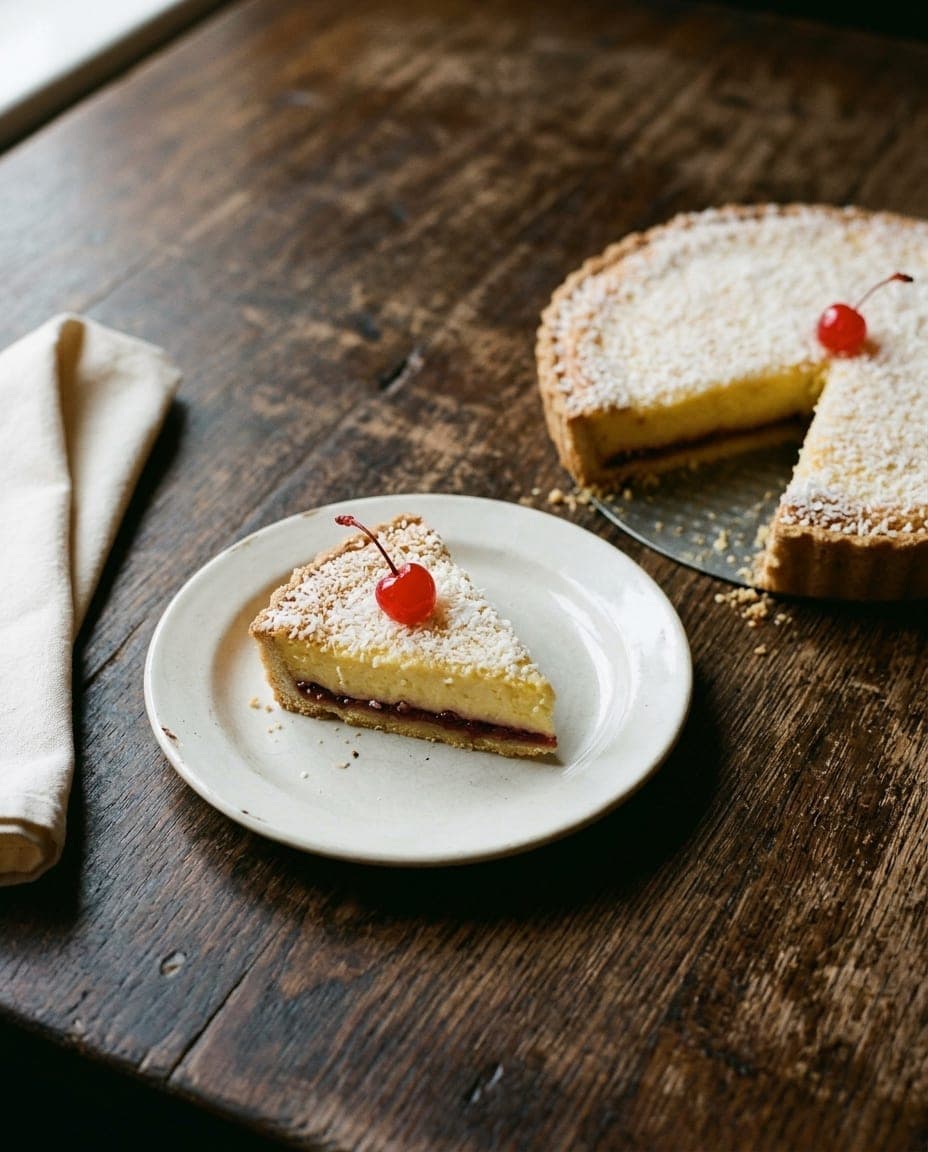
The Manchester tart is a simple sweet pastry that belongs to Greater Manchester rather than the rest of the United Kingdom. It consists of a shortcrust pastry case lined with raspberry jam, filled with a layer of set custard, sprinkled with desiccated coconut and finished with a single glacé cherry in the centre. The result is cold, firm and cut into squares or wedges for serving.
It is not a dish found on the menu of modern fine-dining establishments. Instead, it carries the weight of memory for several generations of English children who ate it at school dinners, community fêtes and family gatherings. Its appeal lies in its straightforward combination of textures: the crumbly pastry, the smooth custard, the chewy coconut and the bright sweetness of the jam.
The history of the Manchester pudding
The tart descends from a much richer Victorian creation known as the Manchester pudding. Mrs Beeton printed it in 1861: a pastry-lined dish spread with jam and filled with a baked custard thickened with breadcrumbs and flavoured with lemon zest and brandy, meant to be eaten cold. It was richer and more elaborate than the version that survives today.
Over time, the recipe simplified. The breadcrumbs, lemon and brandy went, a plain set custard took their place, and coconut and a cherry arrived on top, giving the cold, sliceable tart seen in schools and cafés in the 20th century. While the original pudding was a regional curiosity that faded from common use, the tart remained as a staple of working-class sweetness in the industrial north.
There is no single recorded date for when the transition occurred, nor a named inventor who declared the new version official. The evolution appears to have been gradual, driven by the practical needs of feeding large groups of people and the availability of ingredients like custard powder and desiccated coconut in the post-war era.
What goes into it
The structure of the tart relies on five distinct components that must be present for it to be recognised as authentic:
- Shortcrust pastry: A buttery, crumbly base that holds the other ingredients without becoming soggy. The case is usually blind-baked before the fillings are added.
- Raspberry jam: A layer of sweet, red fruit preserve spread across the bottom of the pastry case. It provides a sharp contrast to the creamy custard.
- Set custard: A thick, vanilla-flavoured mixture that solidifies when cooled. This forms the main body of the tart and gives it its characteristic smooth texture.
- Desiccated coconut: Dried, shredded coconut scattered over the top of the custard. It adds a chewy texture and a subtle nutty flavour to the surface.
- A glacé cherry: A single bright red cherry placed in the centre as a finishing touch. It serves as the visual anchor for the whole tart.
The combination is not intended to be subtle. The sweetness is high, the colours are bold and the textures are varied. It is a dish that prioritises satisfaction over complexity.
How it was eaten
For decades, the Manchester tart was the standard dessert in school dining halls across Greater Manchester and beyond. Children would receive a square or wedge of the cold tart as part of their lunch, often served alongside other simple treats like jam tarts or fruit salads. The custard had to be firm enough to hold its shape when lifted from the tray, and the pastry needed to remain crisp even after sitting in the refrigerator.
Outside the school gates, the tart appeared at community events, church fairs and family celebrations. It was a practical choice for feeding a crowd: easy to make in large batches, cheap to produce and popular with both adults and children. The cold temperature meant it could be prepared hours or even days in advance, which suited the schedules of busy householders and event organisers.
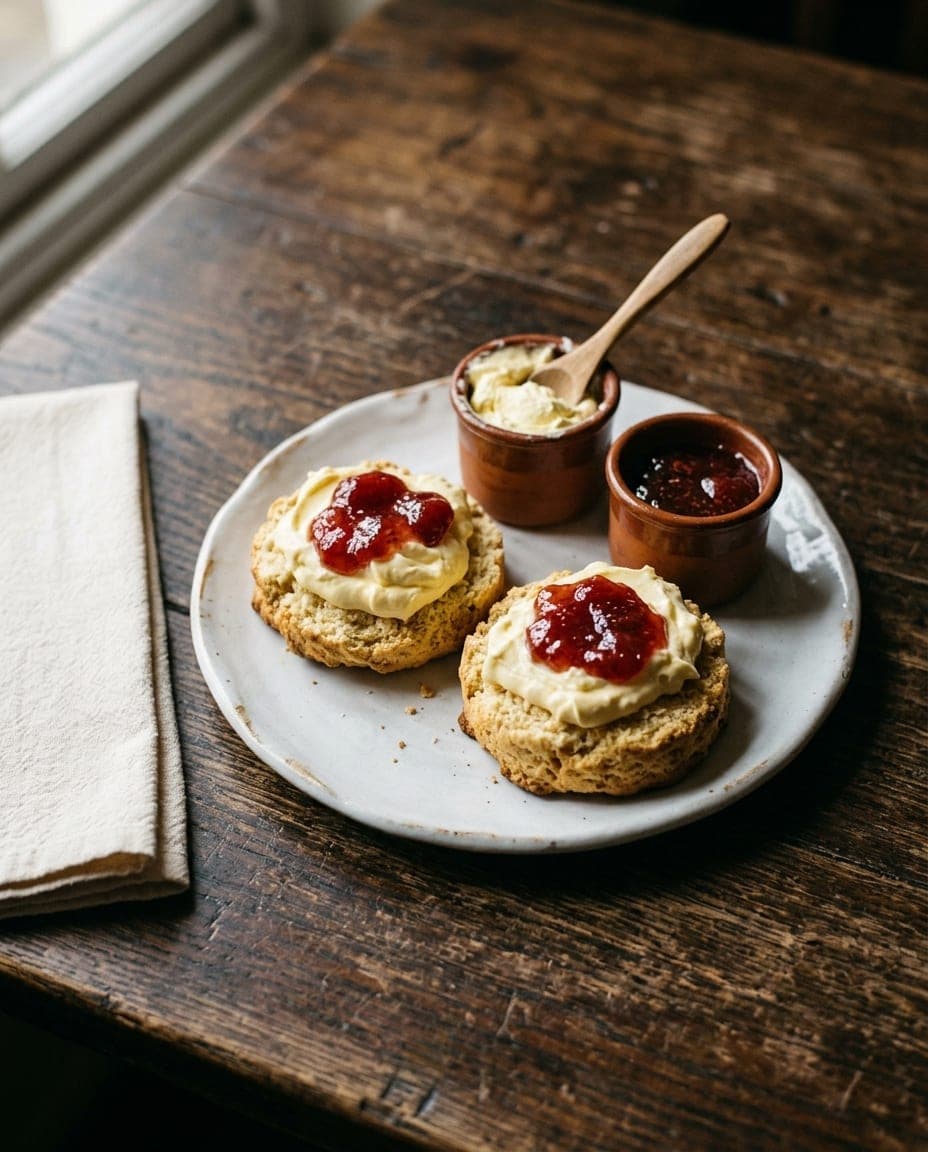
It survives now in traditional cafés and in bakery windows in Manchester, usually cut into squares and sold by the piece. Tea is the drink beside it, against the sugar.
Curious facts
- A regional identity. The tart is strongly tied to Greater Manchester and does not appear with the same frequency in other parts of the United Kingdom.
- A school dinner staple. For many children at school in the 1970s and 1980s, the cold custard square was a defining feature of their school lunches.
- Always cold. Mrs Beeton already meant her pudding to be eaten cold, and the modern tart is served cold once the custard has set in the fridge.
- Simple ingredients only. The recipe relies on basic items that were widely available and affordable, which helped it survive long periods of economic change.
- A visual symbol. The single red cherry in the centre acts as a marker for the whole tart, making it instantly recognisable even from a distance.
- A tea companion. The tart is usually eaten with a cup of hot tea, which cuts the sweetness.
Where to try it
Greater Manchester: cafés, bakeries and corner shops in the city centre and the towns around it. It was once a school-dinner pudding far beyond the city, but the name keeps it tied to Manchester.
Availability is erratic — it turns up as a daily special rather than a fixture, and it appears at a church fair or a family gathering more reliably than on any menu. It is not restaurant food and has never pretended to be.
Where to try it
1 destination
 Camper Van Rentals
Manchester
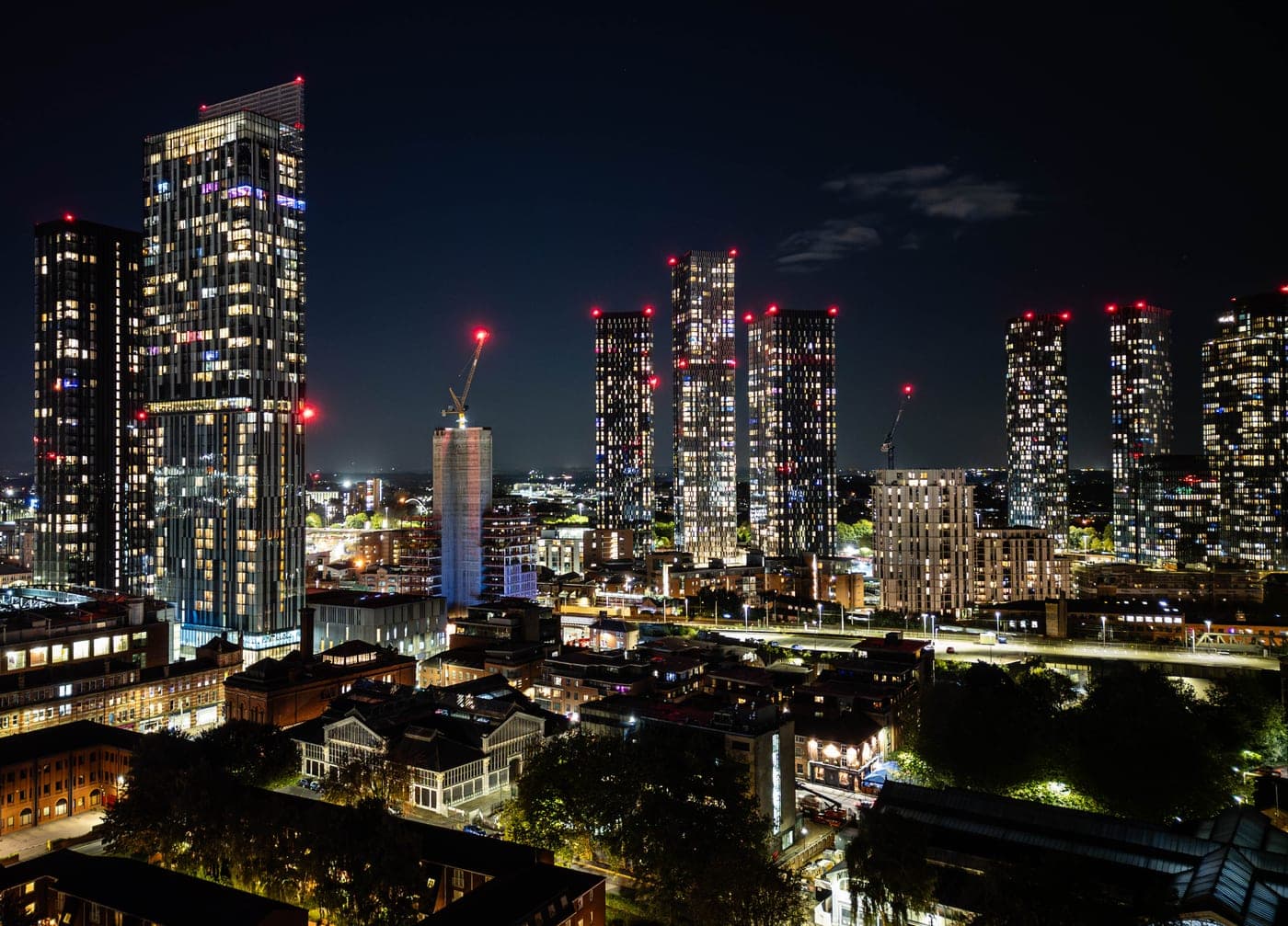
Vibrant city known for its industrial heritage, music scene, and football.
Camper Van Rentals
1 region
- Camper Van Rentals1 destination
Greater Manchester
Greater Manchester sits where the flat Cheshire plain gives way to the rising moors of the Pennines. It is a region built from cotton, coal and canal water, and its slow-travel character comes less from any single view than from a pattern that repeats from town to town: a canal basin, a former cotton mill turned into flats or studios, a covered market hall, a parish church with a soot-darkened tower. Reading that pattern, town by town, is what makes exploring the region worthwhile. Manchester itself anchors the region, its warehouse districts and Victorian civic buildings now holding galleries, independent shops and the city's long-running music venues. Salford, across the water from the city centre, keeps its own identity around the restored docks of Salford Quays, once a working dock for the city's trade. Stockport, above the River Mersey, has its own market hall and a warren of former mill buildings and railway arches now used by small breweries. Bury holds one of the region's markets, still trading on its historic stalls. Bolton, Oldham, Rochdale and Wigan each carry the same textile-town layout of mill chimneys, terraced streets and market squares, softened now by parks and reused industrial buildings. Beyond the built-up towns, the region edges into open country. Saddleworth, a cluster of stone villages in the Pennine foothills, keeps a slower, more rural pace than the towns below it. Moorland reservoirs and packhorse routes lace the hills around it, laid out originally to serve the textile trade and now walked for their own sake. Closer to the city, Heaton Park has formal gardens and open lawns within an urban setting, while the Bridgewater and Rochdale canals thread through several towns, their towpaths still following the routes barges once used to move coal and cloth. Food and craft culture in the region grows directly from this working history. Markets in Bury, Bolton and Ashton-under-Lyne sell black pudding, meat pies and baked goods alongside fresh produce, and a number of small breweries now operate from the same brick mill buildings that once spun cotton. Museums across the region, from restored mills to preserved engine houses, explain the mechanics of the Industrial Revolution in the buildings where it happened, rather than behind glass elsewhere. Architecture is a constant thread. Red-brick mills, often five or six storeys with rows of tall windows built to let in light for weaving, dominate the skyline of towns like Stockport and Ashton-under-Lyne. Grand Victorian town halls in Manchester, Rochdale and Bolton reflect the wealth the textile trade generated, with detailed stonework and clock towers that still mark the centre of each town. Victoria Baths in Manchester, a restored public swimming and bathing complex, gives a sense of how public life was organised in the region a century ago. What unites Greater Manchester's towns is this shared inheritance of industry and its slow, ongoing conversion into something new: mills into studios, docks into waterside walks, markets that never stopped trading. Villages on the region's moorland edge offer a quieter counterpoint, their stone cottages and chapel spires a short step from the industrial towns below. Together they give the region a layered, unhurried rhythm — one town's market square leading naturally to the next town's canal basin, and from there up onto open moor.
Camper Van Rentals