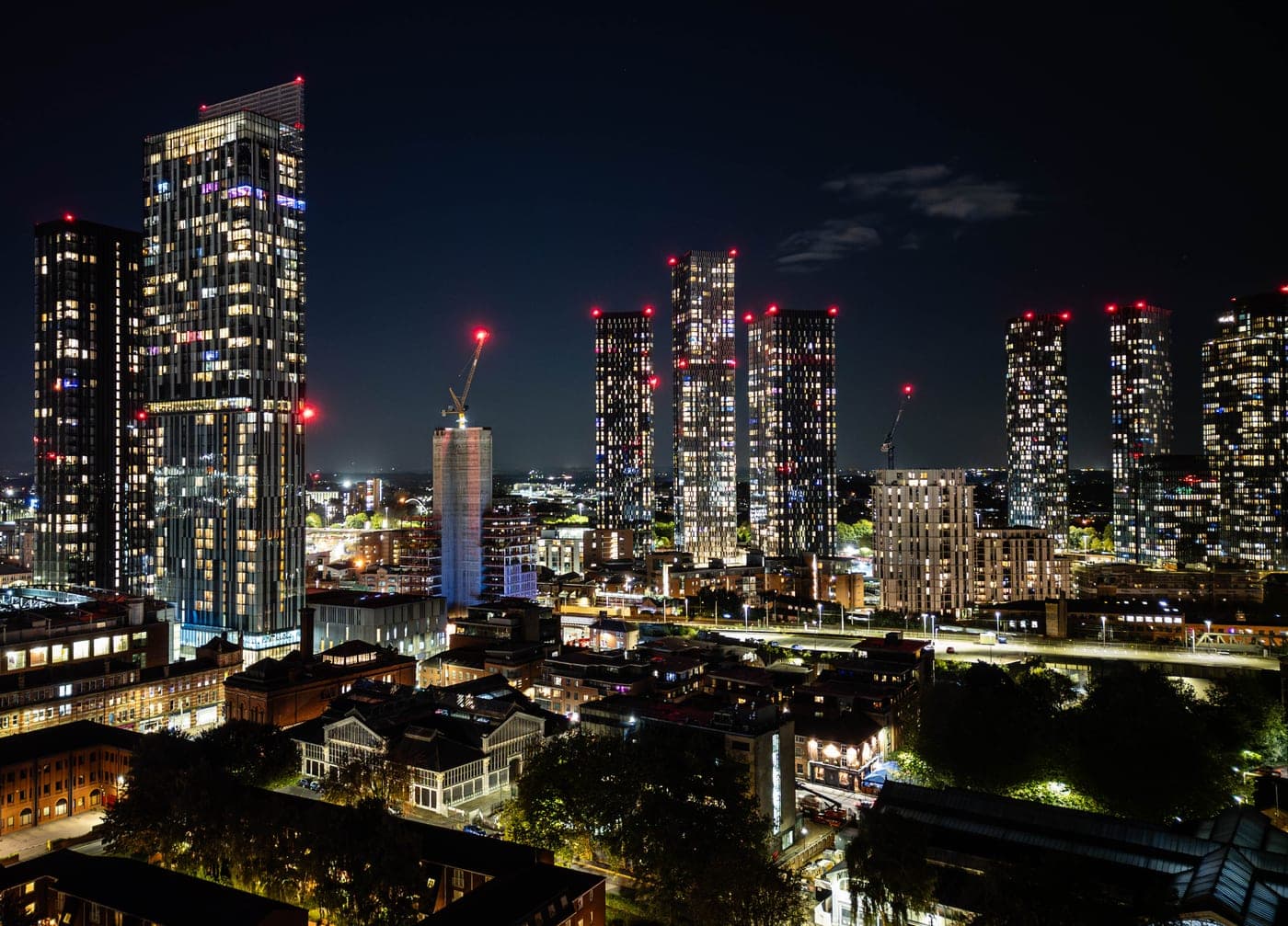
Greater Manchester sits where the flat Cheshire plain gives way to the rising moors of the Pennines. It is a region built from cotton, coal and canal water, and its slow-travel character comes less from any single view than from a pattern that repeats from town to town: a canal basin, a former cotton mill turned into flats or studios, a covered market hall, a parish church with a soot-darkened tower. Reading that pattern, town by town, is what makes exploring the region worthwhile.
Manchester itself anchors the region, its warehouse districts and Victorian civic buildings now holding galleries, independent shops and the city's long-running music venues. Salford, across the water from the city centre, keeps its own identity around the restored docks of Salford Quays, once a working dock for the city's trade. Stockport, above the River Mersey, has its own market hall and a warren of former mill buildings and railway arches now used by small breweries. Bury holds one of the region's markets, still trading on its historic stalls. Bolton, Oldham, Rochdale and Wigan each carry the same textile-town layout of mill chimneys, terraced streets and market squares, softened now by parks and reused industrial buildings.
Beyond the built-up towns, the region edges into open country. Saddleworth, a cluster of stone villages in the Pennine foothills, keeps a slower, more rural pace than the towns below it. Moorland reservoirs and packhorse routes lace the hills around it, laid out originally to serve the textile trade and now walked for their own sake. Closer to the city, Heaton Park has formal gardens and open lawns within an urban setting, while the Bridgewater and Rochdale canals thread through several towns, their towpaths still following the routes barges once used to move coal and cloth.
Food and craft culture in the region grows directly from this working history. Markets in Bury, Bolton and Ashton-under-Lyne sell black pudding, meat pies and baked goods alongside fresh produce, and a number of small breweries now operate from the same brick mill buildings that once spun cotton. Museums across the region, from restored mills to preserved engine houses, explain the mechanics of the Industrial Revolution in the buildings where it happened, rather than behind glass elsewhere.
Architecture is a constant thread. Red-brick mills, often five or six storeys with rows of tall windows built to let in light for weaving, dominate the skyline of towns like Stockport and Ashton-under-Lyne. Grand Victorian town halls in Manchester, Rochdale and Bolton reflect the wealth the textile trade generated, with detailed stonework and clock towers that still mark the centre of each town. Victoria Baths in Manchester, a restored public swimming and bathing complex, gives a sense of how public life was organised in the region a century ago.
What unites Greater Manchester's towns is this shared inheritance of industry and its slow, ongoing conversion into something new: mills into studios, docks into waterside walks, markets that never stopped trading. Villages on the region's moorland edge offer a quieter counterpoint, their stone cottages and chapel spires a short step from the industrial towns below. Together they give the region a layered, unhurried rhythm — one town's market square leading naturally to the next town's canal basin, and from there up onto open moor.