Bury black pudding
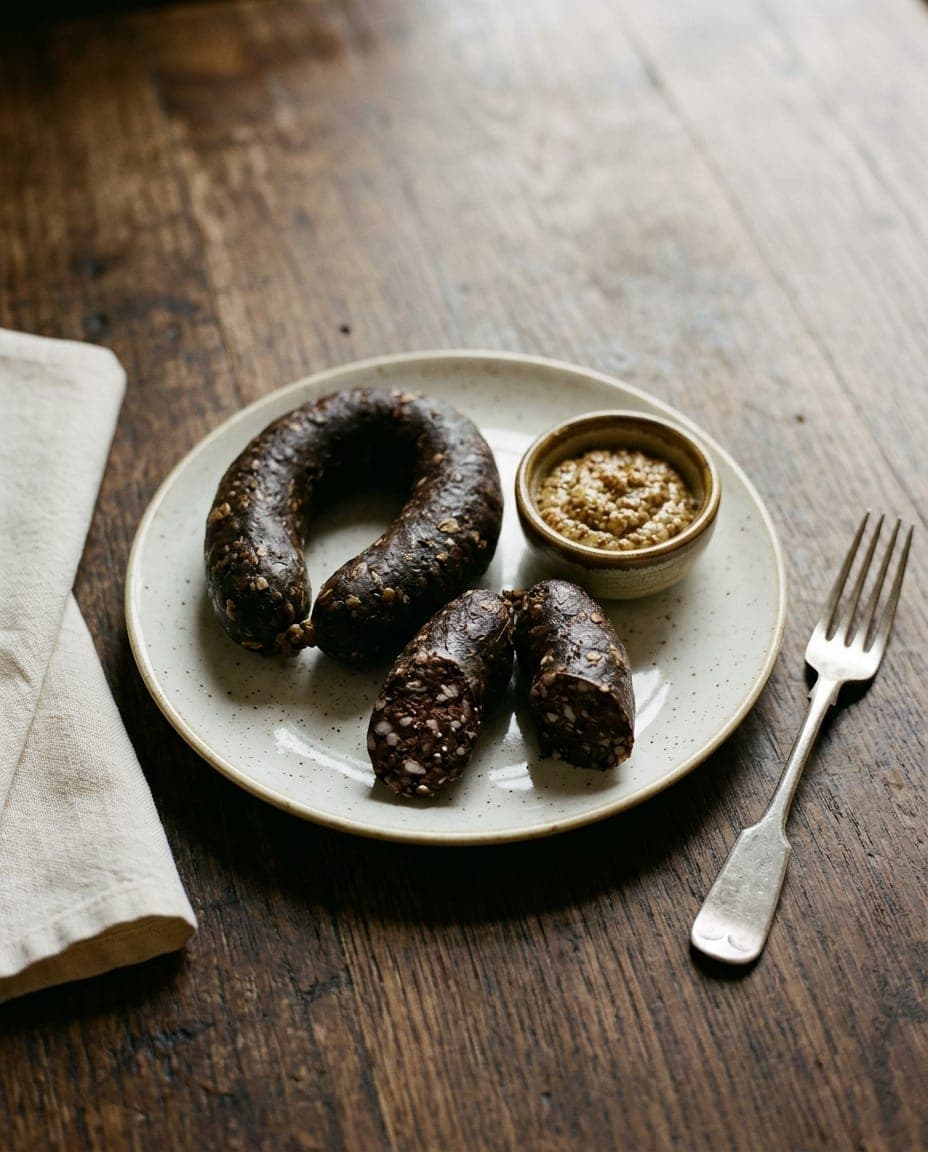
A boiled ring of blood, oats and barley
- Local name
- Bury black pudding
- Served with
- Mustard or malt vinegar
- Best eaten at
- Bury Market stalls
- Pairs with
- Northern bitter
What it is
Bury black pudding is a specific type of blood sausage made in and around the town of Bury in Greater Manchester. Like most British black puddings it is bulked out with cereal and pork fat; local butchers often use pearl barley alongside oatmeal, which gives a coarse, chewy grain. The mixture is seasoned with spices, packed tightly into casings, tied off and boiled until cooked through.
This dish is not a national standard but a regional speciality tied closely to the town of Bury. While black pudding appears on menus across the United Kingdom, the version from Bury has a distinct texture and history. It is dense and savoury, and the chew of the grain is what carries it. The result is a hearty food that has served as a staple for local workers for generations, particularly in the industrial north-west.
How it is made
The preparation follows a method honed over many years by traditional butchers in the area. Fresh pork blood forms the base, bound with a blend of oats and pearl barley. The barley is the key differentiator here; it gives the pudding a coarser, chewier grain that holds its shape well during boiling. Pork fat from the slaughter adds moisture and depth to the flavour, while seasoning typically includes salt, pepper, and dried herbs.
Once the ingredients are mixed, they are stuffed into casings and tied into rings. These puddings are then boiled in large vats until fully cooked. Unlike many other sausages that are smoked or fried immediately after cooking, Bury black pudding is often sold as a ready-to-eat product from the boil. The casing remains on during this stage, creating a tight, uniform cylinder before it is sliced or served whole.
How to eat it
At the market it is served hot out of the pot or steamer: a whole pudding, often split open, handed over in paper with mustard or a splash of malt vinegar.
It is eaten standing, in the hand, with the mustard applied heavily. That is the Bury method, and it is different from most of the country, where black pudding is sliced and fried or grilled.
It is also common to see the pudding served as part of a full breakfast or a fry-up. In this context, slices of the black pudding are fried alongside eggs, bacon, tomatoes and mushrooms. However, even in a cooked dish, the texture remains distinct, offering a chewy counterpoint to softer elements like the egg or tomato.
Where it comes from
The tradition is rooted in the industrial history of Lancashire, of which Bury was part until 1974. As the region developed its textile mills and heavy industry, workers required substantial meals that could be prepared quickly and eaten on the move. The Bury black pudding filled this need perfectly. It was portable, filling and relatively inexpensive to produce using by-products from local butchers.
The town of Bury became the best-known centre for black pudding making in Lancashire, with local claims dating it back to at least 1810. Local families passed down their recipes through generations, refining the balance between the blood, the fat and the grain. While other towns in Lancashire and Yorkshire have their own variations, the Bury version gained a reputation for being served whole, boiled and hot.
The market has long been the heart of this culinary practice. Bury Market has hosted black pudding stalls for generations, some run by the same families for close to a century. The continuity of the stallkeepers connects the modern visitor to the workers of the past who ate similar meals while working in the mills.
What goes into it
The ingredients are simple and locally sourced, reflecting the practical nature of the dish:
- Pork blood, which gives the colour and the iron taste underneath everything else.
- Oats and pearl barley, a combination that gives the pudding its characteristic texture and body.
- Pork fat, usually from the belly or back, which keeps the mixture moist and adds body.
- Seasonings, typically including salt, black pepper and sometimes dried herbs like sage or thyme.
- Casings, traditionally natural intestine, which hold the mixture together during boiling.
The balance of these components varies slightly between butchers, and so does the choice of grain. The final product is dense and dark, with a texture that ranges from soft to chewy depending on the exact ratio of grain to blood.
Curious facts
- Grain gives the chew. Barley and oatmeal give the pudding its texture, and the high proportion of cereal is what separates British black pudding from most continental blood sausages.
- Served whole at the stall. Unlike most black pudding, which is sliced before serving, the Bury pudding is often sold whole, split open for the customer to eat.
- Mustard or vinegar. Mustard against the fat is the favourite at the stalls, but malt vinegar is just as traditional.
- Mill food. It was cheap, filling and portable, which is why it fed the textile workers of the north-west.
- Market tradition. Bury Market has been selling this sausage for generations, with a continuity of recipe and method that few other food items can claim.
Where to try it
Bury Market, in Greater Manchester, is where the dish is served the way it is meant to be: stalls selling puddings straight out of the pot, split open to eat on the spot. The market runs through the day and the pots are hottest in the middle of it.
While some cafes in Bury serve slices of the pudding as part of a breakfast or lunch menu, the experience of standing at a stall with a hot pudding and a pot of mustard is unique to the market. It is not necessary to seek out a specific named producer, as the quality remains consistent across the traditional stalls that have operated there for years. A Northern bitter beer pairs well with the deep flavours of the sausage, though water or tea are also common choices.
Where to try it
1 region
 Camper Van Rentals1 destination
Greater Manchester
Greater Manchester sits where the flat Cheshire plain gives way to the rising moors of the Pennines. It is a region built from cotton, coal and canal water, and its slow-travel character comes less from any single view than from a pattern that repeats from town to town: a canal basin, a former cotton mill turned into flats or studios, a covered market hall, a parish church with a soot-darkened tower. Reading that pattern, town by town, is what makes exploring the region worthwhile. Manchester itself anchors the region, its warehouse districts and Victorian civic buildings now holding galleries, independent shops and the city's long-running music venues. Salford, across the water from the city centre, keeps its own identity around the restored docks of Salford Quays, once a working dock for the city's trade. Stockport, above the River Mersey, has its own market hall and a warren of former mill buildings and railway arches now used by small breweries. Bury holds one of the region's markets, still trading on its historic stalls. Bolton, Oldham, Rochdale and Wigan each carry the same textile-town layout of mill chimneys, terraced streets and market squares, softened now by parks and reused industrial buildings. Beyond the built-up towns, the region edges into open country. Saddleworth, a cluster of stone villages in the Pennine foothills, keeps a slower, more rural pace than the towns below it. Moorland reservoirs and packhorse routes lace the hills around it, laid out originally to serve the textile trade and now walked for their own sake. Closer to the city, Heaton Park has formal gardens and open lawns within an urban setting, while the Bridgewater and Rochdale canals thread through several towns, their towpaths still following the routes barges once used to move coal and cloth. Food and craft culture in the region grows directly from this working history. Markets in Bury, Bolton and Ashton-under-Lyne sell black pudding, meat pies and baked goods alongside fresh produce, and a number of small breweries now operate from the same brick mill buildings that once spun cotton. Museums across the region, from restored mills to preserved engine houses, explain the mechanics of the Industrial Revolution in the buildings where it happened, rather than behind glass elsewhere. Architecture is a constant thread. Red-brick mills, often five or six storeys with rows of tall windows built to let in light for weaving, dominate the skyline of towns like Stockport and Ashton-under-Lyne. Grand Victorian town halls in Manchester, Rochdale and Bolton reflect the wealth the textile trade generated, with detailed stonework and clock towers that still mark the centre of each town. Victoria Baths in Manchester, a restored public swimming and bathing complex, gives a sense of how public life was organised in the region a century ago. What unites Greater Manchester's towns is this shared inheritance of industry and its slow, ongoing conversion into something new: mills into studios, docks into waterside walks, markets that never stopped trading. Villages on the region's moorland edge offer a quieter counterpoint, their stone cottages and chapel spires a short step from the industrial towns below. Together they give the region a layered, unhurried rhythm — one town's market square leading naturally to the next town's canal basin, and from there up onto open moor.
Camper Van Rentals