Double crème de la Gruyère
Thick unwhipped cream from Fribourg, served with meringues
- Vegetarian
- Local name
- Double crème de la Gruyère
- Served with
- Meringues and berries
- Best eaten at
- A Gruyères village café
What it is
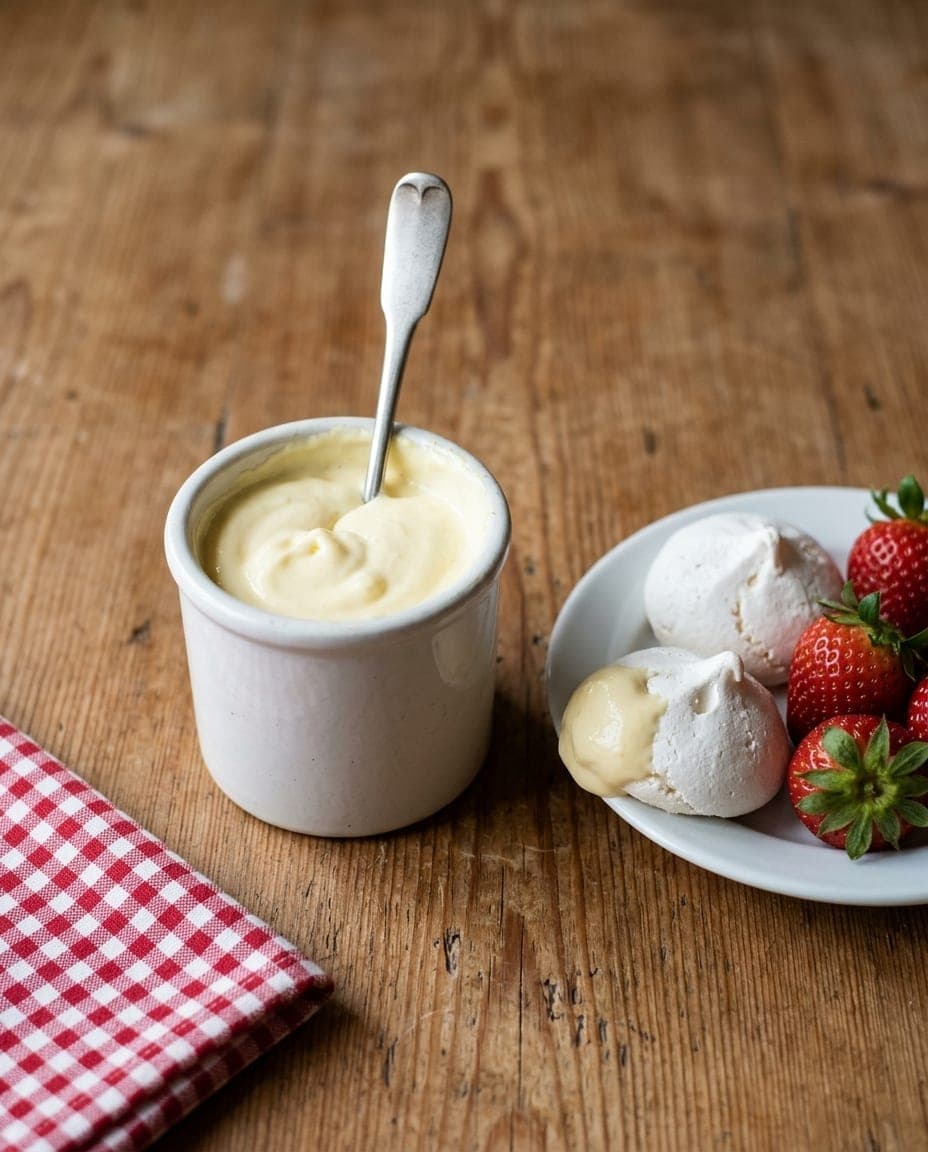
Double crème de la Gruyère is a regional dairy product from the Gruyère district of the canton of Fribourg in Switzerland. It is not a cheese, nor is it a standard pouring cream found in most supermarkets. This is an ultra-thick, unwhipped cream with a fat content of around 50 per cent, above the 45 per cent minimum for Swiss double cream. The texture is dense enough that a spoon is said to stand upright in it.
The cream is served cold and plain. It contains no added sugar, vanilla or flavourings. Instead, it functions as the base for a specific local dessert: a bowl of crisp meringues, a tub of the heavy cream, and whatever berries are available in the season. The combination is a simple regional tradition rather than an elaborate confection. In the villages around Gruyères, this pairing is often the final course of a meal, and meringues with double cream close the Bénichon feast every autumn.
Where it comes from
The product is most closely associated with the Gruyère district, though it is made and eaten across the canton of Fribourg, where it is simply the standard cream. The 19th-century chef Joseph Favre praised it as one of the finest in Europe and credited the Alpine pastures. Double crème is a statement about fat rather than a method: it marks a cream far above the standard, and the Gruyère version sits at the top of the Swiss range.
While the exact method varies between small producers, the result remains consistent: a heavy, rich cream skimmed from the milk and left thick rather than whipped or churned into butter. It is not a protected designation of origin in the legal sense, but it is listed in the Culinary Heritage of Switzerland inventory as a recognised local speciality. The tradition persists because the texture complements the dry, airy meringues so well, creating a balance of mouthfeel that feels natural to those who have eaten it for generations.
What goes into it
There are no added ingredients in the cream itself. It is made solely from the milk of local cows raised on the pasturelands of Fribourg. The high fat content comes from how much of the milk's fat is concentrated into the cream when it is skimmed, and the rich Alpine grazing gives it its flavour.
The dish as served involves three simple components:
- Double crème de la Gruyère, a thick, pale yellow cream with a deep, buttery flavour.
- Meringues, typically small, crisp French-style meringues or local versions made from egg whites and sugar, which provide a dry contrast to the heavy cream.
- Berries, chosen based on the season, such as strawberries in summer or blackcurrants in late summer, often served fresh or lightly macerated.
The cream softens the sugar of the meringue and the acid of the fruit, which is the whole reason the three are served together.
How to eat it
In the villages around Gruyères it comes to the table as three separate things: a tub of cream, a bowl of meringues, a dish of berries.
The method is to break a meringue into the cream and let it soften for a moment before lifting it out, or to dip it straight in. One serving finishes most people.
Water or coffee is the usual accompaniment; nothing sweet is added to a plate that already has this much fat and sugar on it.
Curious facts
- The spoon test. The cream is thick enough that a spoon is said to stand upright in the tub, a quick way to tell it from ordinary pouring cream.
- No sweetener added. Unlike many European desserts, this cream contains no sugar or vanilla. The sweetness comes entirely from the meringues and the fruit.
- Seasonal fruit only. Strawberries in early summer, raspberries and blackberries later; in winter the meringues are served with the cream alone.
- Served in wood. The cream is traditionally brought to the table in a small wooden tub with a carved wooden spoon.
- It does not travel well. The cream is fresh and short-lived, and it is at its best close to the dairy where it was made.
Where to try it
A café in Gruyères or one of the villages around it, where the cream comes from a dairy within a few miles and is sold in a tub to take away as well as served at the table.
The cheese dairy below the castle and the village shops both sell the tubs, which travel for a day or two in a cool bag and no further. The meringues are sold beside them, which is the local assumption about what anyone is buying the cream for.
Its best-known partner is the crisp Swiss meringue, served alongside it with seasonal berries.
Where to try it
1 region
 Boat Rentals3 destinations
Fribourg
Fribourg is a Swiss region built for a slower pace. It sits between the French- and German-speaking parts of the country, and that mix still shapes daily life here — road signs change language partway through the canton, and the same cheese is sold under two names at the same market stall. The regional capital, also named Fribourg, sits on a sandstone hill above a bend in the Sarine river. Its old town is one of the larger medieval centres in Switzerland, with covered wooden bridges, a Gothic cathedral, and streets so steep that some are built as steps rather than roads. From the ramparts, the river loops below and the rest of the canton spreads out towards the hills. South of the city, the land softens into rolling dairy country. This is Gruyère territory, named after both the cheese and the small walled town of Gruyères that still gives it its name. Around Gruyères and the nearby town of Bulle, farms and mountain huts still make cheese by hand through the summer months, when herds move up to the high pastures. Several dairies open their doors to visitors watching a wheel of Gruyère being pressed and salted, a process that has changed very little over generations. The landscape rises further south into pre-alpine terrain: green terraces, scattered timber barns, and villages built from wood that has weathered dark over centuries. Walking paths here follow old cattle tracks between pasture and forest, gentle enough for an unhurried afternoon rather than a full day's climb. In autumn, cattle are led back down from the alpine pastures in a tradition still marked with flowers, bells, and a village gathering — one of the few moments when the summer's quiet farm work becomes a public event. To the north and west, the canton reaches Lake Neuchâtel and Lake Murten. Murten itself is a walled medieval town on the water, small enough to circle on foot within the hour, with a lakeside promenade that fills with café tables in summer. In warmer months, passenger boats cross the lake to nearby towns, a pleasant way to spend an afternoon without hurrying. One of the quieter pleasures of the region is its local railway, which climbs from the lowland towns into the hills in short, unhurried stages, following the river through farmland before a hilltop town's towers come into view above the tracks. These are working regional trains rather than tourist rides, and that is much of their charm — riders share the carriage with people going to market or coming home from the fields. Food shapes much of what there is to do here. Beyond cheese, the region is known for its double cream, for meringues eaten with that cream, and for a dried, air-cured meat found across French-speaking Switzerland. Village markets, especially in Bulle and Fribourg itself, are where these products change hands directly between maker and buyer, often with a taste offered first. A comfortable way to see Fribourg is over three to five days: a day or two in the old town and along the Sarine, a day around Gruyères and its cheese dairies, and a day or two further into the hills or out to Murten and the lake. Trying to fit it into a single day usually means choosing between the city and the countryside, and both reward more time than that. What makes the region worth this pace is less any single sight than how its parts connect — a cathedral town, a cheese-making valley, alpine pastures, and a lakeside village, all within a canton small enough to move between slowly and still see plenty. Fribourg does not have the scale of the Bernese Oberland or the fame of Lake Geneva, but it holds a quieter version of the same Swiss countryside, with fewer crowds and more time to notice the details: the smell of a cheese cellar, a wooden bridge underfoot, the particular green of a pasture after rain.
Boat RentalsHikingPanoramic Trains