Klippfisk
Salted dried cod from Norway's west coast
- Local name
- Klippfisk
- Served with
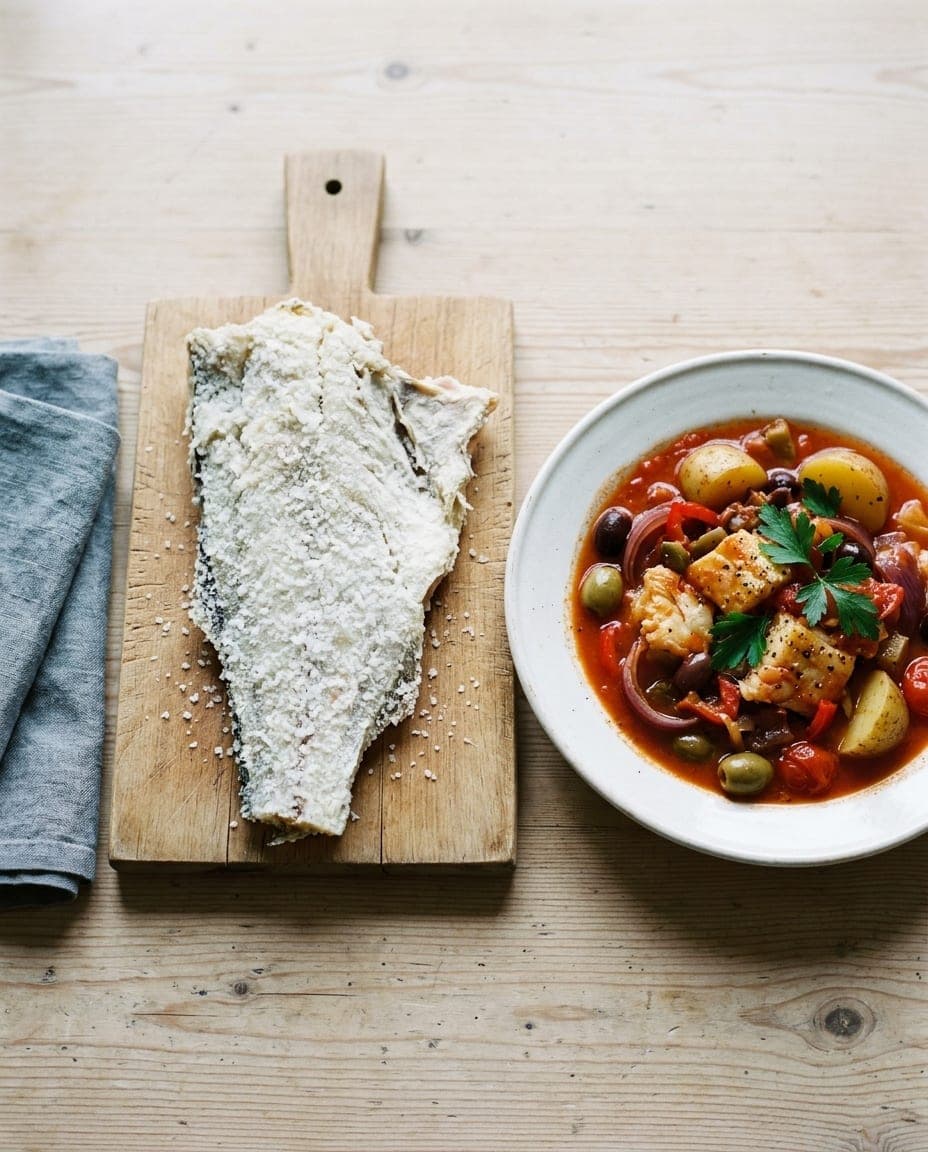
- Potatoes, tomato sauce (bacalao)
- Best eaten at
- A Kristiansund restaurant
- Pairs with
- Red wine or aquavit
What it is
Klippfisk is salted, dried cod that has been cured on bare rock or in purpose-built drying houses until the flesh turns stiff and pale. The name comes from klippe, the Norwegian word for cliff or bare rock, describing the traditional method where split fish were laid out to dry under the open sky of the coastal islands. This is not a fresh fish dish; it is a preserved one, designed to keep for a long time without refrigeration.
The process begins with splitting the cod and coating it heavily in salt to draw out moisture. Once dried, the fish becomes hard as wood and can be stored for long periods. To cook it, the fish must be soaked for several days, with the water changed frequently until the flesh softens and returns to a texture suitable for eating.
Dried cod is produced along much of the Norwegian coast, and the klippfisk trade centred on the north-west: Kristiansund, on the coast between Trøndelag and the Romsdal fjords, built itself on it. The fish went south to Spain and Portugal, where it was soaked again and cooked with tomato, onion, pepper and olive oil — and that dish came back north under its Iberian name, bacalao, to become a speciality of the town that had exported the fish in the first place.
The trade that built a city
For centuries, the export of klippfisk shaped the geography and economy of western Norway. From the 18th century onwards, it was one of the country's most important exports. The fish was dried on the exposed cliffs of the coast, where the cold air and strong winds preserved it naturally. This industry turned small fishing villages into bustling port towns, with Kristiansund rising as the central hub.
Spanish and Portuguese buyers came north for it in quantity, and what they made at home was a stew of the soaked fish with tomato, onion, pepper, potato and olive oil. Bacalao and bacalhau are simply their words for cod; in Norway the name came to mean the Iberian-style dish rather than the fish.
In Kristiansund, the story came full circle. The city developed its own version of this return journey. The local population adopted the Mediterranean preparation method, mixing the rehydrated klippfisk with tomatoes and other ingredients to create a dish that was distinct from the plain boiled cod eaten elsewhere in Norway. This specific adaptation became the signature meal of the region, linking the Norwegian coast directly to the culinary traditions of the Iberian Peninsula.
The return journey as bacalao
In Kristiansund, klippfisk is most often enjoyed not as a simple boiled fillet, but as part of a hearty stew. The dish known locally as bacalao combines the rehydrated cod with a sauce made from tomatoes, onions, peppers and potatoes, often finished with olive oil. This preparation reflects the historical trade links between Norway and Spain, where the fish was sent south only to return in a new form.
The texture of the fish is firm and flaky after the long soaking process. It holds its shape well in the stew, absorbing the flavours of the tomato sauce while retaining a distinct oceanic taste. The dish is usually served with boiled potatoes, which are essential for balancing the saltiness of the cod. A simple tomato sauce or bacalao sauce is the standard accompaniment, though variations may include garlic or herbs depending on the kitchen.
This version of the dish is a regional speciality rather than a nationwide tradition. In other parts of Norway, dried cod might be eaten with butter and lefse, or simply boiled with salt and pepper. In Kristiansund and the rest of Nordmøre, however, the Mediterranean influence remains strong, and the tomato-rich stew is the most common way to experience the fish.
How it is prepared and served
The preparation of klippfisk requires patience before the cooking begins. The dried fish must be soaked in cold water for several days, with the water changed multiple times to draw out the salt. Thick pieces take longer than thin ones, depending also on the desired level of saltiness. Once rehydrated, the fish is ready for boiling or stewing.
When served in Kristiansund, the dish is typically presented as a main course at lunch or dinner. The rehydrated cod is simmered gently in a tomato-based sauce with onions, peppers and potatoes. The result is a warm, savoury meal that is both filling and comforting. It is often accompanied by boiled potatoes, which are used to soak up the sauce.
A glass of red wine or a shot of aquavit pairs well with the dish. The tannins in the wine cut through the saltiness of the cod, while the sharpness of the aquavit complements the oceanic notes. Both are common companions to the meal in the region.
Curious facts
- The name is the drying ground. Klippe means rock: the split, salted cod was once dried on the bare coastal rock, spread out in the open air and turned by hand.
- Not the same as stockfish. Tørrfisk is air-dried on racks without salt; klippfisk is salted first. The two are different products with different markets.
- Kristiansund built the trade. Production on a commercial scale started there in the 1690s, and the town's wealth and much of its architecture came out of it.
- It must be soaked. The fish arrives hard as a board and needs several days in cold water, changed several times, before it can be cooked.
- The stew came home. The tomato, pepper and olive oil version Norwegians call bacalao is an Iberian way of cooking the fish that followed the export trade back north.
Where to try it
Kristiansund, where the trade history is still visible in the architecture. A restaurant in the town centre or a small place on the harbour will usually have the bacalao stew on as a daily special, and it is cooked most in the colder months.
On a Nordmøre menu it appears as klippfisk or bacalao, usually with potatoes and tomatoes named alongside it. The fish turns up in other coastal towns, but the tomato version belongs to Kristiansund: the fish went south by sea and the way of cooking it came back.
Where to try it
1 region
 Boat Rentals1 destination
Trøndelag
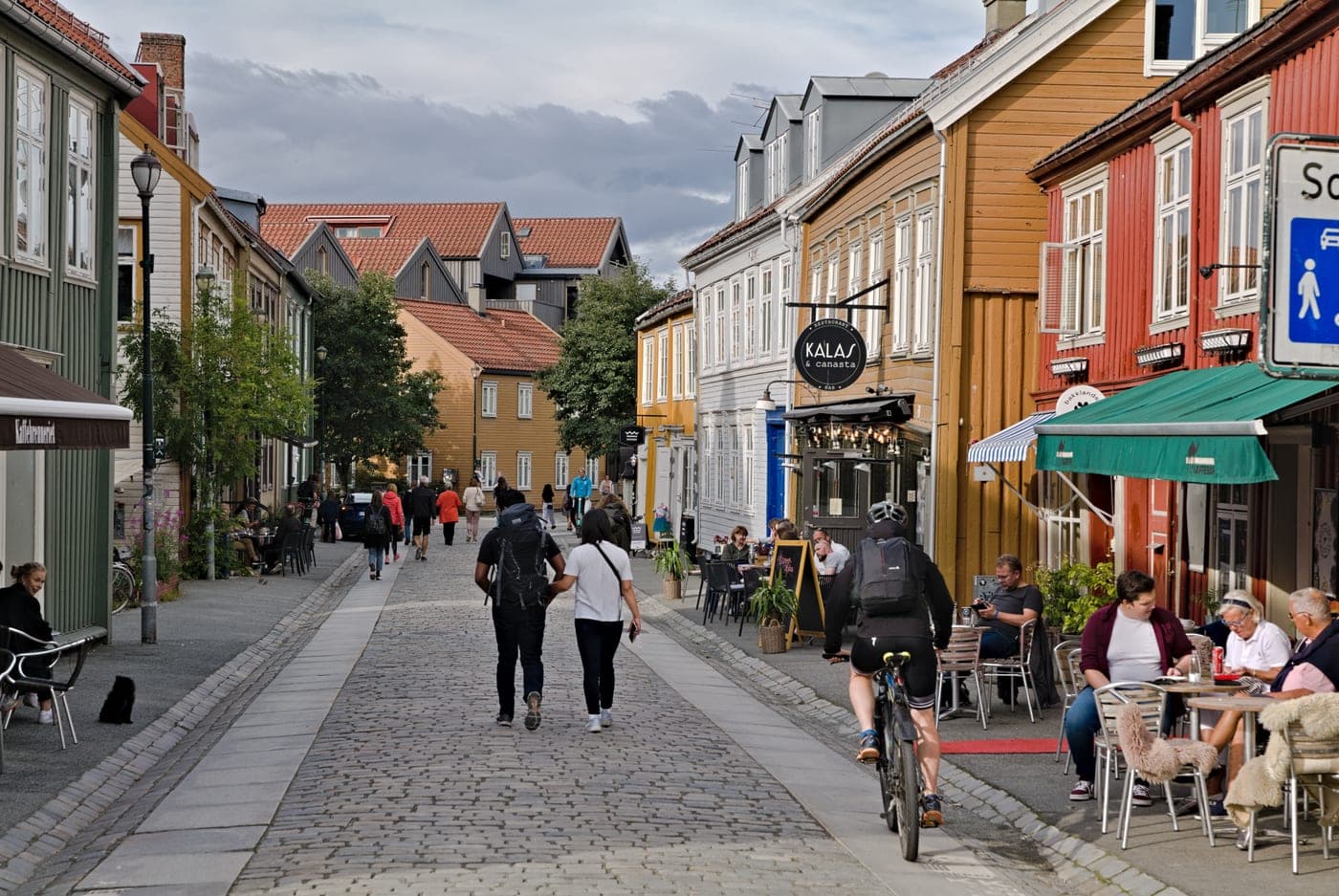
Trøndelag sits in the middle of Norway, where the coast folds into Trondheimsfjorden and the land behind it opens into some of the country's best farmland. At its centre is Trondheim, a former royal capital built along the curve of the Nidelva river. The city grew around Nidaros Cathedral, a Gothic building raised over the burial place of King Olav Haraldsson and long the destination of pilgrim routes that crossed Norway on foot. The cathedral remains the coronation church of the Norwegian monarchy and the largest medieval building in Scandinavia, its west front covered in carved figures added and restored over many generations. Trondheim itself keeps a layered, working character. Along the river, rows of wooden warehouses on stilts, once used for storing fish and grain, now hold cafés and small businesses, their reflections doubling in the water at low tide. The old town bridge, painted deep red, links the centre to Bakklandet, a district of narrow lanes and timber houses that has kept its scale even as the city around it has grown. Markets and bakeries here still deal in the region's dairy and grain, produced on the flat, fertile land stretching inland from the fjord — some of the most productive farming country in Norway, unusual this far north. Outside the city, Trøndelag's coastline breaks into islands and skerries. Hitra and Frøya, reached across the outer fjord, combine fishing communities with salmon farming, an industry that has shaped the local economy for decades. Further along the coast, smaller harbours still send boats out for cod and other whitefish, continuing a trade that once made dried and salted klippfisk one of Norway's most important exports. Warehouses built for that trade still stand in several fishing villages, their weathered red and white timber a common sight along the shore. Inland, the region changes character again. East of Trondheim, the valley of Gauldalen climbs gently inland, following a route used for centuries by traders and travellers moving between the coast and the interior. Further south, the historic mining town of Røros sits on a high, treeless plateau. Founded around copper deposits and shaped almost entirely in wood, Røros is a UNESCO World Heritage town, its narrow streets lined with blackened timber houses that have survived largely unchanged since mining ended. Winters here are hard and clear, and the town's church, built of stone rather than wood as a mark of the mining company's wealth, still dominates the skyline. Trøndelag's food culture draws on both the coast and the inland farms. Cured and dried fish remain part of the everyday diet in fishing communities, alongside dairy products from the region's grazing land — cheeses and cultured milk that rarely travel far from where they are made. Trondheim's covered market halls and smaller town markets sell this produce directly, often from the same families who have farmed or fished the surrounding area for generations. The region's Viking-era past is visible in scattered burial mounds and place names across the farmland east of Trondheim, part of a landscape that was already settled and cultivated long before the cathedral was built. Later, the pilgrim routes leading to Nidaros drew travellers from across Scandinavia and beyond, a tradition that has been revived in recent decades as walkers again follow the old paths through forest and farmland toward the cathedral doors. Between the fjord, the farmland, and the mining plateau, Trøndelag holds together a working coastline, a historic capital, and an inland mining town that has changed remarkably little, each shaped by what could be grown, fished, or dug from its own ground.
Boat RentalsHikingLocal Cuisine