Brunost (brown cheese)
Caramelised whey cheese, sliced thin

- Local name
- Brunost
- Served with
- Waffles or crispbread
- Best eaten at
- A Norwegian mountain cabin (hytte)
- Pairs with
- Coffee
What it is
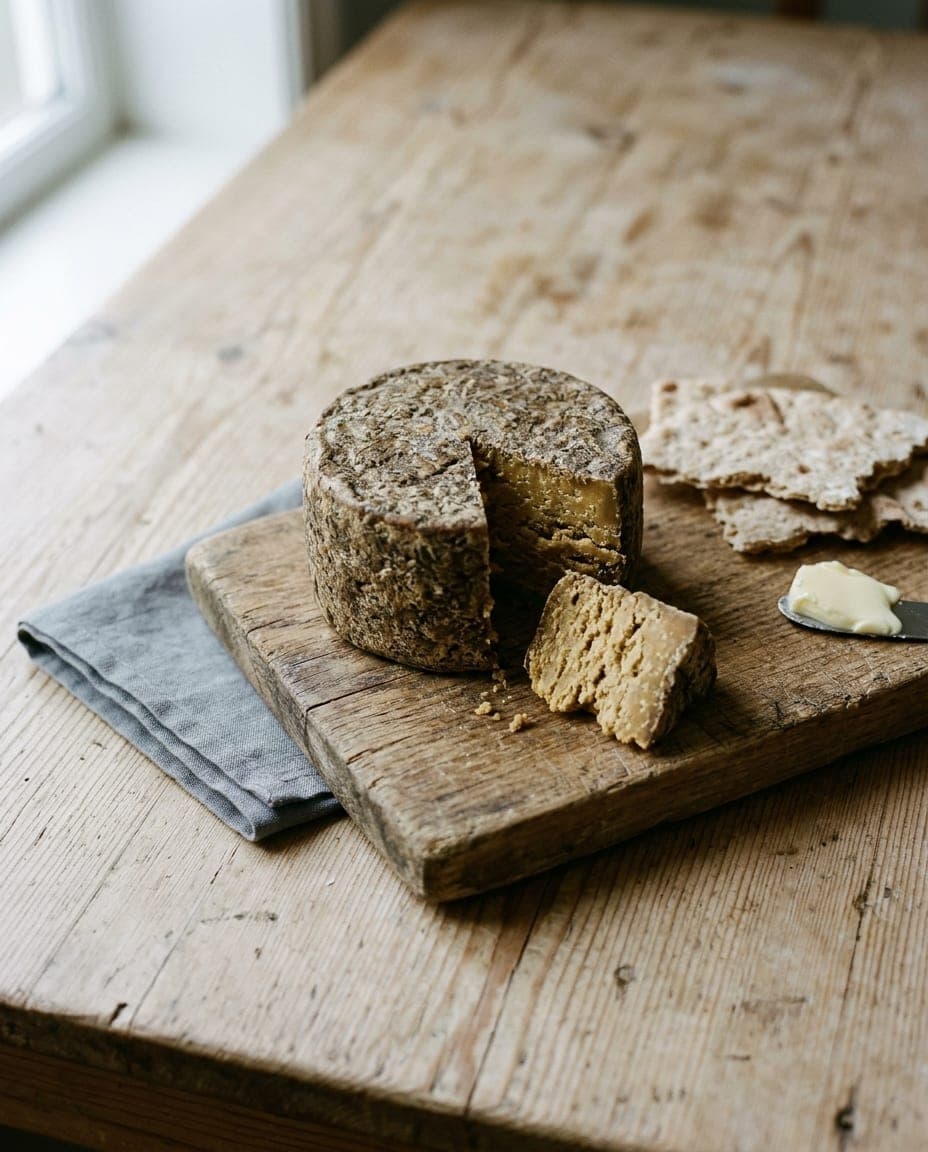
Brunost, literally "brown cheese", is one of the most distinctive foods to emerge from Norway. It is not a cheese in the conventional sense of curds separated from whey and pressed. Instead, it begins with the liquid left over after making traditional white cheese. This whey is boiled down slowly for several hours until the water evaporates and the milk sugars caramelise. The result is a dense, fudge-brown block that tastes at once sweet, salty and faintly of toffee.
The texture ranges from soft and spreadable to hard enough to shave with a knife. While the colour is its most obvious feature, the taste is what defines it: a deep, nutty sweetness balanced by a sharp, savoury edge. Cream and milk are often added back into the boiling whey for richer versions, but the base remains the caramelised residue of the cheese-making process.
It is eaten across the whole country, from the coastal cities to the high mountain valleys. In Oslo, it appears on breakfast tables and in bakeries alongside standard white cheeses. Yet its true home is the hytte, a Norwegian mountain cabin where skiers often arrive after a long day on the slopes. There, a thin slice of brunost on crispbread or waffles is a standard comfort food, often accompanied by a strong cup of coffee.
Opinion on it splits sharply among people meeting it for the first time. Norwegians are unbothered by that, treating it as an ordinary staple rather than something to be explained.
The origins in the Gudbrandsdalen valley
The most famous version of the cheese is known as Gudbrandsdalsost, named after the Gudbrandsdalen valley in central Norway. Whey has been boiled down into brown cheese and spreads in Scandinavia for a very long time, but this style dates from the 1860s, and its name is often used interchangeably with brunost in general conversation, though technically it refers to that specific style made from whey with cow's and goat's milk and cream.
The cream version is credited to Anne Hov, a dairymaid at Solbråsetra in the valley, in 1863: she stirred cream into the whey as it boiled and produced something far denser and sweeter than the thin brown cheese farms had been making from whey alone. It sold well enough that the account usually adds that it rescued the valley's farms.
The cheese became a practical solution for remote farming communities. It was stable at room temperature, easy to transport in small amounts due to its high density, and provided a long-lasting source of calories. Over time, the technique was refined, and the caramelised whey became a regional speciality that spread beyond the valley. A local trader took it to Kristiania (Oslo), where it sold well, and by the early 20th century it was being produced in dairies on an industrial scale.
How the cheese is sliced
The method of eating brunost is as important as the cheese itself. The block is too dense and rich to be eaten in thick chunks; a large slice would be overwhelming. Instead, it must be shaved paper-thin using an ostehøvel, the Norwegian cheese slicer. This tool was invented by Thor Bjørklund in Lillehammer in 1925 and has become a standard kitchen item in households across the country.
The ostehøvel consists of a frame with a sharp blade that is pulled across the block of cheese. When used correctly, it produces translucent ribbons that melt instantly on the tongue. These thin slices drape over the bread or waffle rather than sitting on top of them. If cut too thickly, the cheese becomes difficult to chew and the sweetness can dominate the palate. The thin slice is the whole technique, ensuring the flavour remains balanced and the texture stays smooth.
In a mountain cabin setting, the cheese is often served alongside other simple ingredients that complement its intensity. A dollop of sour cream or a spoonful of berry jam adds a cooling contrast to the sweet cheese. The bread is usually crispbread, known as knekkebrød, which offers a sturdy base that does not compete with the flavour of the cheese.
Where it fits in daily life
Brunost is eaten year-round in Norway, but its presence changes slightly depending on the season and location. In Oslo, it is common to find it in supermarkets and bakeries, often sold alongside other cheeses or as part of a breakfast platter. It appears on menus in cafes that serve traditional Norwegian breakfasts, paired with coffee or tea.
The true ritual, however, takes place in the hytte. After skiing or hiking in the mountains, Norwegians often return to their cabins for a warm meal. A plate of waffles, topped with a thin slice of brunost and perhaps some jam or sour cream, is a classic way to refuel.
The pairing with coffee is essential. The strong, dark roast of Norwegian coffee cuts through the sweetness of the cheese, creating a balanced finish.
The regional variations
While Gudbrandsdalsost is the most well-known type, brunost comes in several forms depending on the region and the specific recipe used. Some versions are made with a higher proportion of goat's milk, giving them a sharper, more tangy flavour. Others rely almost entirely on cow's whey, resulting in a milder, sweeter taste. The texture also varies; some batches are soft and spreadable, while others are hard enough to be shaved into delicate ribbons.
Some versions, such as fløtemysost, are made with cow's milk and cream only. These tend to be lighter in colour and milder than the goat's-milk styles. The method underneath does not change: whey, boiled until it caramelises.
Curious facts
- It is not a cheese in the usual sense. Brunost is made from whey left over from making white cheese, boiled down until the sugars caramelise rather than being curdled and pressed like traditional cheeses.
- The slicing tool is Norwegian. The ostehøvel, invented in 1925, is a standard kitchen item in Norway and is essential for serving the cheese correctly.
- It travels well. Before refrigeration was common, brunost was a practical food for travellers because it could be stored at room temperature for long periods without spoiling.
- The colour comes from sugar. The deep brown hue is not added artificially; it results from the milk sugars browning during the slow boiling process.
- It divides opinion globally. Visitors often find the sweet, salty flavour unusual or overwhelming, while Norwegians consider it a normal part of their diet.
- The name is literal. Brunost simply means "brown cheese" in Norwegian, describing its most obvious feature rather than any specific recipe or origin.
Where to try it
The best place to experience brunost is where it was made famous: the Gudbrandsdalen valley in central Norway. Some dairies and summer farms there show the boiling process and sell their own styles alongside the standard block.
In Oslo, look for it in bakeries or cafes that serve traditional Norwegian breakfasts. A plate of waffles with a thin slice of brunost and a cup of coffee is a standard offering. For the authentic mountain experience, visit a hytte in the Gudbrandsdalen or other high-altitude regions after a day of skiing. The combination of crispbread, sour cream, and the sweet cheese is a ritual that defines Norwegian hospitality.
For those who prefer to avoid the intense sweetness, try it with a strong cup of coffee or a tart berry jam to balance the flavour. Whether in the city or the mountains, the thin slice of brunost remains a symbol of Norwegian resourcefulness and the simple pleasure of good food.
Where to try it
1 region
 Camper Van Rentals1 destination
Oslo
Oslo, Norway's capital, is the largest city in the country and serves as a cultural hub with a rich maritime history. The city is surrounded by fjords and forests, offering a unique blend of urban life and nature. Known for its museums, such as the Viking Ship Museum and the Munch Museum, Oslo also features vibrant neighborhoods like Grünerløkka, where local cafes and galleries thrive. The city's commitment to sustainability is evident in its extensive public transport system and green initiatives. Nearby, the Nordmarka forest invites visitors for hiking and outdoor activities, while the Oslofjord islands provide tranquil escapes just a short ferry ride away. With events like the Oslo Jazz Festival and the annual Nobel Peace Prize ceremony, the city is alive with cultural significance.
Camper Van RentalsHiking