Staffordshire oatcakes
Soft oatmeal pancakes, filled and rolled
- Local name
- Staffordshire oatcakes
- Best eaten at
- A Potteries oatcake shop
- Pairs with
- Tea
What it is
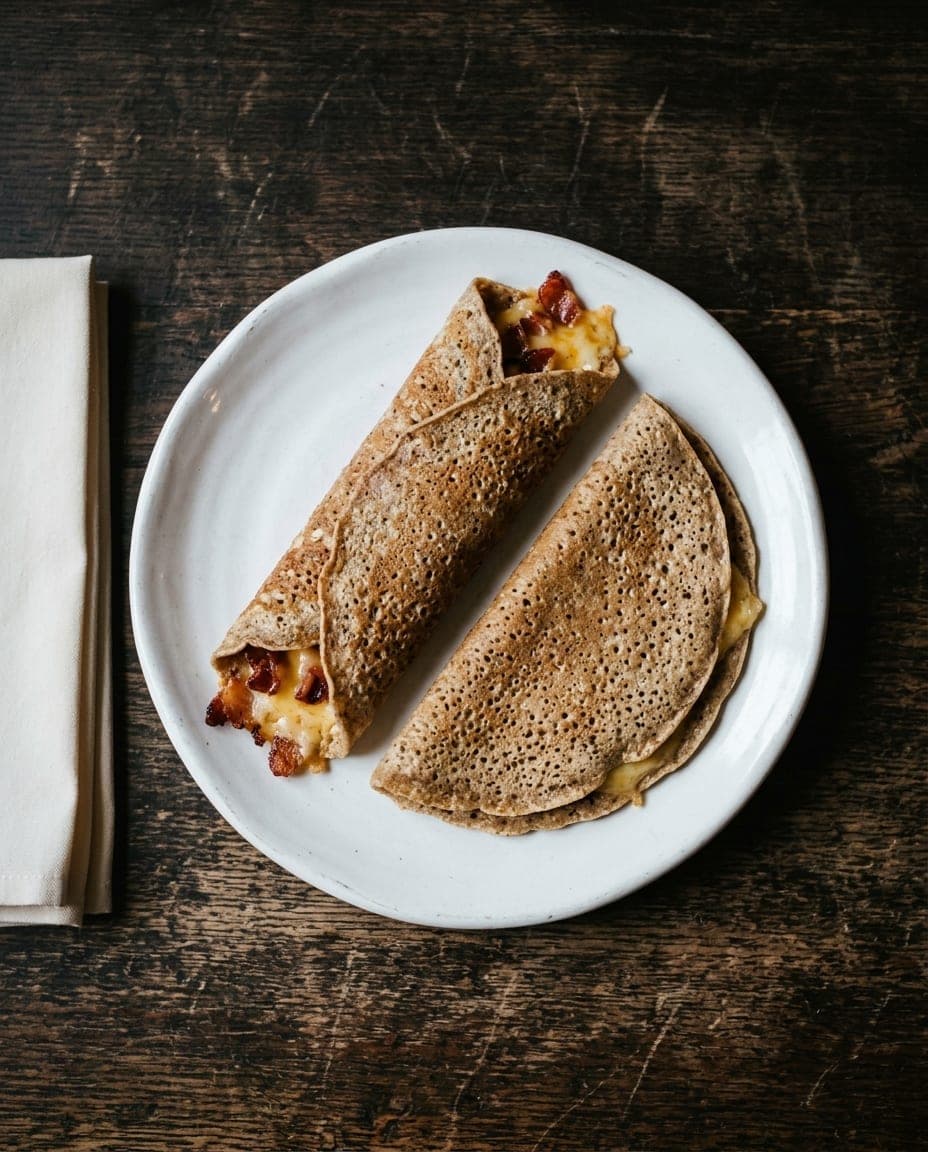
Staffordshire oatcakes are not the hard, crumbly biscuits often found in Scottish bakeries. They are soft, floppy pancakes, roughly the size of a dinner plate, made from a yeasted batter of oatmeal, flour, milk and water. The mixture is left to ferment until it bubbles, then poured onto a hot griddle where it cooks into a grey-brown disc with a slightly sour taste.
In Stoke-on-Trent, known as the Potteries, this dish was once a common breakfast for pottery workers who needed something hearty before starting their shifts in the kilns. It remains a Staffordshire speciality, and barely travels beyond the Potteries. The most common way to order them is not as a plain side, but as a savoury roll: the hot cake is folded around slices of cheese and bacon, then placed under a grill until the cheese melts into a gooey pool inside the fold.
The history of the Potteries breakfast
The oatcake belongs to industrial Stoke-on-Trent, where it was the pottery workers' breakfast through the 19th century: cheap, quick over a griddle, filling enough to carry a shift in front of a kiln, and foldable enough to eat on the way in.
No origin date is recorded. What is documented is the trade that grew round it: oatcake shops run out of the front rooms of terraced houses, selling through the window to the queue going to work. The method has not changed — a batter that waits for yeast rather than for baking powder.
What goes into it
The batter is simple, relying on the quality of its few components to create the characteristic texture and flavour. Unlike modern quick breads, this version requires patience for the yeast to work.
- Oatmeal, usually medium or coarse ground, which gives the pancake its earthy taste and soft body.
- Plain flour, added in small amounts to help bind the batter and give it structure without making it heavy.
- Milk and water, mixed to create a liquid consistency that pours easily but holds together on the griddle.
- Yeast, which allows the batter to ferment, creating the slight sourness and airy texture essential to the dish.
- Salt, added to balance the flavour of the oats.
The finished pancake is soft, slightly chewy, and warm. It is not a crisp bread; it bends easily and absorbs flavours well, which is why it serves as the perfect vessel for cheese and bacon.
How to eat it
They are eaten hot, within minutes of the griddle, from a shop in Stoke-on-Trent or one of the other Potteries towns.
The standard order is two or three, filled with cheese and bacon and put under the grill until the cheese runs. They are held in one hand, and tea goes with them.
Plain discs are sold by the half-dozen to take home; over a counter, the filled and grilled version is what arrives.
Curious facts
- It has not travelled far. Beyond packs in supermarkets around the region, the oatcake stayed in the Potteries; shops outside North Staffordshire are rare enough to be remarked on.
- The batter needs time. The yeast requires several hours to ferment before cooking, meaning these pancakes cannot be rushed like modern griddle cakes made with baking powder.
- Not a biscuit. Despite the name "oatcake", this is a soft pancake, not the hard, dry Scottish oatcake often served with tea in other parts of the UK.
- Sold by the half-dozen. Shops sell them plain in bags of six or a dozen for people to fill at home, as well as filled over the counter.
- The griddle method. They are cooked on a flat hot plate or griddle, which gives them their characteristic grey-brown colour rather than a golden crust.
Where to try it
An oatcake shop in Stoke-on-Trent or one of the six towns of the Potteries. Selling through the window of a terraced house was once common; it survives now as an exception. Most are small independent shops, and the trade has stayed where it started.
Where to try it
1 destination
 Boat Rentals
Staffordshire
County with canal boat rentals on the historic Staffordshire and Worcestershire Canal network.
Boat Rentals
1 region
- Boat Rentals1 destination
West Midlands
The West Midlands is a historically rich region in the UK, known for its industrial heritage and vibrant cultural scene. Birmingham, the largest city, boasts a variety of museums and the diverse cuisine of its Balti Triangle. Nearby, Coventry is famous for its medieval cathedral and the unique Herbert Art Gallery. The region also features the picturesque canals of Stratford-upon-Avon, the birthplace of Shakespeare, where visitors can explore historic sites related to the playwright. The Malvern Hills offer stunning landscapes and walking trails, ideal for outdoor enthusiasts. This area is recognized for its local festivals celebrating everything from music to food, providing a glimpse into the region's cultural tapestry.
Boat Rentals