Milk chocolate
The creamy Swiss sweet born from Vevey's 1875 experiment
- Vegetarian
- Local name
- Chocolat au lait
- Best eaten at
- Vevey and Lake Geneva chocolatiers
What it is
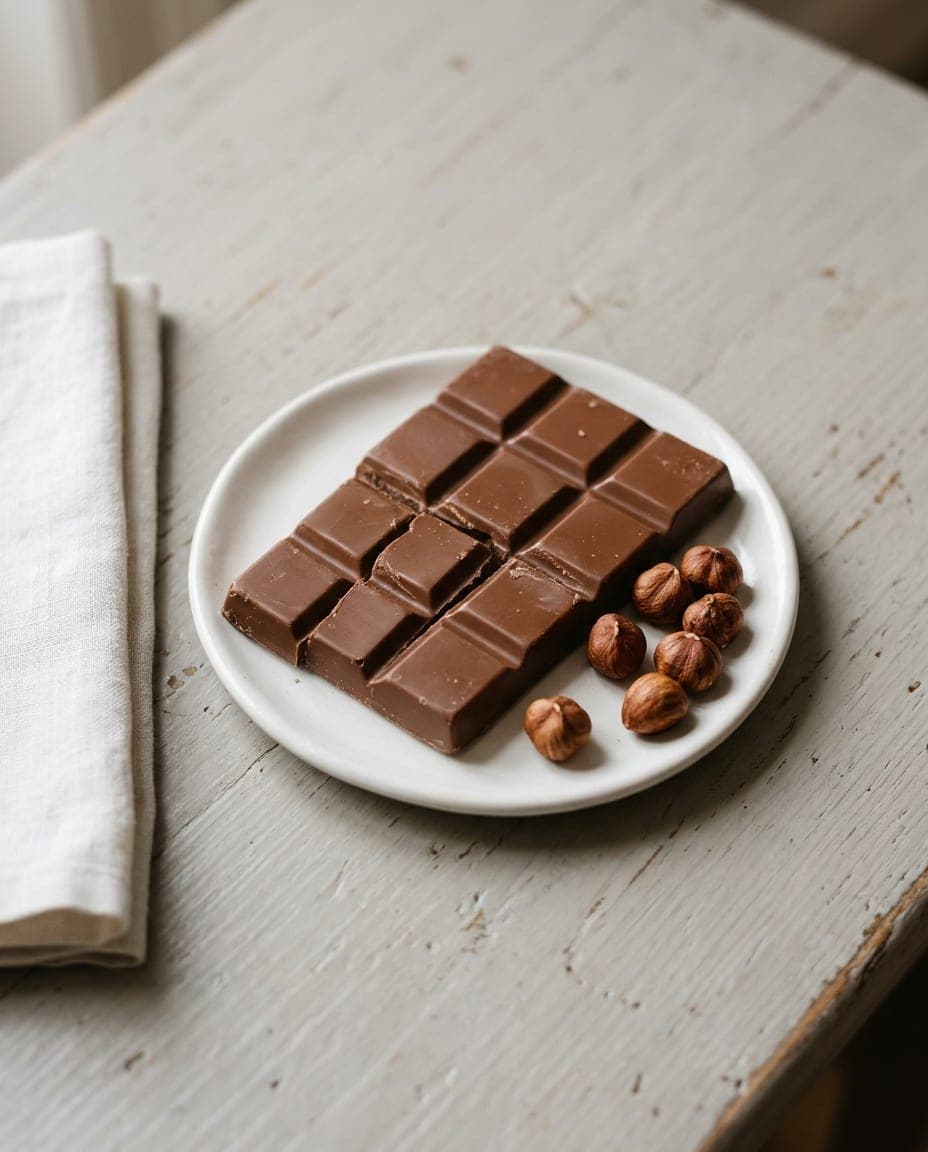
Milk chocolate, known locally as chocolat au lait, is a smooth, pale brown confection that defines Swiss sweetness for many visitors. It is not a dish served in bowls or on plates like a meal, but rather a solid block of sweetened cocoa and milk, melted by the warmth of the mouth into a deep, velvety liquid. Its texture is the defining feature: it yields instantly to the tongue, leaving no grit, with a creamy sweetness that balances the bitter notes of the cocoa bean.
The Swiss version is distinct from many other chocolate types because of its high milk content and the specific method used to process it. While dark chocolate relies on the pure flavour of the bean and sugar, chocolat au lait introduces dairy in a way that softens the sharp edges of cocoa. It is produced year-round across Switzerland, yet its true home lies in the canton of Vaud, specifically around the town of Vevey on the shores of Lake Geneva. Here, the tradition began in the late 19th century and established a reputation that would eventually make Swiss chocolate synonymous with quality worldwide.
The invention in Vevey
The story of this confection begins in the 1870s in the small town of Vevey. Daniel Peter, a candle-maker from Moudon who had turned to chocolate in Vevey, was already making chocolate bars when he encountered a persistent problem: the water in milk would not combine with the cocoa, and the chocolate turned grainy and quickly went mouldy. For years, he sought a solution that would allow the creamy texture of milk to exist within the solid chocolate without ruining its structure.
The breakthrough came through his neighbour, Henri Nestlé, a Vevey food maker who worked with milk and supplied him with condensed milk, which has most of its water removed and keeps for long periods. Combining that milk with cocoa mass and sugar gave him a stable bar. The date usually given is 1875, though he spent years refining the recipe and it only became a commercial success in the late 1880s.
Peter's discovery did not happen in isolation. Vevey at the time was a busy centre of chocolate and food making, and Peter and Nestlé later went into business together. While Peter is credited with the invention, the success relied heavily on the availability of Nestlé's condensed milk, which solved the water problem that had stumped chocolate makers for decades.
The texture revolution
Four years after Peter's breakthrough, another Swiss innovation transformed the eating experience. In 1879, Rodolphe Lindt, a chocolatier in Bern, developed the conche, a machine designed to grind and aerate melted chocolate over long periods. Before this invention, chocolate often had a rough texture or a heavy mouthfeel that required significant chewing. The conche changed everything by continuously mixing the chocolate for hours, sometimes even days, allowing air to escape and the particles to become incredibly fine.
This process, first applied to dark chocolate, later gave Swiss milk chocolate its signature smoothness. The machine worked the cocoa butter, sugar and, in milk chocolate, the milk solids together until they formed a homogeneous paste that melted effortlessly on the tongue. Lindt's contribution was not about creating a new flavour, but about refining the texture of existing recipes. When combined with Peter's milk formula, the result was a chocolate that felt different from anything else available at the time: creamy, uniform, and easy to eat.
The impact of these two inventions, separated by only a few years, reshaped the global confectionery industry. The Swiss approach prioritised texture as much as flavour, setting a standard that other nations would eventually emulate. While dark chocolate remained a separate category, the combination of milk and cocoa created a new class of sweet treat that appealed to a wider audience, particularly children and those who found traditional dark chocolate too intense.
What goes into it
The composition of chocolat au lait is straightforward but relies on specific ingredients to achieve its characteristic taste. There are no secret spices or hidden flavourings in the standard version; the complexity comes from the quality of the base components. The primary ingredients include cocoa beans, which provide the deep, earthy foundation, and sugar, which balances the bitterness with sweetness.
The defining element is the milk, usually in the form of condensed milk or powdered milk, which adds a creamy richness that distinguishes it from dark chocolate. The ratio of milk to cocoa varies by maker, but Swiss makers tend to use a generous proportion of dairy to create that soft, melting quality. Cocoa butter, the natural fat extracted from the beans, is also essential, acting as the vehicle that carries the flavour and provides the smooth texture when melted.
The classic bar is plain: a solid block of one texture, scored into squares. Hazelnuts, almonds and fillings came later and are variations on it rather than the thing itself.
How it is eaten
Milk chocolate is rarely served as part of a larger meal in Switzerland. Instead, it is enjoyed as a standalone snack or a small dessert, often paired with coffee or tea. It is broken into squares and eaten slowly, with coffee, in the afternoon. The texture invites a deliberate pace; one does not rush through a piece of smooth milk chocolate but rather allows it to melt fully before swallowing.
In Vevey and the surrounding Vaud region, it is common to buy small bars from local chocolatiers and eat them while walking near the lake or sitting on a bench in the town square. The chocolate is often wrapped in simple paper or foil, making it easy to carry and share. While it can be used as an ingredient in baking or desserts, its primary role is as a confection meant for direct consumption.
Pairing is key to the experience. A cup of strong black coffee cuts through the sweetness, while a glass of local white wine from the Vaud vineyards offers a contrasting dryness that highlights the creamy texture. The goal is to appreciate the balance between the cocoa's depth and the milk's softness without distraction.
Curious facts
- A Swiss first. While other nations experimented with adding milk to chocolate earlier, Daniel Peter is credited with creating the first successful milk chocolate in 1875 using condensed milk.
- The machine that changed texture. Rodolphe Lindt's conche, invented in Bern in 1879, changed the process rather than the recipe, and gave Swiss chocolate its unique smoothness and melted consistency.
- Vevey as the birthplace. The town of Vevey on Lake Geneva remains the symbolic home of milk chocolate, where the first successful combination of cocoa and condensed milk occurred.
- No water allowed. The breakthrough relied on removing water from the milk to prevent it from seizing the cocoa, a problem that had plagued chocolate makers for decades.
- A global standard. The Swiss method of combining milk and cocoa set a benchmark for quality that influenced chocolate production worldwide, making Swiss chocolate synonymous with smoothness.
Where to try it
The best place to taste authentic chocolat au lait is in Vevey itself, where the history of its creation is still visible in the local culture. Small chocolatiers along the lakefront and in the town centre often produce their own versions, using traditional methods that honour the original recipe. These shops are not large factories but intimate workshops where visitors can watch the chocolate being made or simply enjoy a fresh bar.
Beyond Vevey, other towns in the Vaud canton offer excellent examples of Swiss milk chocolate, particularly those near Lake Geneva. The region's focus on quality means that even smaller producers maintain high standards for their cocoa and dairy sources. While Switzerland as a whole is known for its confectionery, the specific character of milk chocolate is most closely tied to this lakeside area.
Vevey also holds the food museum set up by the company that grew out of Nestlé's condensed milk, which is the other half of the story and is on the lakefront.