Gruyère AOP
The nutty hard cheese of Fribourg, made in copper vats
- Vegetarian
- Local name
- Le Gruyère AOP
- Served with
- Bread, pears
- Best eaten at
- The Gruyères cheese dairy
- Pairs with
- Chasselas
What it is
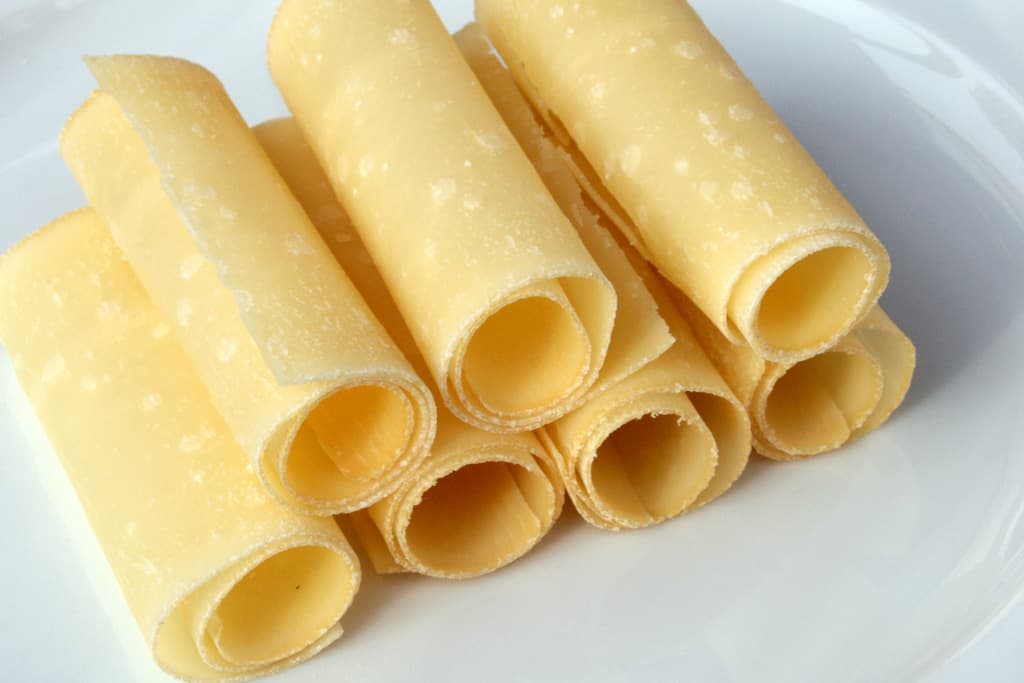
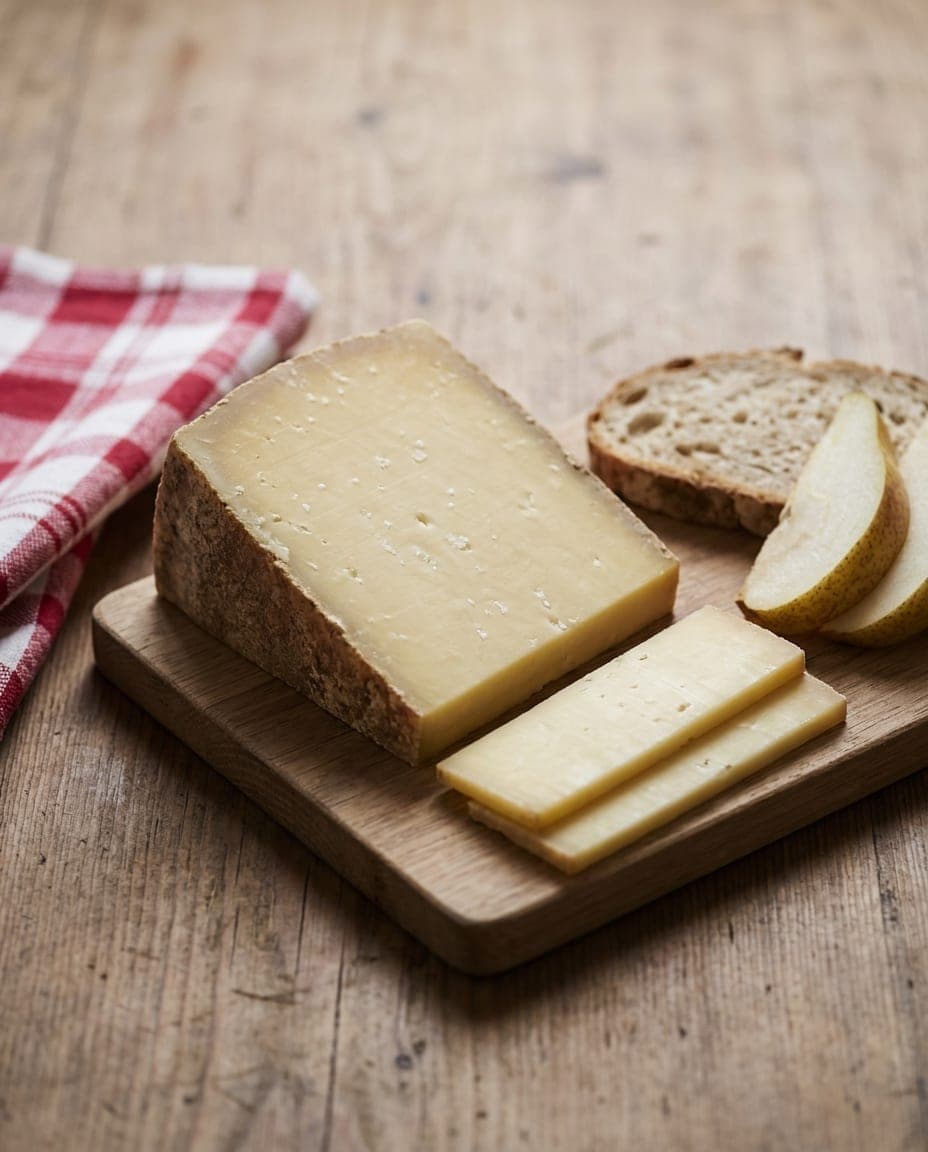
Le Gruyère AOP is a hard, firm cheese made from cow's milk in the cantons of Fribourg, Vaud, Neuchâtel and Jura and parts of the canton of Bern. Named after the town of Gruyères at the foot of the Moléson mountain, it is one of the country's most recognisable products. The cheese has a pale yellow interior with few or no holes, a texture that ranges from smooth to slightly grainy as it ages, and a flavour that evolves from mild and creamy to deep, nutty and savoury.
Despite its fame on menus worldwide, this is not the Swiss cheese full of large holes seen in cartoons; that is Emmentaler. Le Gruyère AOP may have a few small eyes of around 4 to 6 mm, but large holes count as a defect. The cheese is made from raw milk, which gives it a distinct character that pasteurised versions cannot replicate. It is aged for at least five months on spruce boards, though many wheels mature for a year or more, developing the complex profile that defines the AOP standard.
The cheese serves as a culinary anchor in Switzerland. It forms the backbone of the national fondue alongside Vacherin Fribourgeois in the traditional moitié-moitié blend. Outside of melted dishes, it is equally popular served cold in thick slices with bread or fresh pears. The AOP label guarantees that the milk comes from farms within the defined area, fed without silage, and that the production follows strict methods there.
The history of the Fribourg dairy
The story of Le Gruyère is rooted in the medieval traditions of the Fribourg region, where mountain farming required a way to preserve milk during the long winter. Cheese making in the Gruyère mountains is recorded as early as 1115, and medieval chronicles describe the region's cheese being sold in France and Italy. The town of Gruyères, seat of the Counts of Gruyère, gave its name to the product.
For centuries, the cheese was made in individual farms using copper vats and wooden curd cutters. The method relied on the quality of the grass from the alpine meadows and the skill of the fromager in handling the curds. The name was imitated from the 19th century on and fought over for most of the 20th century, in Switzerland and abroad. Swiss protection came late: the cheese received its controlled designation (AOC) in 2001 and the AOP, recognised across the European Union, in 2011.
The production process has remained remarkably consistent. The milk is poured into large copper vats where it is gently heated and coagulated. The curds are cut by hand or machine, cooked slowly, and then pressed into moulds. Once the wheels are formed, they are brined before being moved to the cellars for maturation, where they are regularly turned and rubbed with salt water. There, they rest on spruce boards that allow the cheese to breathe while developing its characteristic crust and flavour.
The role of the alps and the valley
Le Gruyère AOP is a product of the landscape. In summer the cows graze the meadows and pastures of the production area, feeding on the diverse flora of the high meadows. This seasonal diet imparts a specific aroma to the milk that translates into the final cheese. In winter, the cows are fed hay, mostly from their own farm; silage of any kind is banned, ensuring continuity in the taste throughout the year.
The AOP rules distinguish between two types of production: the standard Le Gruyère AOP made in the valley dairies, and the Gruyère d'alpage, which is made exclusively on mountain pastures during the summer grazing season. The alpine version is often considered more intense due to the rich grasses available at high altitudes, but both carry the same protected name. This distinction highlights the importance of the local environment in shaping the cheese's character.
What goes into it
The ingredients are simple, yet the process transforms them into something complex. The cheese is made from raw cow's milk, salt, rennet, and lactic ferments. No additives or preservatives are allowed in the AOP version. The milk must come from farms within the AOP area.
The production method requires open copper vats, which are believed to help regulate temperature and contribute to the cheese's texture. The curds are cooked slowly, then pressed into moulds to form the wheel shape. After brining, the wheels are moved to cellars where they age on spruce boards for at least five months. During this time, the cheese develops a natural rind and its internal structure becomes firm yet pliable.
The result is a cheese that can be sliced, melted, or grated. In its younger form, it is creamy and mild, suitable for eating with bread. As it ages beyond a year, the texture becomes crumbly and the flavour intensifies, developing notes of roasted nuts, dried fruit and a subtle saltiness. The dense paste means the cheese melts evenly, making it ideal for fondue or gratins.
How to eat it
Le Gruyère AOP is versatile, but it shines in specific contexts. In Switzerland, it is most commonly served as part of a fondue, often mixed with Vacherin Fribourgeois to create the moitié-moitié blend. The cheese melts into a smooth, creamy consistency that coats the bread without separating. For those who prefer the cheese on its own, slicing it thick and serving it with crusty bread or fresh pears is a classic combination.
The cheese pairs well with Chasselas, the dry white grown on the terraces above Lake Geneva in the Vaud. The acidity of the wine cuts the fat of the cheese, while the nutty notes of the Gruyère complement the fruitiness of the wine. In a more rustic setting, it can be paired with dark beer or a light red wine from the Fribourg area.
It is served at room temperature rather than cold, and for fondue it is grated rather than cubed so it melts evenly.
Curious facts
- Few holes allowed. Unlike the cartoon stereotype, Le Gruyère AOP has at most a few small eyes; large holes are graded as a defect.
- Copper vats matter. The traditional use of copper vessels for heating the milk is believed to influence the cheese's texture and flavour development.
- A year or more. While the minimum maturation period is five months, many wheels age for a year or longer to reach their full nutty potential.
- The alpine difference. Le Gruyère d'alpage is a separately labelled version made only on mountain pastures during summer, offering a more intense taste.
- Fondue foundation. The cheese is the backbone of Swiss fondue, often blended with Vacherin Fribourgeois to create the classic moitié-moitié mixture.
- Protected name. The term "Gruyère" is protected in Switzerland; only cheese made in the defined area of western Switzerland under AOP rules can bear the label. Neighbouring France has its own, separately protected Gruyère IGP.
Where to try it
Gruyères, the walled hill town the cheese is named after, has a working demonstration dairy at the foot of it where the copper vats can be watched through glass and the cellars are open. The town itself is small, medieval and busy in summer.
The cheese is sold at every dairy and village shop in the canton, usually in three or four ages at once, and the difference between a five-month wheel and an eighteen-month one is worth tasting side by side before buying. For the alpine version, the mountain dairies above the Intyamon valley sell at the door through the summer.
Where to try it
1 destination
 Panoramic Trains
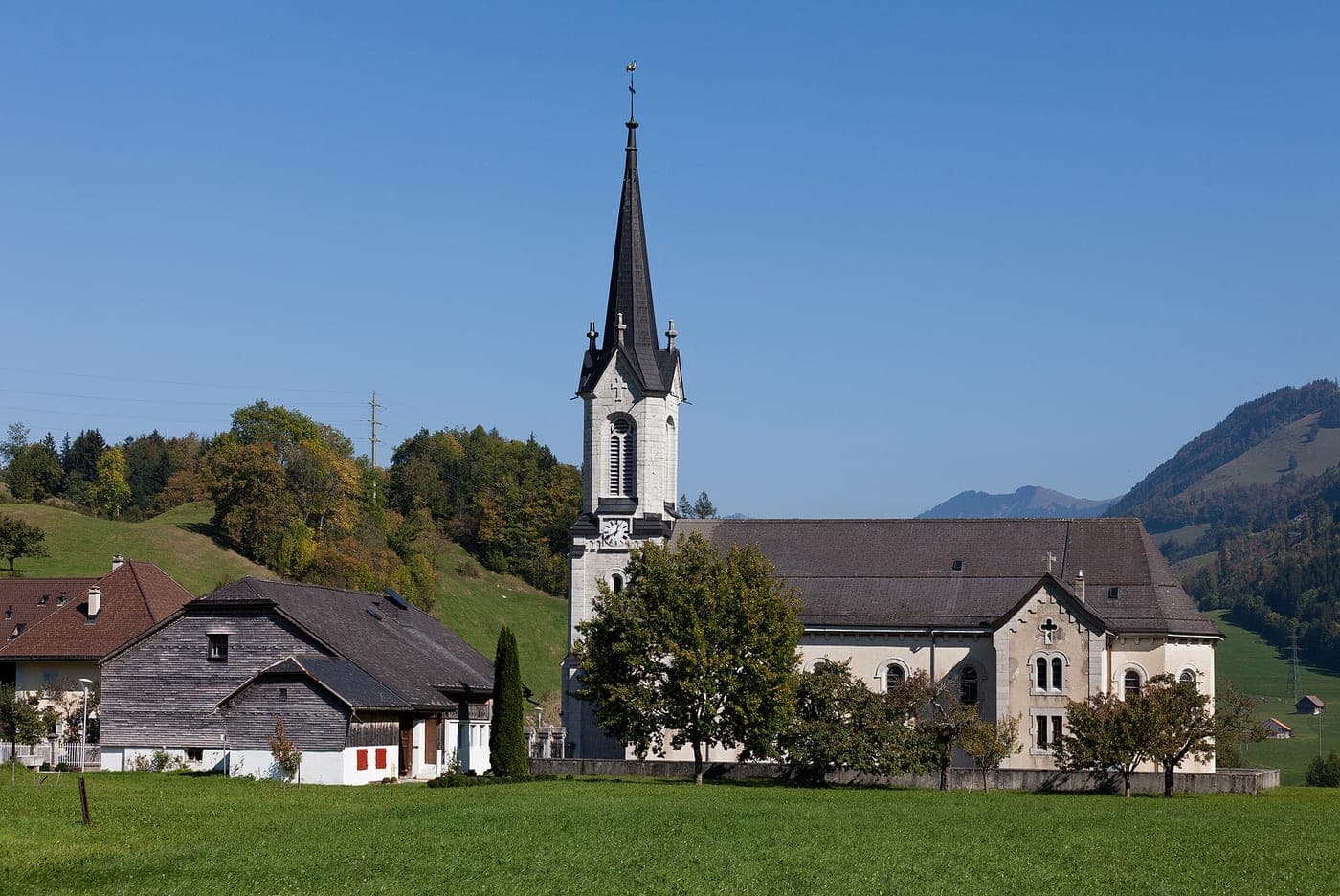
Montbovon
Mountain village where the Golden Pass and Chocolate Train routes meet.
Panoramic TrainsHiking
1 region
 Boat Rentals3 destinations
Fribourg
Fribourg is a Swiss region built for a slower pace. It sits between the French- and German-speaking parts of the country, and that mix still shapes daily life here — road signs change language partway through the canton, and the same cheese is sold under two names at the same market stall. The regional capital, also named Fribourg, sits on a sandstone hill above a bend in the Sarine river. Its old town is one of the larger medieval centres in Switzerland, with covered wooden bridges, a Gothic cathedral, and streets so steep that some are built as steps rather than roads. From the ramparts, the river loops below and the rest of the canton spreads out towards the hills. South of the city, the land softens into rolling dairy country. This is Gruyère territory, named after both the cheese and the small walled town of Gruyères that still gives it its name. Around Gruyères and the nearby town of Bulle, farms and mountain huts still make cheese by hand through the summer months, when herds move up to the high pastures. Several dairies open their doors to visitors watching a wheel of Gruyère being pressed and salted, a process that has changed very little over generations. The landscape rises further south into pre-alpine terrain: green terraces, scattered timber barns, and villages built from wood that has weathered dark over centuries. Walking paths here follow old cattle tracks between pasture and forest, gentle enough for an unhurried afternoon rather than a full day's climb. In autumn, cattle are led back down from the alpine pastures in a tradition still marked with flowers, bells, and a village gathering — one of the few moments when the summer's quiet farm work becomes a public event. To the north and west, the canton reaches Lake Neuchâtel and Lake Murten. Murten itself is a walled medieval town on the water, small enough to circle on foot within the hour, with a lakeside promenade that fills with café tables in summer. In warmer months, passenger boats cross the lake to nearby towns, a pleasant way to spend an afternoon without hurrying. One of the quieter pleasures of the region is its local railway, which climbs from the lowland towns into the hills in short, unhurried stages, following the river through farmland before a hilltop town's towers come into view above the tracks. These are working regional trains rather than tourist rides, and that is much of their charm — riders share the carriage with people going to market or coming home from the fields. Food shapes much of what there is to do here. Beyond cheese, the region is known for its double cream, for meringues eaten with that cream, and for a dried, air-cured meat found across French-speaking Switzerland. Village markets, especially in Bulle and Fribourg itself, are where these products change hands directly between maker and buyer, often with a taste offered first. A comfortable way to see Fribourg is over three to five days: a day or two in the old town and along the Sarine, a day around Gruyères and its cheese dairies, and a day or two further into the hills or out to Murten and the lake. Trying to fit it into a single day usually means choosing between the city and the countryside, and both reward more time than that. What makes the region worth this pace is less any single sight than how its parts connect — a cathedral town, a cheese-making valley, alpine pastures, and a lakeside village, all within a canton small enough to move between slowly and still see plenty. Fribourg does not have the scale of the Bernese Oberland or the fame of Lake Geneva, but it holds a quieter version of the same Swiss countryside, with fewer crowds and more time to notice the details: the smell of a cheese cellar, a wooden bridge underfoot, the particular green of a pasture after rain.
Boat RentalsHikingPanoramic Trains