Tigelada
Egg custard baked in small clay bowls from Abrantes
- Vegetarian
- Local name
- Tigelada
- Served with
- Coffee
- Best eaten at
- An Abrantes pastelaria
- Pairs with
- Moscatel
What it is
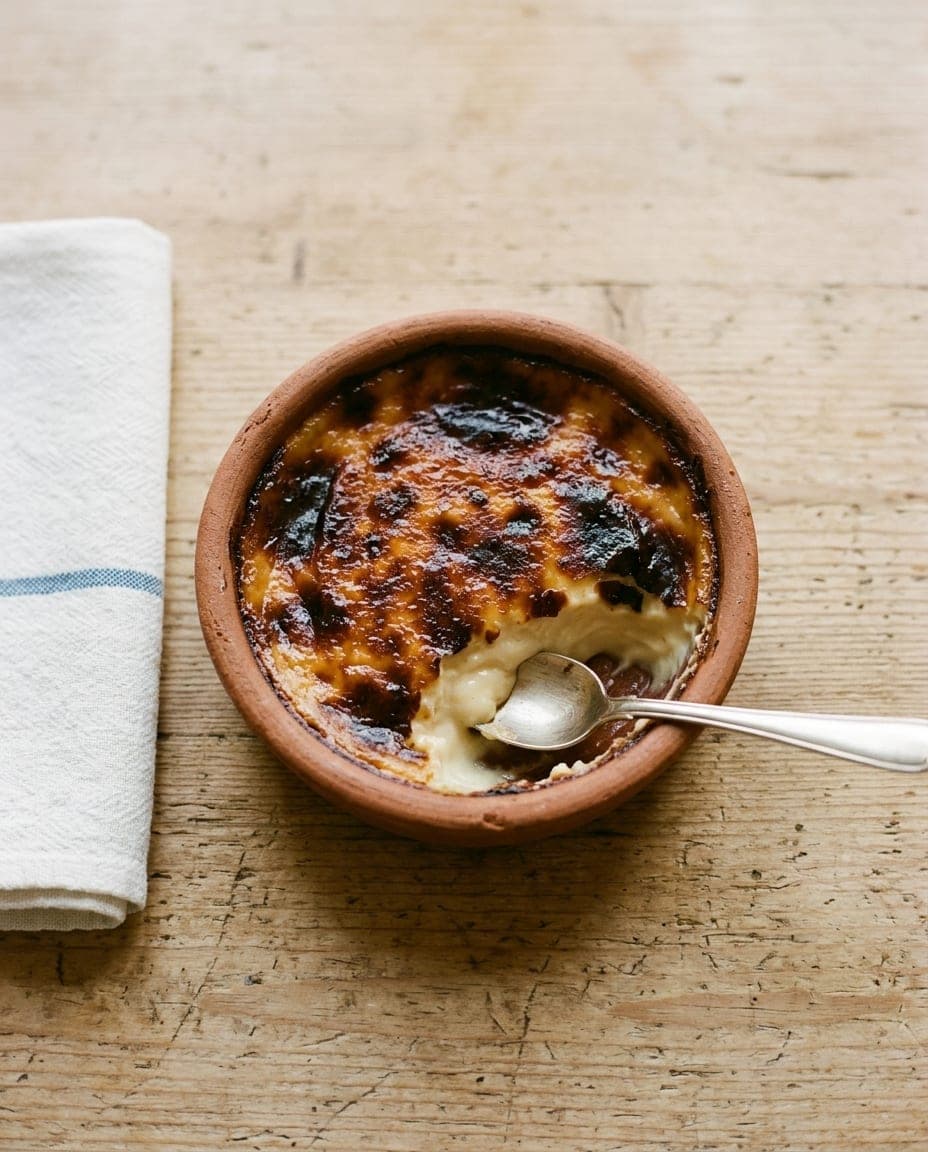
Tigelada is a simple egg custard that belongs to the interior regions of Portugal, specifically the Beira and the Ribatejo. It is not found on every menu across the country, but it remains a staple in the Abrantes area, where several places in the municipality claim to be its birthplace. The dish consists of a mixture of eggs, milk, sugar, a little flour and lemon zest, sometimes with cinnamon, baked until it sets firmly inside small clay bowls known as tigelas.
The name comes directly from these vessels. The bowls are heated in the oven before the batter goes in, so the custard puffs and sets quickly while the edges brown unevenly, the top develops a darker crust and the base turns slightly honeycombed. This method of baking in a traditional wood-fired oven gives the dessert a texture that is firmer at the sides than in the centre, with a distinctive warmth that metal tins cannot replicate. It is a dish designed for comfort rather than show, often appearing as the final course after a meal or alongside coffee in the afternoon.
The clay and the oven
The specific shape of the tigela plays an active role in how the custard cooks. These small, wide bowls are shallow enough to allow the heat to reach the centre quickly but deep enough to hold the mixture steady. Because they are made of unglazed clay, they absorb and retain the oven's temperature differently than glass or ceramic.
The bowls go into the hot oven empty and come out very hot, and the batter is poured straight in. This creates a gradient of texture: the custard against the clay firms up first, creating a slight crust, while the middle is the last part to set. The top often develops a mottled brown surface rather than a uniform colour, a result of the direct heat radiating from the clay walls.
This technique relies on the traditional wood-fired ovens still found in many bakeries across the Ribatejo. These ovens maintain a steady, dry heat that cooks the custard through without boiling it. The result is a dense, rich dessert that holds its shape when turned out or eaten directly from the bowl.
What goes into it
There are no elaborate ingredients in tigelada. The list remains short and consistent across the Abrantes region:
- Eggs, which provide the structure and richness of the custard.
- Milk, usually full-fat, to create a smooth base that blends with the eggs.
- Sugar, added to sweeten the mixture before it sets in the clay.
- Flour, a small amount, which helps the custard hold together.
- Cinnamon, used in some versions as a ground spice or a stick infused in the milk, which gives the custard a warm, spicy note.
- Lemon zest, added sparingly to cut the fat and give the dish a fresh finish.
No cream or butter is included. The texture comes mostly from the eggs and the fierce heat of the bowl. Once baked, the custard is firm enough to hold its shape but soft enough to be eaten with a spoon directly from the clay bowl.
How to eat it
Tigelada is best enjoyed warm, often straight from the oven or just after it has cooled slightly. In the Abrantes area, it is common to order a small portion as a sweet treat alongside a strong black coffee. The combination of the warm custard and the bitter coffee creates a balanced finish to a meal.
It is a pastelaria dish, made in the morning and sold through the day. The bowls come to the table still warm, and the contrast between the set edge and the soft middle is clearest then.
It pairs naturally with a glass of Moscatel, the sweet fortified wine made on the Setúbal peninsula to the south-west. The sweetness of the wine complements the cinnamon and lemon in the custard without overwhelming it. It is an easy match at a tavern table or at the counter of a bakery where the dessert is served fresh.
Curious facts
- The name comes from the bowl. The word tigela refers to the small clay vessel used for baking, not the custard itself, though the dish has adopted the name over time.
- No thermometer involved. Bakers judge the bread oven by feel and the custard by the colour of its top, not by a number.
- A convent recipe. Tigelada is usually counted among Portugal's convent sweets, and Abrantes's archives hold tigelada recipes from the town's Convento da Graça.
- Regional boundary. While the Beira has its own tigeladas, the clay-bowl version is most strongly linked to Abrantes, not the coast or the north.
- Simple ingredients only. The recipe contains no cream or butter, relying on eggs, milk, sugar, a little flour and lemon zest.
- Served with coffee. It works as a dessert, but it is just as often eaten with a strong black coffee or a glass of Moscatel.
Where to try it
The pastry shops of Abrantes, in the Ribatejo interior, where the bowls are lined up on the counter and sold singly. It is cheap, ordinary and made every day, despite the convent recipe behind it.
Village festivals and country restaurants across the Beira Baixa and the Ribatejo put it on as a standard dessert. The clay bowl is often part of the deal: the custard is eaten straight out of it.