Pudim Abade de Priscos
Egg-yolk pudding from Braga, made with port and bacon fat
- Local name
- Pudim Abade de Priscos
- Best eaten at
- A Braga restaurant
- Pairs with
- Tawny port
What it is
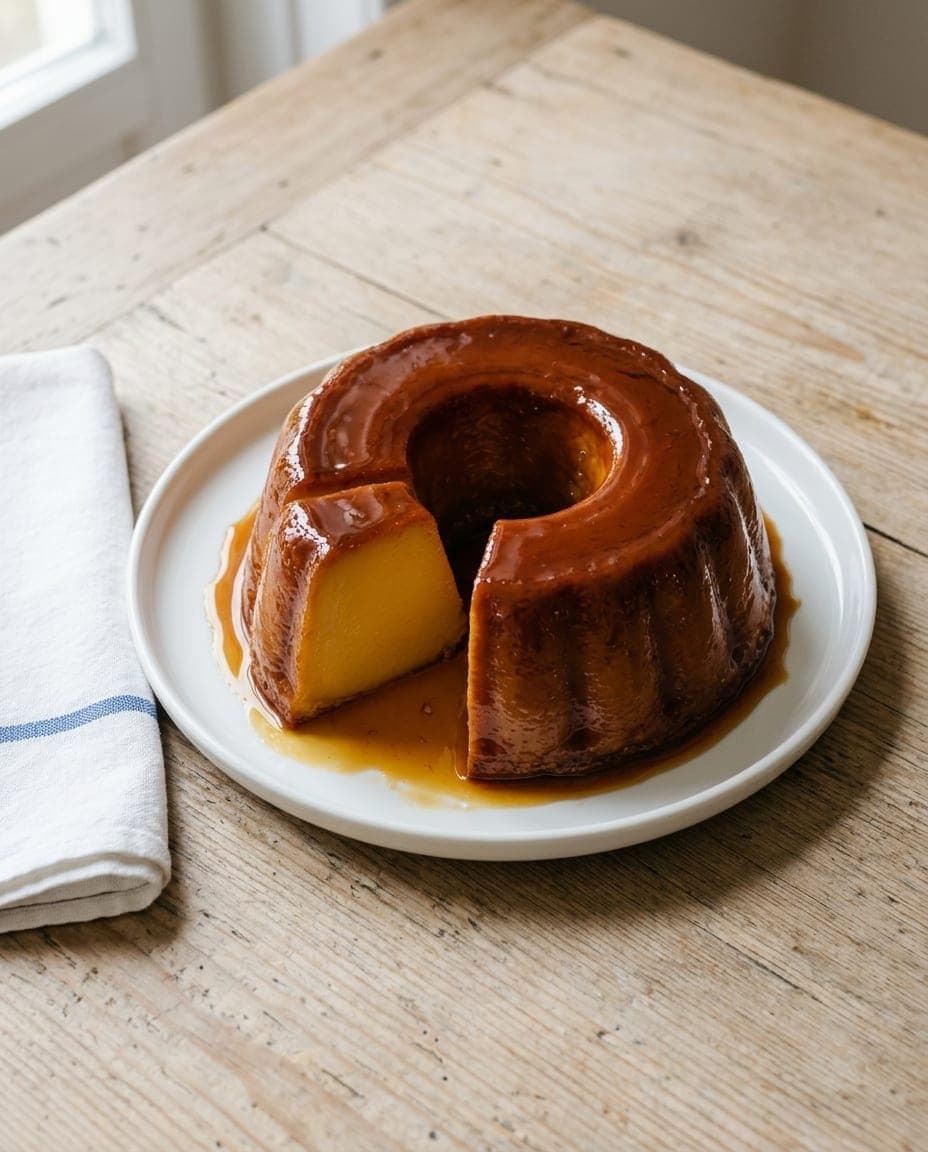
Pudim Abade de Priscos is a deep, dark pudding made almost entirely of egg yolks, sugar syrup and port wine, baked in a caramel-lined mould. It comes from the city of Braga in the northern region of Portugal, where it remains a local speciality rather than a dish found on menus across the country. The texture is dense, glossy and smooth, resembling a firm jelly or a heavy custard that holds its shape when sliced.
The defining feature of this pudding is the inclusion of pork fat, known locally as toucinho. A piece of bacon fat is boiled in the sugar syrup, together with lemon peel and a cinnamon stick, and the syrup is then strained onto the yolks and port. The fat is not there for a bacon flavour; it is said to give the richness and silky consistency that distinguish the dish from other egg-based desserts. The result is a pudding that is intensely sweet, with the port cutting against the weight of the yolks.
The priest who made it
The dish is named after Manuel Joaquim Machado Rebelo (1834–1930), abbot of Priscos, a small parish just outside Braga, from 1883 until his death. He had a national reputation as a cook as well as a priest, and in 1887 oversaw a banquet for King Luís and the royal family at Póvoa de Varzim. He is credited with creating this pudding, which has since become the pride of Braga.
He shared few of his recipes, but this was one of them: he passed it on so that it could be taught to the girls at a convent school in Braga. Even so, the versions that exist now vary from one kitchen to another, and there is no single official formula. What remains constant is the identity of the dish as a creation of the Priscos abbot, a fact that gives it its enduring name and place in the city's food history.
How to eat it
Pudim Abade de Priscos is served as a dessert, typically after a meal or alongside coffee. It is usually served as a slice on a plate, glossy with the caramel that ran down when the pudding was turned out of its mould. It yields easily to a spoon but holds firm enough to be lifted without breaking.
A glass of Tawny port is a natural accompaniment. The sweetness of the wine complements the caramel and the richness of the egg yolks, and it echoes the port in the pudding itself. Some visitors also enjoy it with a strong coffee, which helps cut through the density of the dessert.
What goes into it
The ingredients are few but specific, creating a pudding that relies on quality rather than variety:
- Egg yolks, used in large quantities to create the deep yellow colour and the thick, custard-like body.
- Sugar syrup, made by boiling sugar and water with lemon peel and a cinnamon stick, then strained onto the yolks.
- Port wine, Tawny or Vintage, which adds a distinct fruity depth.
- Pork fat (toucinho), a piece of bacon boiled in the syrup and then removed, credited with the characteristic texture.
The caramel lining of the mould is essential for the final presentation. Once the pudding is cooked in a bain-marie and cooled, it is inverted onto a plate, allowing the dark, sticky caramel to coat the bottom and sides of the slice.
Curious facts
- The pork fat cannot be tasted. It does not read as bacon in the finished pudding; it is there for richness and texture.
- A royal cook. The abbot cooked for King Luís and Queen Maria Pia, and was one of the best-known cooks in 19th-century Portugal.
- It stays in the north. The pudding is standard in Braga and less common elsewhere, though it does turn up on menus in Lisbon.
- Caramel first. The caramel is added to the mould before the mixture goes in, ensuring the bottom of the pudding is coated in dark sugar syrup.
- A priestly kitchen. The story of a parish priest making such a rich dessert highlights the tradition of clerical households producing their own food in rural Portugal.
Where to try it
A traditional restaurant in Braga, where it is on the dessert list as a matter of course and sometimes arrives on a trolley with the rest of the regional sweets.
Priscos itself is a parish on the edge of the city, which is as close as the dish gets to a place of origin. Pastry shops in Braga sell it too, and the versions differ: the quantity of yolks, the port, and how much toucinho went into the syrup.
Where to try it
1 destination
 Wine Tasting
Braga
Historic city in Vinho Verde region with wine routes and baroque architecture.
Wine Tasting
1 region
 Wine Tasting12 destinations
Norte
Norte is the largest region in Portugal, known for its diverse landscapes ranging from rugged mountains to a stunning coastline. Porto, the region's main city, is famous for its port wine and historic Ribeira district, while towns like Guimarães and Braga boast rich medieval history and architecture. The Douro Valley, a UNESCO World Heritage Site, offers breathtaking views and opportunities to explore terraced vineyards. Unique cultural festivals, such as the Festa de São João in Porto, showcase local traditions. The region is also noted for its traditional cuisine, including dishes like francesinha and regional cheeses. Nature lovers can hike in the Peneda-Gerês National Park, experiencing the region’s natural beauty away from the crowds.
Wine TastingHikingBoat RentalsCamper Van Rentals