Caldo verde
Potato soup with fine-shredded kale and chouriço
- Local name
- Caldo verde
- Served with
- Broa cornbread, chouriço
- Best eaten at
- A Porto tasca
- Pairs with
- Vinho Verde
What it is
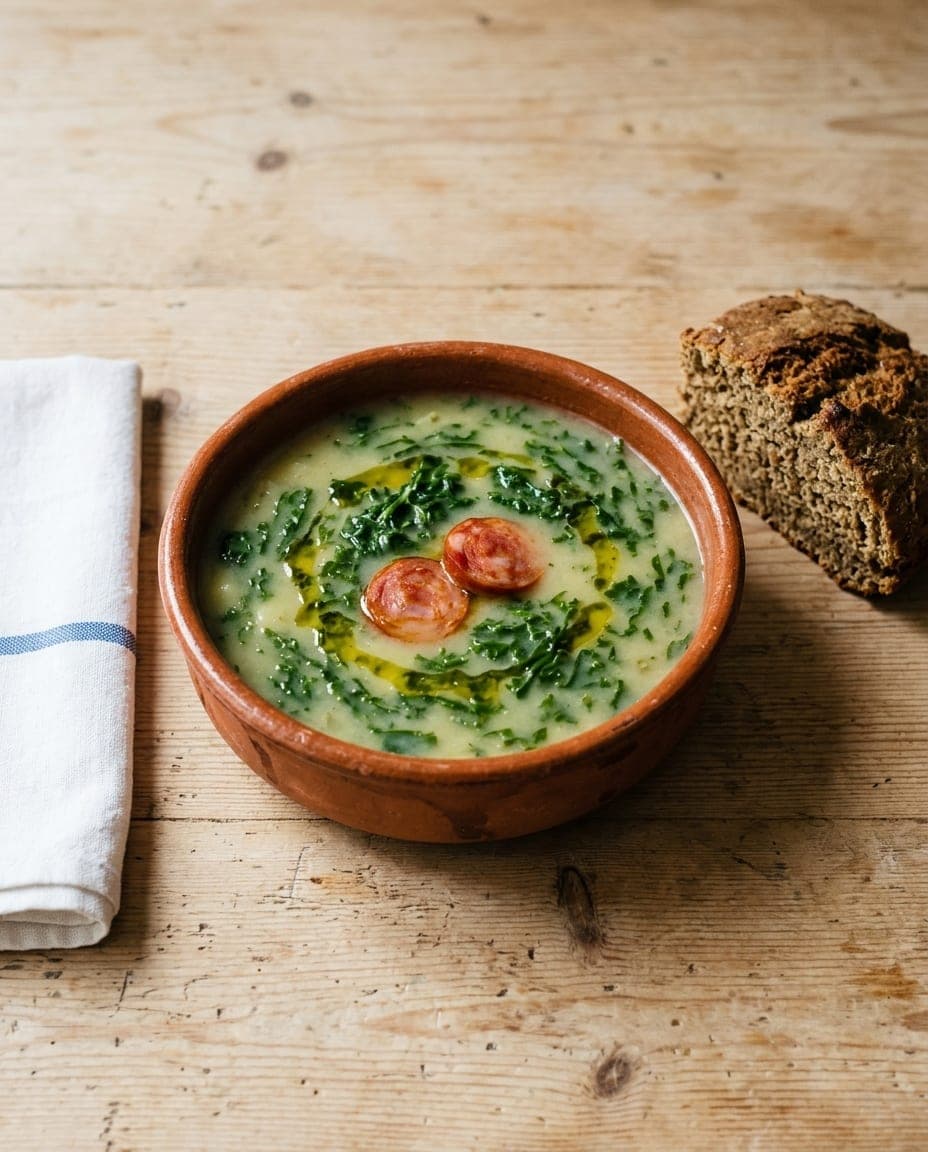
Caldo verde is the most recognised soup in Portugal, a dish that moves from the humblest kitchen table to the grandest wedding feast without losing its identity. Its name translates directly as "green broth", yet the liquid itself is often pale and creamy-looking, the green coming entirely from the kale added at the very end. It is a comforting mixture of potatoes and onions cooked until soft, then crushed or blended into a smooth base before being dressed with olive oil and a slice of smoked chouriço.
The soup originates in the Minho region, the northernmost part of Portugal bordering Spain, but it has become a national favourite. It is eaten across the whole country, from the coast to the interior mountains, yet its heart remains in the north. In Porto it is a fixture of the tascas, and the city gets through an extraordinary quantity of it on the night of São João, 23–24 June.
What defines it is texture and timing rather than complexity: potatoes cooked until they fall apart, onions for sweetness, and kale in at the last moment.
Where it comes from
The roots of caldo verde lie in the Minho, a region of steep valleys, vineyards and small family farms known as quintas. The green the dish needs is a leafy cabbage rather than a headed one. The variety is called couve galega or Galician kale, a plant with broad, dark green leaves that are tougher and more flavourful than common garden varieties.
In the past, this was the food of the rural working class, a way to stretch a small amount of meat into a meal that could feed a large family. The potatoes provided the bulk and the kale the colour and a faint bitterness. Over time, as people moved from the countryside to the cities, the soup followed them. It became a symbol of Portuguese identity, appearing on menus in Lisbon just as often as it does in Braga or Viana do Castelo.
It is now a fixture at weddings, birthdays and family celebrations, often served late in the evening, and it is on the menu of nearly every traditional restaurant in the country.
How it is made
There is no single official recipe, but the method follows a strict logic that has been passed down through generations. The cook begins by boiling potatoes and onions in water until they are completely soft. These ingredients are then crushed or blended to create a smooth, thick liquid. This step requires patience; if the mixture is too thin, it lacks body, but if it is too heavy, it becomes a stew rather than a soup.
Once the base is ready, the couve galega is prepared. The leaves are stripped from the stems and shredded as finely as possible. In professional kitchens, this is often done with a hand-cranked shredder, a tool sold specifically for this purpose, which creates shreds so thin they look like grass. This fineness is crucial because it allows the kale to cook in just two or three minutes. If the leaves are cut too thickly, they remain tough and bitter; if shredded correctly, they wilt instantly while keeping their bright green colour.
The soup is finished with a generous pour of extra virgin olive oil, which creates a shimmering layer on top, and a single slice of chouriço, a smoked pork sausage spiced with paprika and garlic, placed in each bowl. The heat of the soup warms the fat of the sausage and releases its aroma without melting it entirely.
What goes into it
The ingredients are few and distinct, each playing a specific role in the final balance:
- Potatoes, usually starchy varieties that break down easily to create a creamy texture without needing any dairy or flour.
- Onions, which provide the sweet, aromatic base for the soup.
- Olive oil, poured over the finished bowl, which is where most of the taste comes from.
- Couve galega, or Galician kale, shredded finely so it cooks quickly and retains its deep colour.
- Chouriço, a slice of smoked sausage that adds spice, salt and a smoky aroma to each serving.
The result is substantial without being heavy. The green comes from the kale alone, which goes in at the last moment; left in the pot it turns grey and bitter within minutes.
How to eat it
Caldo verde is usually served as a starter or a light main course, often accompanied by a slice of broa, a dense cornbread from the north that is perfect for dipping into the broth. The bread has a coarse texture and a slightly sour taste that contrasts well with the smoothness of the soup. A glass of Vinho Verde, the young, often lightly spritzy white wine from the same region, is the traditional companion. The acidity of the wine cuts the fat of the olive oil and potatoes.
It comes in individual bowls with the chouriço already in them. The slice of sausage tends to go first, then the soup, then the bread for what is left in the bottom.
Curious facts
- The green comes last. The kale is added only at the very end of cooking to ensure it stays bright green and does not turn brown or mushy.
- A tool for the job. Hand-cranked shredders are sold in Portuguese markets specifically for cutting couve galega into fine shreds, a task that is difficult to do by hand with large knives.
- No dairy involved. Despite its creamy appearance, traditional caldo verde contains no cream or milk; the texture comes entirely from the crushed potatoes.
- A festival staple. In Porto, the soup is eaten in large quantities during the São João festival on 23–24 June, often alongside grilled sardines and garlic bread.
- A national wonder. While it began in the Minho region, the soup is now found on menus in every part of Portugal, and in 2011 a public vote named it one of the Seven Wonders of Portuguese Gastronomy.
Where to try it
The best place to eat caldo verde is a traditional tasca in Porto or any small tavern in the Minho region. These are unpretentious establishments where the focus is on the food rather than the decor. In Porto the taverns around the Ribeira serve it all day, and more of it after dark.
The São João festival on 23–24 June is when the city eats most of it, late and standing up, between the sardine grills. Broa and a glass of Vinho Verde are the rest of the order.
Where to try it
2 regions
 Wine Tasting12 destinations
Norte
Norte is the largest region in Portugal, known for its diverse landscapes ranging from rugged mountains to a stunning coastline. Porto, the region's main city, is famous for its port wine and historic Ribeira district, while towns like Guimarães and Braga boast rich medieval history and architecture. The Douro Valley, a UNESCO World Heritage Site, offers breathtaking views and opportunities to explore terraced vineyards. Unique cultural festivals, such as the Festa de São João in Porto, showcase local traditions. The region is also noted for its traditional cuisine, including dishes like francesinha and regional cheeses. Nature lovers can hike in the Peneda-Gerês National Park, experiencing the region’s natural beauty away from the crowds.
Wine TastingHikingBoat RentalsCamper Van Rentals Wine Tasting4 destinations
Vinho Verde
This northern region is renowned for its lush vineyards and the production of Vinho Verde, a unique, lightly effervescent wine. It is the largest wine-producing region in Portugal, characterized by rolling hills and a temperate climate. Notable towns include Amarante, with its picturesque bridge and historic buildings, and the coastal town of Esposende, known for its beautiful beaches. The area also features the Peneda-Gerês National Park, a haven for hikers and nature lovers. Visitors can explore traditional festivals such as the Festa de São João in Porto, which showcases local culture and cuisine, including fresh seafood and regional cheeses. Vinho Verde is not just a wine; it's a way of life here, making the region a rich tapestry of experiences beyond the typical tourist path.
Wine TastingHiking