Bifana
Garlicky pork steak in a soft roll
- Local name
- Bifana
- Served with
- Mustard
- Best eaten at
- A Lisbon tasca
- Pairs with
- Cold draught beer (imperial)
What it is
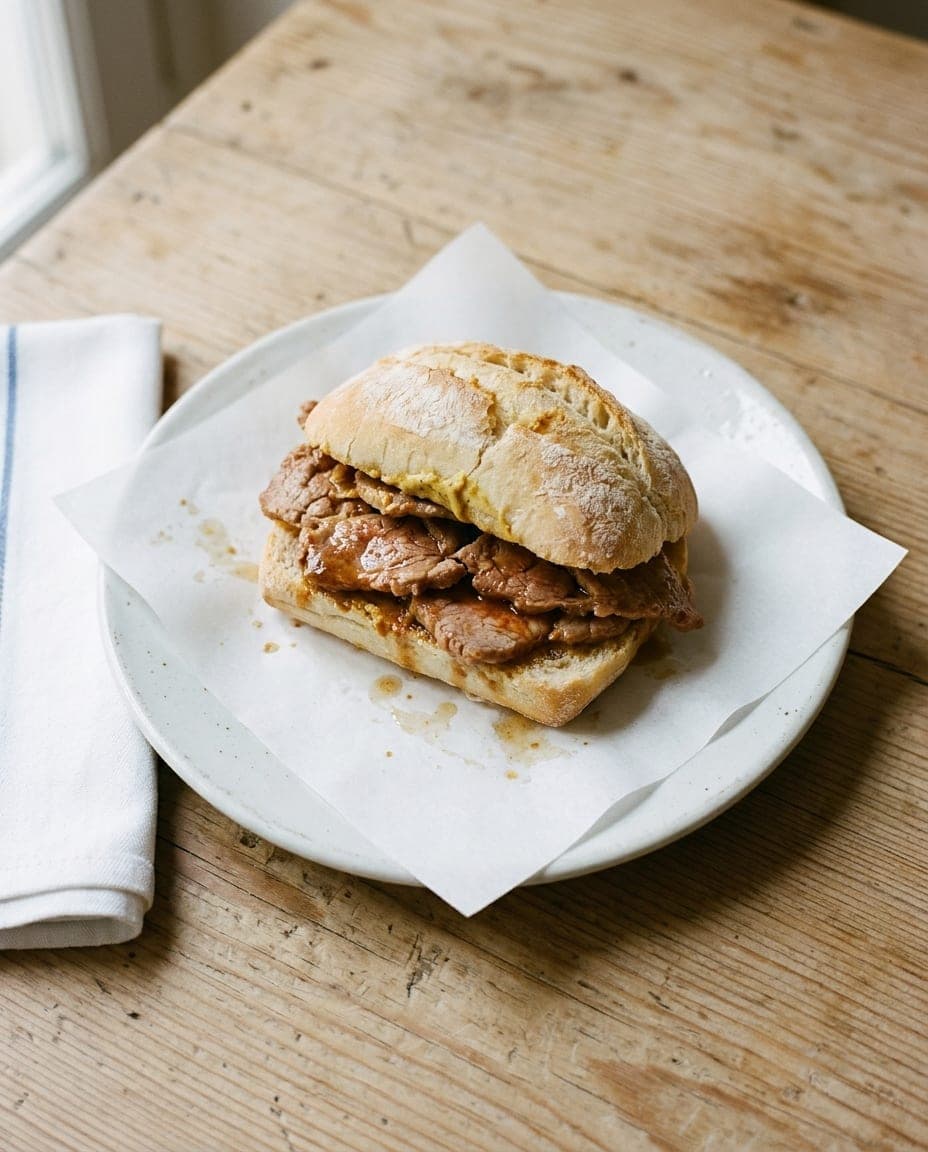
The bifana is the most straightforward answer to hunger that Portugal offers. It is a pork sandwich consisting of thin slices of pork steak, known locally as bifanas, marinated in garlic, white wine, bay leaves and paprika, then simmered in the same liquid until soft and tender. The meat is usually not grilled; it is cooked in the liquid so that it absorbs the flavours of the marinade without losing its texture. These slices are piled into a papo-seco, a plain Portuguese roll with a crisp crust and a soft interior, often doused with a spoonful of the hot cooking juices to keep the bread from drying out.
There is no pretence about the dish. It is not an appetiser meant to be nibbled slowly, nor a heavy meal for a formal dinner. It is counter food, designed to be eaten quickly while standing at a bar or walking down a street. The result is a warm, garlicky, savoury bite that feels like comfort in its simplest form. While the bifana is found in towns across the country, it is most closely associated with Lisbon and the surrounding areas, where it has become a staple of local life.
The history of the simmered pork
The origins of the dish are not tied to a single inventor or a specific date, but rather to the practical needs of Portuguese working life. The method of marinating thin slices of meat in garlic and wine before cooking them in the same liquid appears to have evolved from rural traditions where preserving the softness of cheaper cuts of pork was essential. In Portugal, the technique of slow-cooking meat in its own fat or a light broth is common, and the bifana is a refined version of this everyday practice.
Unlike many other national dishes that claim ancient roots, the bifana does not carry a specific legend of kings or monks. It simply exists as a reliable solution to hunger. The name comes from bife, the word for a steak, and is usually glossed as 'small steak': the thin slices gave the sandwich its name.
The evolution of the dish reflects the changing face of Portuguese dining. In the past, it was primarily a meal for labourers and travellers stopping at roadside inns. Today, while it remains popular in those settings, it has also become a fixture in urban centres, where it is served alongside other quick bites in busy city districts. The simplicity of the recipe has allowed it to remain consistent, even as the surrounding food culture has shifted towards more elaborate offerings.
Regional variations across Portugal
While the core concept remains the same, the bifana adapts to local tastes depending on where it is made. In Lisbon and the Tagus Valley, the version is typically simpler, almost minimalist. The marinade relies heavily on garlic and white wine, with a gentle touch of paprika that adds colour rather than heat. There is less sauce, the roll stays drier, and a touch of mustard is added by those who want it.
In the north, particularly around Porto, the style shifts. The bifana here is saucier and spicier: the pork is cooked briefly in a sauce sharpened with chilli or piri-piri to the house's taste, and the roll is left to soak it up. Mustard is a common addition here too. This variation reflects the northern preference for bolder flavours.
Further south, in the Alentejo region, a specific town known as Vendas Novas has developed its own reputation. Here, the bifana is often sold in large quantities to passing traffic, with thicker meat and a heavier, longer-cooked sauce. The town sits on the EN4, the old main road east from Lisbon, and the trade grew out of drivers stopping on the way through; the portions are built accordingly.
What goes into it
The ingredients are few and specific, with each playing a clear role in the final result:
- Pork steak, cut very thin to ensure quick cooking and tenderness.
- Garlic, used in generous quantities to provide the dominant flavour.
- White wine, which acts as the base for the marinade and helps tenderise the meat.
- Bay leaves and paprika, adding subtle aromatics and colour without overpowering the garlic.
- A papo-seco roll, a plain bread with a crisp crust that holds up to the juices.
- Mustard, often served on the side or added directly.
There is no sauce beyond the cooking liquid, so everything rests on the marinade and the pork. Done properly the meat gives under a fork and still holds together in the roll.
How it is eaten
The bifana is best enjoyed at a traditional Portuguese tavern, known as a tasca. These are small, often unassuming establishments where the focus is on the food and the drink rather than the decor. The sandwich is typically served hot, straight from the kitchen, and eaten immediately while standing at the counter or sitting on a simple stool.
The drink is an imperial — in Lisbon, a small glass of draught lager; in Porto the same measure is called a fino. It is drunk standing, with the sandwich in the other hand.
Pickles sometimes come with it. An extra ladle of the cooking juice over the bread is the usual request, and no cutlery is involved.
Curious facts
- Not breaded. The pork is never coated in breadcrumbs or flour before cooking. It is simply marinated and simmered, unlike the prego, which is a beef steak sandwich.
- A standing meal. The bifana is traditionally eaten while standing at the bar, reflecting its origins as a quick bite for workers and travellers.
- The roll matters. A papo-seco has a specific texture; using a softer or sweeter bread can change the entire experience of the dish.
- Mustard is optional. It is added in Lisbon and Porto alike, but in both the garlic and wine do most of the work.
- A national staple. Despite its simplicity, the bifana is found in almost every town in Portugal, from the capital to the smallest village.
Where to try it
The best place to eat a bifana is at a traditional tasca in Lisbon or Porto. In Lisbon the small taverns around the markets and in Alfama sell them from early morning; in Porto they are in the Ribeira and the streets behind it. Vendas Novas, on the old EN4 road east of Lisbon, built its reputation on them and its cafés still sell them to passing traffic by the thousand each day.
The ordinary ones are good. There is no reservation, no wait, and the whole transaction takes four minutes.
Where to try it
1 region
 Wine Tasting3 destinations
Lisbon
Lisbon, Portugal's capital, is a vibrant city known for its rich maritime history and unique architectural styles, including Manueline and Pombaline. It is situated on the edge of the Atlantic Ocean, making it the only capital city in Western Europe with a coastline. The Alfama district, with its narrow winding streets, offers a glimpse into the city's Moorish past, while the Belém area is home to the iconic Jerónimos Monastery. Off the beaten path, the neighborhood of Graça provides stunning viewpoints and local eateries. The region also hosts local festivals, like Festas de Lisboa, celebrating culture and tradition throughout June. Lisbon's proximity to the Sintra mountains allows for scenic hikes and exploration of palaces, making it a multi-faceted destination for those looking to explore at a leisurely pace.
Wine TastingHikingCamper Van RentalsBoat Rentals