Goldwasser (Gdańska wódka)
A Gdańsk herbal liqueur with gold flakes
- Alcoholic
- Local name
- Goldwasser
- Served
- Chilled, in a small glass
- Best eaten at
- A Gdańsk old-town restaurant
What it is
Goldwasser, sometimes called Gdańska wódka in Polish, is a clear herbal liqueur distinguished by flakes of genuine gold leaf suspended within the liquid. It originates from Gdańsk, a port city on the Baltic coast in the Pomerania region, where it was first made around 1598. The gold flakes are a leftover from the merchant city, where visible wealth in a bottle made commercial sense.
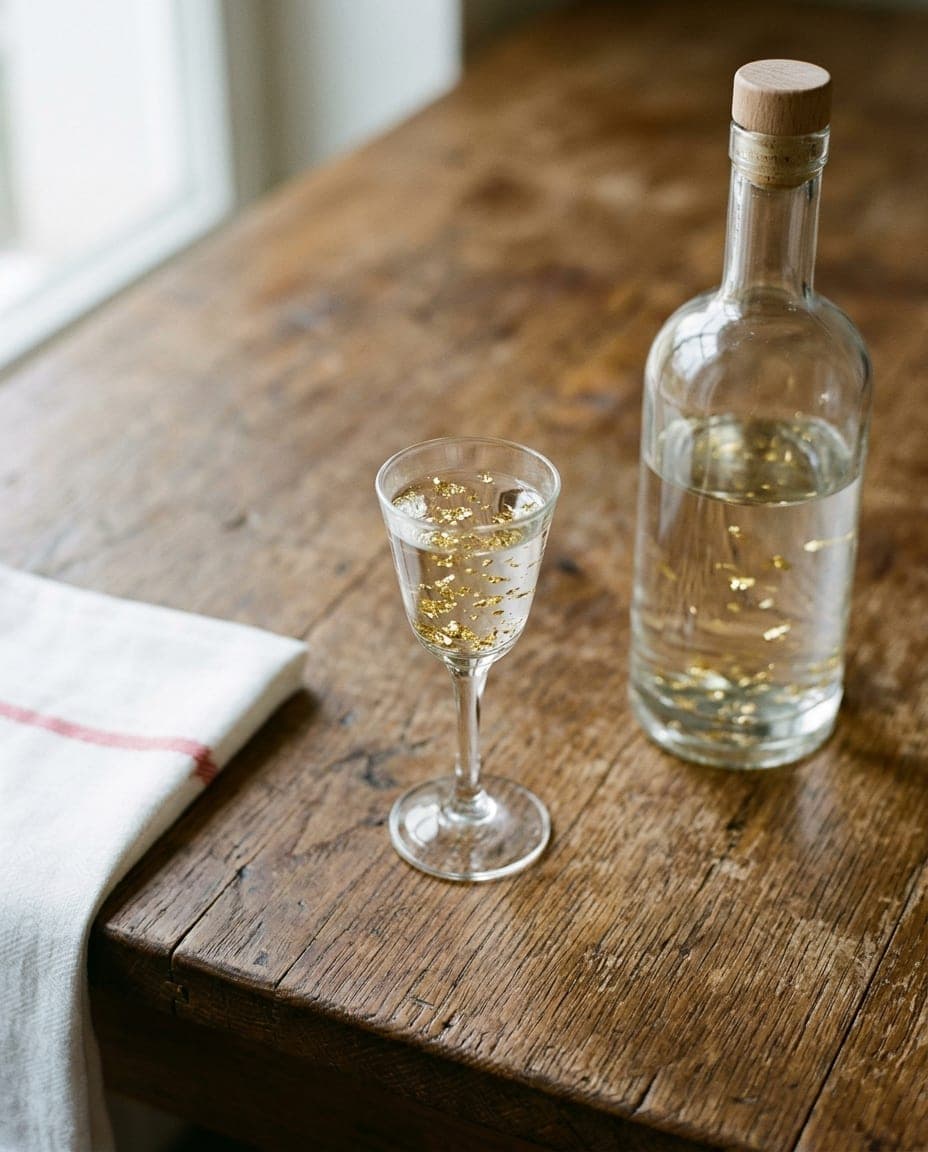
The liqueur presents a striking contrast between its unassuming appearance and its opulent contents. It is a transparent spirit, yet it shimmers with tiny flakes of 23-carat gold when held up to the light. These flakes are not merely decorative; they are said to have been added on the belief that gold possessed medicinal properties, a notion rooted in the alchemical traditions of the era. Today, the gold remains purely symbolic and safe for consumption, serving as the drink's most memorable feature.
The history of Gdańsk's golden spirit
The origins of Goldwasser are tied to the height of Gdańsk's prosperity during the late 16th century. At this time, the city was one of the richest ports on the Baltic Sea, a central node in the Hanseatic trade network that connected northern Europe. It was within this environment of merchant wealth and international exchange that Goldwasser appeared. It is credited to Ambrosius Vermöllen, a Mennonite distiller from the Low Countries who became a citizen of Gdańsk in 1598, the date most commonly cited. In 1704 his descendants moved the business to a house on Szeroka Street (Breitgasse) whose sign showed a salmon, and the liqueur became known as Der Lachs, "the salmon".
The inclusion of gold in the recipe reflects the alchemical beliefs common among European apothecaries and distillers of the period. It was thought that ingesting small amounts of gold could improve health and longevity. While modern science dismisses these claims, the custom persisted for centuries, transforming a medicinal notion into a distinctive regional speciality. The liqueur became a symbol of Gdańsk's affluence, a drink fit for the city's merchants and dignitaries.
After the Second World War, when Danzig became Gdańsk and its German population was expelled, production in the city stopped; the company's Berlin branch, opened in 1922, carried on, and since the 1970s Danziger Goldwasser has been made in Lower Saxony in Germany. The salmon house in Gdańsk was rebuilt but no longer distils. Despite this shift in manufacturing, the drink remains closely associated with its Gdańsk roots, and Polish producers sell similar gold-flecked liqueurs in the city today.
The ingredients and the gold
The composition of Goldwasser is a complex blend of botanicals, though no single official formula is public and the original 16th-century recipe has not survived. It is a sweet, slightly syrupy herbal liqueur of around 40% alcohol, built on herbs, spices and roots. Spices such as cardamom, cinnamon, cloves and coriander lead, with herbs like thyme and lavender and a touch of juniper providing a subtle, warm complexity beneath the surface.
The defining element, however, is the gold leaf itself. Real gold is beaten into extremely thin sheets and then chopped into microscopic flakes that are suspended in the clear liquid. These flakes do not dissolve; they remain intact within the spirit. The bottle is typically shaken before pouring to encourage the flakes to swirl and create a mesmerising effect. This motion ensures that the drinker sees the gold moving through the glass, adding a visual drama to the tasting experience.
The gold is entirely harmless. The flakes are inert, and they are in the bottle for the look and for the old belief rather than for any taste. The safety of the gold leaf has been a subject of curiosity for centuries, and it remains a key part of the drink's identity.
How to drink it
Goldwasser is traditionally served chilled, in a small glass. The cold temperature helps to settle the liquid slightly and enhances the clarity of the gold flakes as they drift through the spirit. It is not a drink meant for sipping slowly over hours; rather, it is usually taken as a digestif after a meal.
The customary setting for enjoying Goldwasser is a restaurant in Gdańsk's old town. In these historic venues, the liqueur is often presented as part of the post-meal ritual. The small glass allows the drinker to appreciate the swirling gold before drinking. It is rarely used as a cocktail base or an aperitif; its usual role is that of a concluding beverage, a sweet and spiced end to the dining experience.
The spirit has long had a wider audience across Europe; Catherine the Great is said to have bought it in quantity in 1767. However, its most authentic context remains the historic port city where it was first distilled. The ritual of shaking the bottle and watching the gold settle is part of the anticipation before the first sip.
Curious facts
- The gold is real. The flakes in Goldwasser are genuine 23-carat gold leaf (food additive E175), not a synthetic coating or food colouring. They are safe to eat but provide no nutritional value.
- A medicinal origin. The addition of gold is traditionally explained by the belief that it possessed healing properties, a common idea in early modern alchemy and medicine.
- Shaking the bottle. The flakes do not dissolve; they must be shaken to create the swirling pattern before pouring. This motion is a standard part of serving the drink.
- A post-war shift. Made in Gdańsk from around 1598, the original Danziger Goldwasser moved to Germany after the Second World War displaced the local producers.
- A regional speciality. The liqueur is strongly tied to Pomerania and the city of Gdańsk, rather than being a national Polish drink found everywhere.
- The small glass tradition. It is served in a small glass as a digestif after a meal.
Where to try it
The most authentic experience of Goldwasser is found in the old town of Gdańsk, where the drink was born more than four centuries ago. A traditional restaurant in this historic district offers the proper setting for the liqueur, often serving it alongside other regional specialities.
Visitors to Gdańsk will find Goldwasser on the menus of many establishments that focus on local heritage. It is a drink that invites conversation about the city's past and its enduring traditions. While it can be found in other locations, the experience is most complete when enjoyed in the port city where it was born. The combination of the historic setting and the shimmering liquid creates a moment that feels both timeless and distinctly local.
Where to try it
1 destination
 Boat Rentals
Gdansk
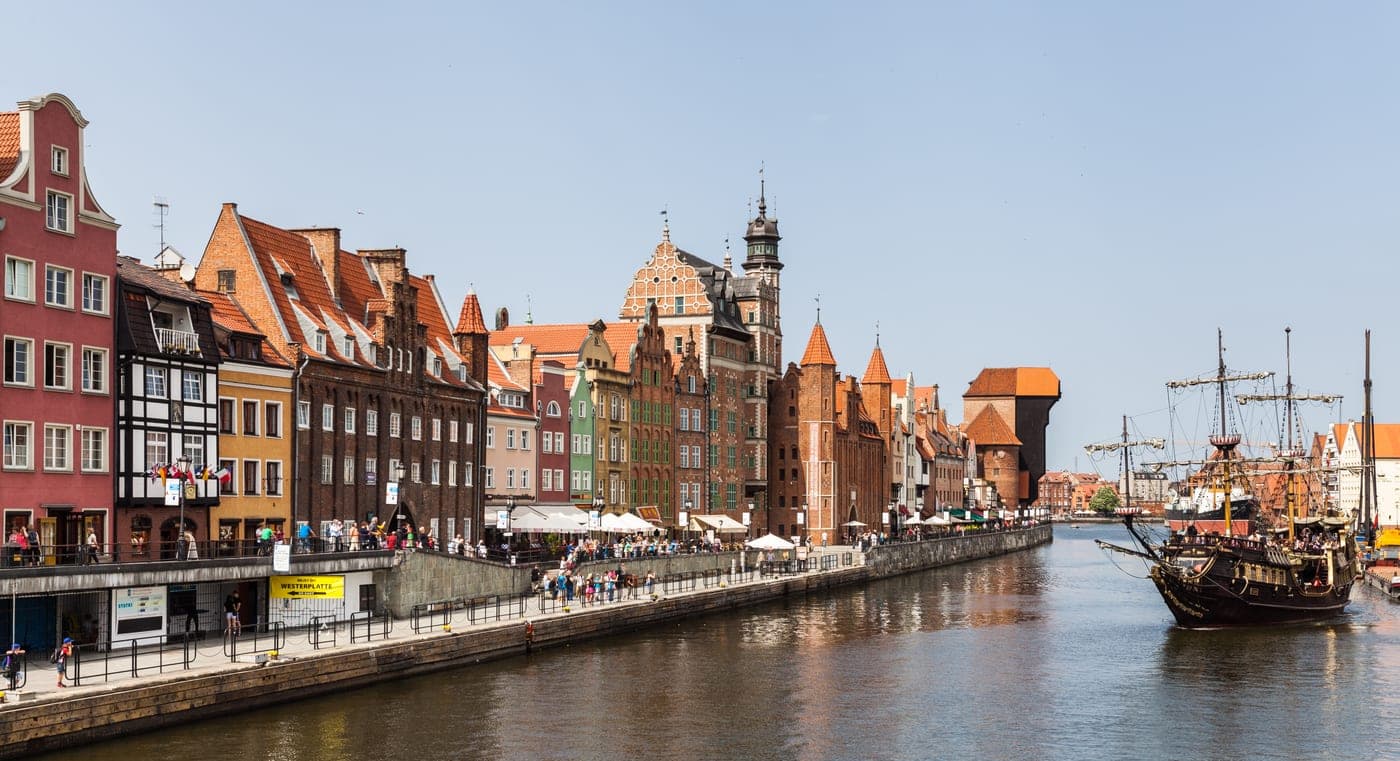
Historic Hanseatic city rebuilt after WWII with stunning old town.
Boat RentalsHiking
1 region
 Boat Rentals4 destinations
Pomerania
Pomerania stretches along Poland's only sea coast, from the brick gables of Gdańsk to the pine forests and lake country further inland. The pace here follows the water and the season: fishing boats going out at dawn, amber traders setting up their stalls, wooden chairs filling the promenade cafés as the light turns gold in the evening. It is a region built for slow movement, with old town cores small enough to know by foot and a landscape that rewards attention rather than speed. Gdańsk sits at the heart of it, a Hanseatic port whose merchant houses, granaries and long waterfront still trace the shape of a medieval trading city. Its streets open onto the Motława river, where grain barges once queued and where cafés now spill onto the cobbles. A short distance along the coast, Sopot keeps a different rhythm: a wooden pier reaching into the Baltic, spa villas from the belle époque, and a beach that fills slowly through the day rather than all at once. Gdynia, younger and built largely in the interwar decades, shows a different Pomerania again — clean modernist lines, a working harbour, and a seafront that mixes cargo ships with sailing boats. Inland, the region softens into Kashubia, a landscape of lakes, birch groves and villages where wooden architecture and folk crafts have survived largely intact. Painted furniture, embroidery and lace are still made here in small workshops, often in the same families for generations. The land rises gently into a range of low hills known locally as the Kashubian Switzerland, a name that says more about local pride than actual altitude — but the effect, with lakes appearing between wooded ridges, is genuinely striking. Wooden churches, some dating back centuries, stand in villages across this belt of countryside, their dark shingled roofs and plain interiors a quiet counterpoint to the brick grandeur of the coastal cities. The coast itself has its own slow attractions. West of Gdańsk, the Hel Peninsula narrows to a thin strip of dunes and pine, with fishing villages that still land herring and cod each morning. Further west, Słowiński National Park protects a belt of shifting sand dunes, some tall enough to bury trees, pushed steadily inland by wind off the Baltic. Between the dunes and the sea, lagoons and reed beds shelter a variety of birdlife, and the whole stretch feels closer to a desert than to a typical northern coastline. Market squares across Pomerania's smaller towns — Kartuzy, Kościerzyna, Puck — keep a rhythm built around weekly markets, church bells and the changing light off nearby lakes or the sea. Food here leans on what the coast and forests provide: smoked fish sold straight from the smokehouse, dumplings filled with blueberries or mushrooms, and rye bread served everywhere from village bakeries to city cafés. Amber, washed up on Baltic beaches for centuries, is worked into jewellery in workshops that still line Gdańsk's old streets, a craft as tied to the region as the fishing itself. What ties Pomerania together is this contrast held in balance: Hanseatic brick against wooden village churches, open sea against quiet inland lakes, a working harbour against a folk-art tradition that has barely changed. Towns are close enough to link into a single, unhurried route, yet distinct enough that each one adds something the last did not — a port, a spa town, a lake, a stretch of dune. It rewards a traveller willing to slow down to the region's own pace: to sit with a coffee by the Motława, walk a pier at low tide, or watch a Kashubian potter shape clay the same way it has been shaped here for generations.
Boat RentalsHikingLocal Cuisine