Gorgonzola
Two distinct blue cheeses from Lombardy and Piedmont, one creamy and sweet, the other sharp and firm
- Local name
- Gorgonzola DOP
- Served with
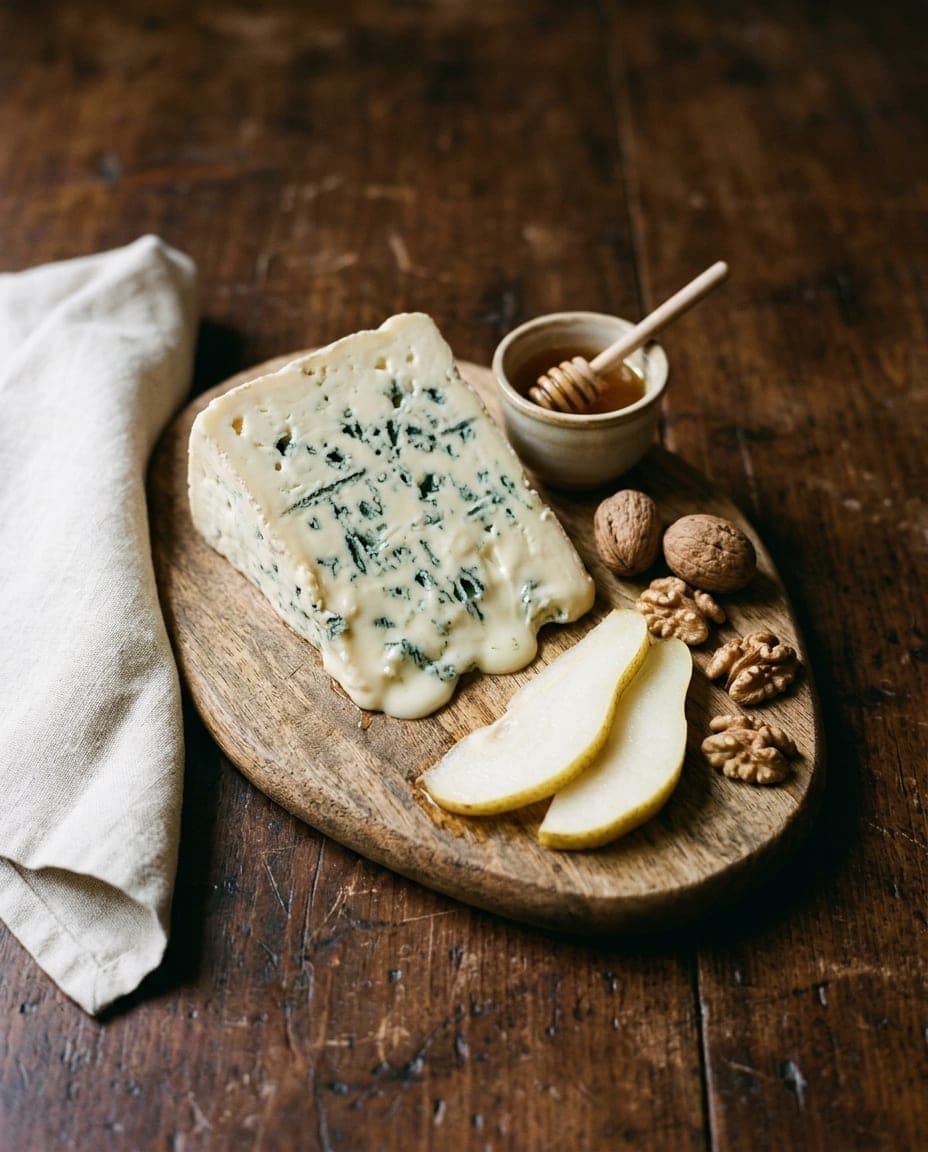
- Polenta, pears, walnuts, honey
- Best eaten at
- A Lombard osteria
- Pairs with
- Passito or Barolo
What it is
Gorgonzola is a blue cheese made from cow's milk in the regions of Lombardy and Piedmont, north-west Italy. It takes its name from the small town of Gorgonzola, just outside Milan, historically the most famous centre of its production. The cheese exists in two distinct forms: Gorgonzola dolce, which is younger, soft and creamy, and Gorgonzola piccante, which is aged longer, firmer and sharper. Both share the characteristic blue-green veining, yet they offer entirely different experiences on the palate.
Dolce is matured for a minimum of 50 days. It remains soft enough to be spread with a spoon, with pale greenish-blue veining running through a buttery white paste. The flavour is mild, slightly sweet and earthy, with a gentle tang. Piccante is matured for at least 60 to 80 days depending on the size of the wheel, often considerably longer. It loses its creaminess and becomes firmer and more crumbly, while the veining becomes denser and darker. Its taste is intense, salty and sharp, with a lingering, pungent finish.
Both types carry the Protected Designation of Origin (DOP), first granted as a national designation in 1955 and registered at EU level in 1996. The production area covers several provinces of Lombardy and Piedmont, including Milan, Bergamo, Como, Pavia, Novara, Vercelli and Cuneo, together with some municipalities around Casale Monferrato. Historically the cheese was known as stracchino di Gorgonzola and later stracchino verde, after the stracche (tired) cows returning from summer pastures.
The legend of the distracted cheesemaker
The origins of Gorgonzola are wrapped in folklore. Some accounts date its first making to the year 879; others place its birth in Pasturo, in the Valsassina. One popular legend tells of a cheesemaker who left the curd hanging overnight, distracted (in some versions by love), and the next morning mixed it with fresh curd to hide his mistake. The two curds did not bind perfectly, mould developed in the gaps, and the result was a cheese with blue veins and a new, complex flavour.
None of these stories can be documented, and the modern production method is precise and controlled. The legend remains a popular way to explain the veining, and a reminder that great food is often credited to happy accidents.
How it is made
Production begins with pasteurised cow's milk, to which lactic ferments and spores of Penicillium mould are added. The milk is then coagulated with calf rennet. Once the curds are formed and drained, they are placed into moulds to take shape as wheels, then salted.
After three or four weeks, the wheels are pierced with long metal needles from both faces. These channels let air into the interior of the cheese, and the oxygen allows the mould already present in the paste to grow into veins. Without the piercing, the blue would barely develop.
The ageing then diverges according to type. Gorgonzola dolce develops a soft, spreadable texture and a mild flavour, with pale veins. Gorgonzola piccante matures for longer, losing moisture and becoming firmer and drier, while the veins deepen in colour and the flavour intensifies. Throughout, the wheels are turned regularly in cool, humid cellars.
What goes into it
The ingredients in Gorgonzola are simple, yet the transformation is complex.
- Cow's milk: from herds in the production area of Lombardy and Piedmont.
- Lactic ferments: start the acidification of the milk.
- Penicillium spores: added to the milk and encouraged to grow by piercing the wheels.
- Calf rennet: used to coagulate the milk, which means the cheese is not suitable for vegetarians.
- Salt: applied to the surface of the wheels in the early days to control moisture and develop flavour.
The difference between the two types lies not so much in the ingredients as in the time allowed for the mould to work and the cheese to dry.
How it is eaten
The way Gorgonzola is served depends on which type is chosen. A young Gorgonzola dolce is often spread on warm, crusty bread. Its creamy texture makes it ideal with sweet elements that balance its saltiness: honey, particularly acacia or chestnut, along with fresh pears, figs or walnuts.
Gorgonzola piccante, with its sharper bite, suits a robust cheese board or cooking. It is used in sauces for pasta, such as pasta al gorgonzola, and in risottos, melting into a creamy sauce with a sharp tang. It is also a classic partner for polenta, which offers a neutral base for the intense flavour.
The choice of drink matters too. For dolce, a sweet passito works well, or a light red that does not compete with the cheese. Piccante demands more structure: a full-bodied Nebbiolo-based red such as Barolo can stand up to its intensity.
Curious facts
- Two cheeses in one name. Dolce and piccante differ in texture, age and flavour, not just in intensity.
- The piercing technique. The blue veins in modern Gorgonzola are the result of mould added to the milk and deliberate needle piercing.
- A regional boundary. Although the name comes from a town near Milan, the protected designation covers a wide area across Lombardy and Piedmont.
- An old name. Before it was simply called Gorgonzola, the cheese was sold as stracchino verde, the "green stracchino".
Where to try it
The most rewarding way to taste Gorgonzola is near its production areas in Lombardy and Piedmont, where local markets and cheese shops sell wheels at different stages of maturity. The province of Novara, in Piedmont, where the producers' consortium is based, is a good place to start.
A Lombard osteria, a traditional tavern serving simple, hearty food, offers the best context for tasting the cheese: dolce served with honey and walnuts on rustic bread, or piccante melted over polenta or pasta. While the cheese is sold in supermarkets worldwide, tasting it close to its source shows how much a well-kept dolce or a long-aged piccante can differ from an exported wedge.
Where to try it
2 destinations
 Wine Tasting
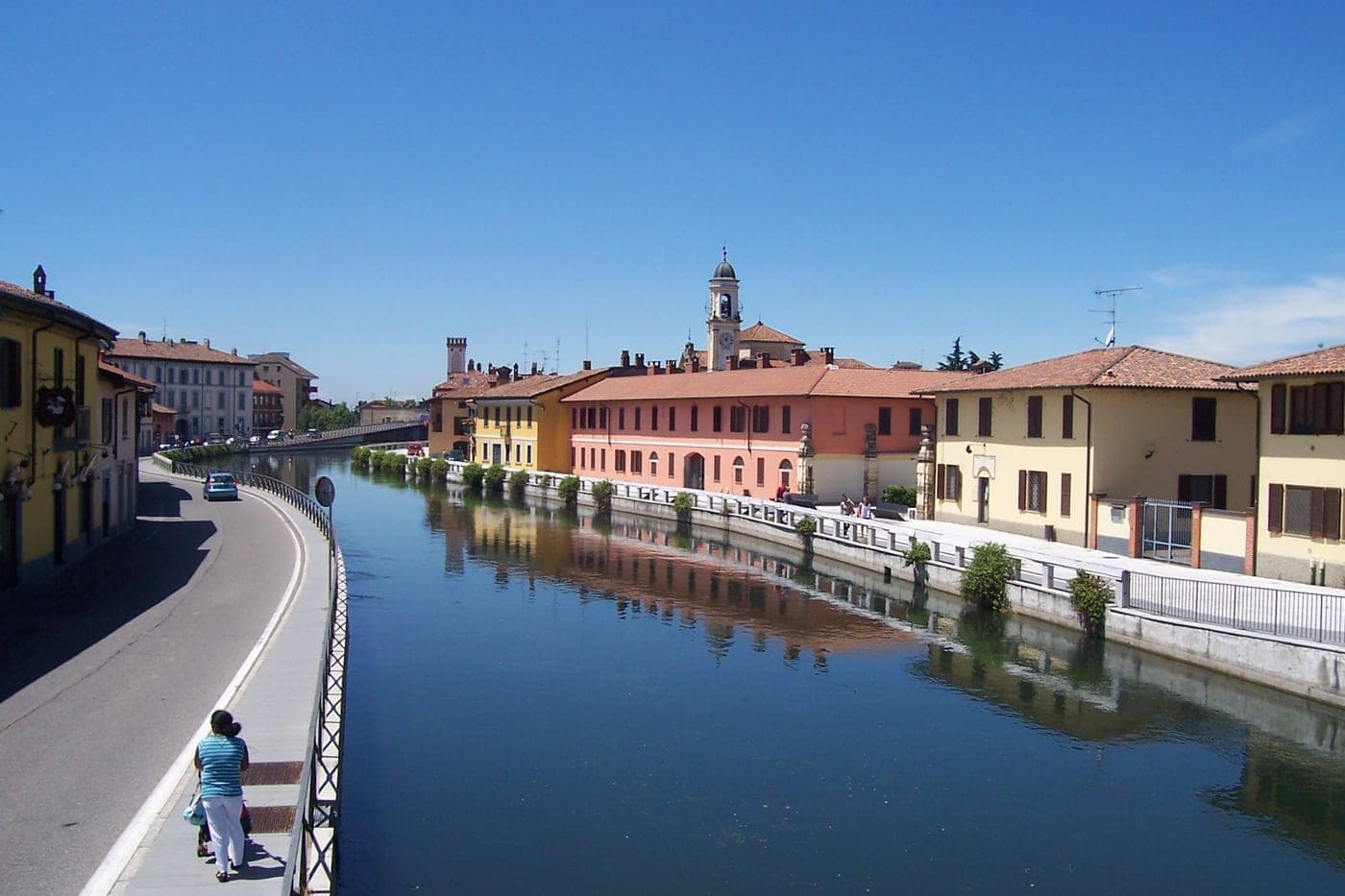
Gaggiano
Town near Milan with access to Lombardy wine routes and rural estates.
Wine Tasting
1 region
 Boat Rentals12 destinations
Lombardy
Lombardy runs from Alpine peaks in the north down to the flat rice fields of the Po valley in the south, and this range sits behind almost everything the region does well for slow travel. Milan anchors it as a capital of fashion and finance, but the quieter pace that draws travellers who like to slow down lives outside the city, spread across lake villages, hill towns, and wine roads that ring it on every side. Lombardy rewards a traveller who picks one valley, one lake shore, or one wine road and stays with it rather than trying to cover the whole region at once. Lake Como is one of Lombardy's most recognisable landscapes, its stone villages stacked against steep slopes and its old villas opening their gardens to the water. Bellagio, Varenna, and Menaggio each keep a small working harbour where boats still connect the shoreline settlements. Further east, the region also touches the western shore of Lake Garda, where towns like Sirmione sit on a narrow peninsula with Roman ruins at its tip, and Lake Iseo sits quieter still, ringed by Franciacorta's vineyards on one side and Monte Isola, the largest lake island in southern Europe, on the other. Between the lakes, the Brianza hills and the lower Alpine valleys hold smaller villages built around a single church square, a mill, or a market that still runs on its traditional day, largely untouched by the crowds that gather on the main lake shores in summer. Wine gives the region another rhythm, and Lombardy's wine roads are built for slow exploring rather than a single tasting stop. Franciacorta, in the hills east of Brescia, produces Italy's best-known sparkling wine made in the traditional method, and its cellars sit among vineyards that climb gently toward Lake Iseo, many open for visits by appointment. Further south, the Oltrepò Pavese hills near Pavia grow both still and sparkling wines on slopes that agriturismo farms have worked for generations, offering rooms and meals built around what the land produces that season. In the far north, the Valtellina valley grows Nebbiolo on narrow terraces held up by dry stone walls, alongside the mountain cheeses and cured meats the valley is known for; the Strada del Vino e dei Sapori della Valtellina links the terraced vineyards to the villages and cellars below them. The hill towns carry this same unhurried character. Bergamo's upper town, the Città Alta, sits behind a ring of stone walls built by Venice when the city belonged to its inland territories; inside them, narrow lanes lead to a Renaissance chapel and a quiet main square that empties out once the day-trippers head back down. Mantua, ringed by three artificial lakes, kept its Gonzaga-era palaces and squares largely intact and shares a joint UNESCO listing with the smaller fortress town of Sabbioneta, built from scratch as an ideal Renaissance city. Cremona, on the Po plain, has built violins since the Amati and Stradivari workshops opened there, and the craft continues in small workshops around its cathedral square. Pavia, a university town south of Milan, holds a Carthusian monastery on its outskirts whose carved marble façade is one of the region's finest. Smaller villages such as Clusone in the Val Seriana or Gromo, with its old ironworking streets, keep the same rhythm on a smaller scale, each built around a single square, a mill stream, or a covered market. Food ties all of this together, and it is where Lombardy's slow food traditions show clearest. The region cooks with butter and rice rather than the olive oil of the south: risotto alla milanese, coloured with saffron, is the signature dish, while polenta remains a staple in the mountain valleys, often served alongside stewed meat or local cheese. Grana Padano is made across much of the Po plain, and the mountain dairies of Valtellina produce their own aged cheeses, including Bitto and Casera. Markets in the smaller towns still run on a weekly schedule, selling produce grown within a short distance of the stall, and many agriturismo farms across Oltrepò Pavese and Franciacorta serve meals built entirely from what they grow or raise themselves. Landscape and table hold Lombardy together: a lake village built around its harbour, a wine road that climbs from valley floor to ridge line, a hill town that keeps its own pace once the tour groups leave. The towns and wine roads below each hold a different piece of this pattern, from the Renaissance squares of Mantua to the terraced vineyards of the Valtellina, and together they map out a version of Lombardy built for slow travel rather than a checklist of sights.
Boat RentalsWine TastingHikingCamper Van Rentals





