Schwarzwälder Schinken (Black Forest ham)
Dry-cured, cold-smoked ham from Germany's Black Forest
- Local name
- Schwarzwälder Schinken
- Served with
- Farmhouse bread, butter
- Best eaten at
- A Black Forest Vesperstube
- Pairs with
- Baden Pinot Noir
What it is
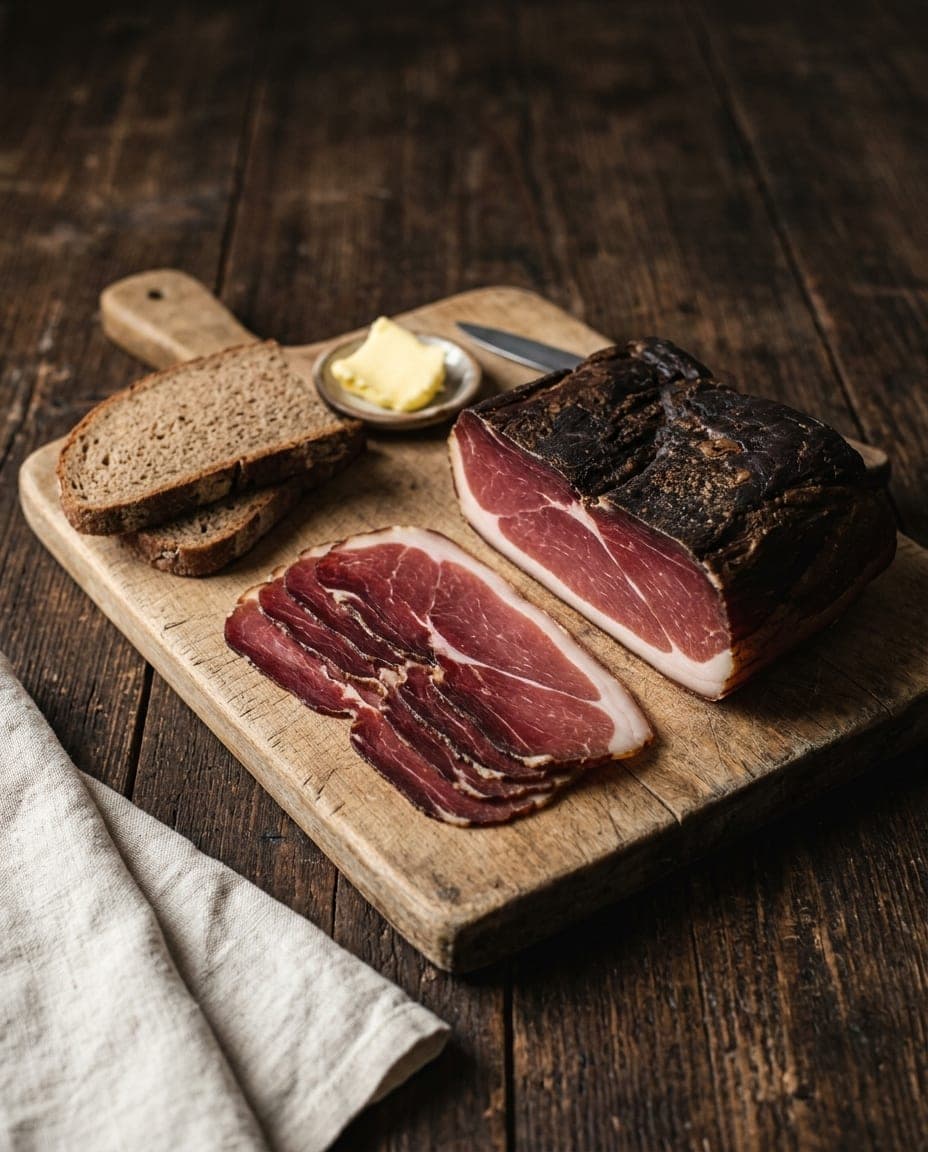
Schwarzwälder Schinken, the Black Forest ham, is a dry-cured, cold-smoked ham that comes specifically from the Black Forest region in the south-west of Germany. It is not simply a type of ham found anywhere in the country; its identity is tied to the geography of Baden-Württemberg and the method used to cure it. The result is a boneless piece of pork with an almost black, resinous exterior and deep red meat inside.
The texture is firm yet tender, and the flavour is defined by the smoke rather than just salt or spices. Unlike hams from Italy or Spain that are dried in the air alone, this ham undergoes a slow cold-smoking process over fir wood. The smoke penetrates the meat, giving it a distinct, resinous aroma that lingers on the palate. It is a product of the forest itself, where the trees provide the fuel for the smoke.
The ham is typically served cold, sliced very thinly to allow the fat and meat to soften slightly in the mouth. Instead of being cooked, it forms the heart of a traditional cold meal known as a Vesper. This practice turns a simple piece of cured meat into a ritual of eating that connects the diner to the rural traditions of the region.
The method behind the black exterior
The identity of Schwarzwälder Schinken lies in its method. The process begins with boneless cuts from the hind leg of the pig, which are rubbed by hand with salt and spices. While every producer may have their own variation, the classic seasonings are juniper berries, coriander, black pepper and garlic. These are rubbed into the meat and infuse the flesh during the curing phase.
After the salting, the ham is left to cure for several weeks at cool temperatures. During this time, the salt draws out moisture while the spices penetrate the muscle fibres. The crucial step follows: cold smoking. Unlike hot smoking, which cooks the meat, cold smoking takes place at a low temperature, around 25 °C, using smoke from fir wood and fir brushwood, and lasts at least a week. This resinous softwood smoke gives the ham its characteristic dark colour and flavour. The black exterior is not the result of a heavy spice rub or soot, but of smoke accumulating on the surface over time.
Once the smoking phase is complete, the hams mature further, so that the whole process takes at least three months. This long maturation concentrates the flavours and creates a texture that is firm but not hard. The final product keeps for a long time, a practical solution for rural households before refrigeration became common.
A regional speciality with protected status
Schwarzwälder Schinken is a regional speciality, not a nationwide German dish. Since 1997 it has held protected geographical indication (PGI) status within the European Union. This designation ensures that only ham produced in the Black Forest according to a binding product specification can bear the name Schwarzwälder Schinken. A producers' association monitors that the rules are followed.
The protection prevents mass-produced imitations from diluting the reputation of the genuine article. In the local context, the name carries weight and implies a certain standard of care in the curing process, and producers in the region take pride in it as a guarantee of tradition.
How it is eaten as a Vesper
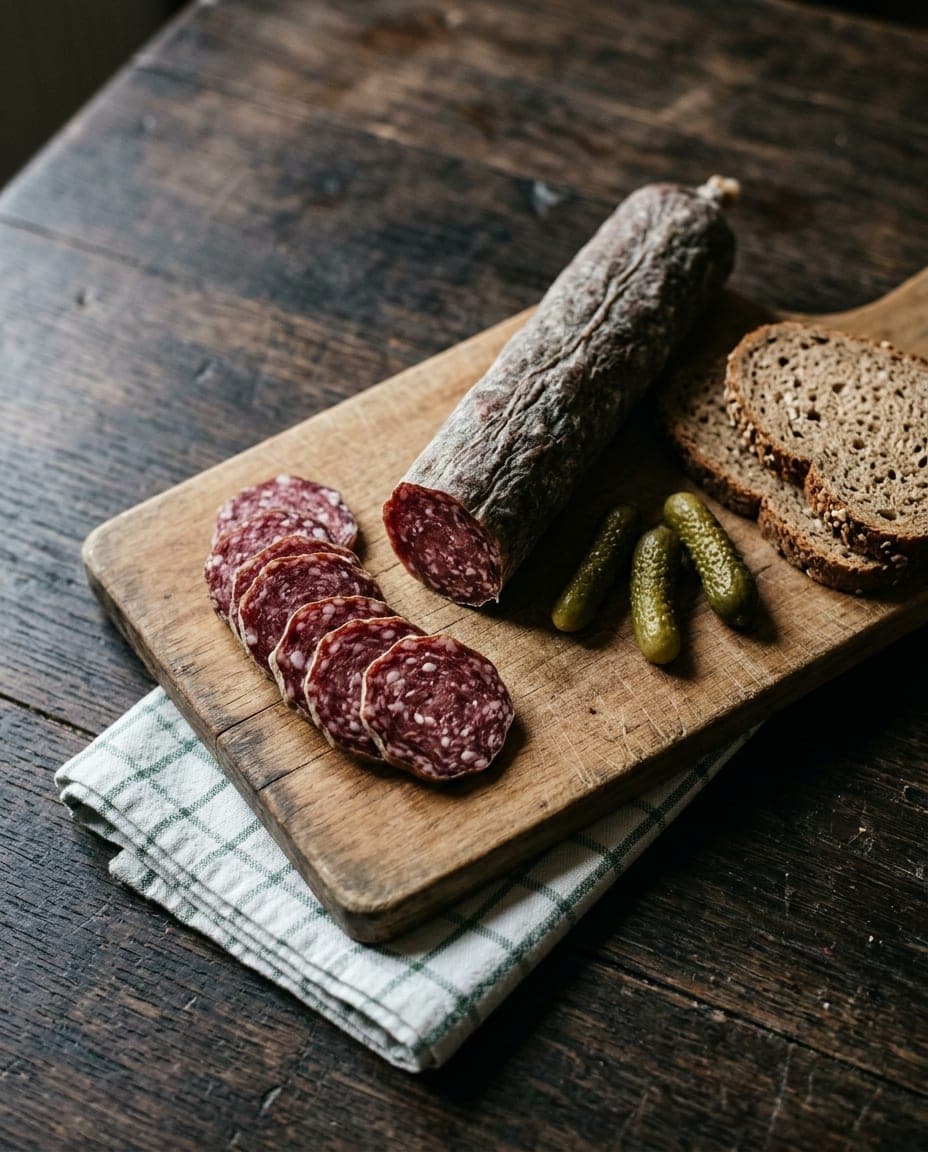
The traditional way to enjoy Schwarzwälder Schinken is as part of a Vesper, the cold snack or simple meal of south-west Germany, taken mid-morning, in the afternoon or as a light supper. The custom is bound up with Swabian and Baden culture. The ham is sliced paper-thin and arranged on dark, dense farmhouse bread spread with a generous layer of butter, which complements the saltiness of the meat.
The combination is straightforward but satisfying. The salt from the ham cuts the fat of the butter, while the smoke flavour adds depth to the earthy taste of the rye or wheat bread. This snack sustained workers in the fields and forests during long days, and today it remains a popular way to pause for a moment of rest.
In a Black Forest Vesperstube, a small tavern or guesthouse serving traditional food, this combination appears on almost every menu. The ham is often presented on a wooden board, sometimes with pickles or onions on the side, but the core remains the bread, butter and ham. It is meant to be savoured slowly, often accompanied by a glass of local wine or a cold beer.
What goes into it
The ingredients of Schwarzwälder Schinken are simple. There is no single recipe, as each producer guards their own method, but the essential components remain consistent across the Black Forest:
- Juniper berries, which add a piney note that complements the smoke.
- Coriander seeds, providing a warm, nutty undertone.
- Black pepper, offering a gentle heat.
- Garlic, enhancing the savoury depth.
These spices are mixed with salt and rubbed into the meat before the smoking process begins. The smoke itself comes from fir wood and brushwood, burned slowly to produce a cool, resinous vapour.
Curious facts
- The black skin is smoke. The dark, almost black exterior of the ham comes from the resinous fir smoke, not from a heavy spice rub or soot.
- A regional name only. Only hams made in the Black Forest following the product specification can legally be called Schwarzwälder Schinken.
- Usually eaten raw. The ham is almost always eaten raw and cold, thinly sliced, rather than cooked.
- A Vesper tradition. Eating this ham as part of a Vesper goes back to rural working life in the Black Forest.
- Protected since 1997. The product has held protected geographical indication (PGI) status in the European Union since 1997.
Where to try it
The most authentic experience of Schwarzwälder Schinken is found in the heart of the Black Forest, where Vesperstuben, small taverns and farm guesthouses serve the classic combination of dark bread, butter and thinly sliced ham.
In these establishments, the ham is often presented on a wooden board alongside local pickles or onions. A glass of Baden Pinot Noir pairs well with the salty, smoky flavour of the meat, though a cold beer is also common.
Some producers welcome visitors to see how the hams are hung and smoked, and the region's village festivals offer further opportunities to taste the genuine article.
Where to try it
1 destination
 Cabins
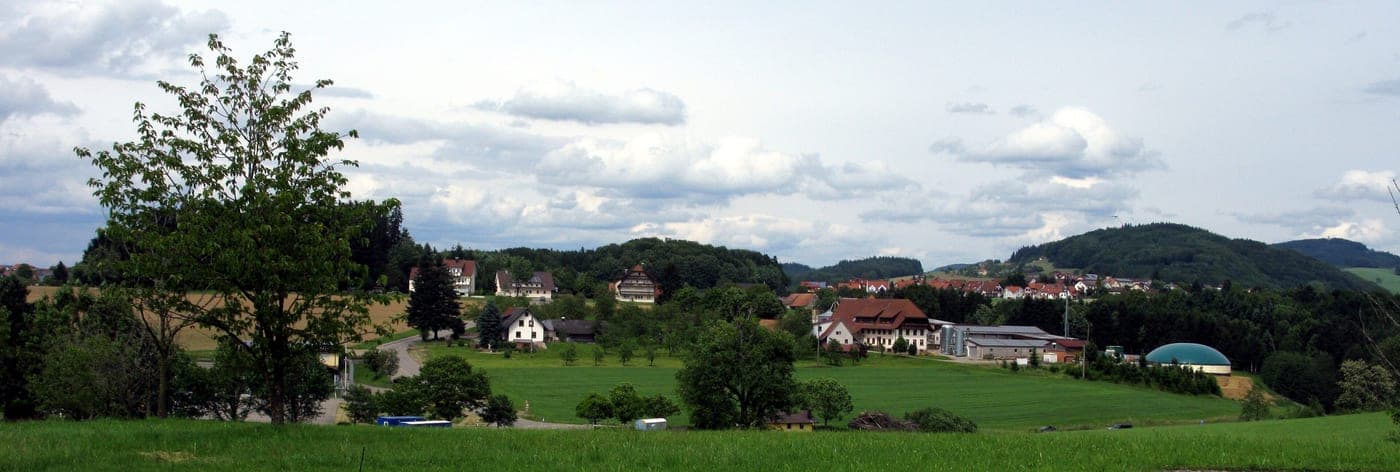
Freiamt
Black Forest village with traditional timber houses and hiking trails
CabinsHikingLocal Cuisine
1 region
 Camper Van Rentals12 destinations
Baden-Württemberg
Baden-Württemberg fills Germany's southwest corner, from the Rhine plain in the west to the limestone plateau of the Swabian Jura in the east. The land moves in slow shifts here: vineyard slopes give way to dense forest, forest opens onto grassland and cave country, and everything eventually settles toward the wide, calm water of Lake Constance in the south. It is a region built for a wandering pace, town by town, valley by valley. Wine gives much of the region its rhythm. On the Upper Rhine, the volcanic hill of the Kaiserstuhl holds terraced vineyards that catch unusually strong sun for Germany, and small growers here work Spätburgunder and Grauburgunder grapes into wines poured in village Weinstuben. South of it, the Markgräflerland carries its own soft vineyard hills toward the Swiss border, linked by paths that wind through the vines from one wine village to the next. Near Stuttgart, the Neckar valley holds the Württemberg wine region, where Trollinger and Lemberger vines grow on steep terraces braced by dry stone walls that vintners still mend by hand. East of the Rhine, the Black Forest rises into ridges of spruce and fir, its valleys dotted with timber farmhouses under heavy, sloping roofs. Clockmaking has never quite left these villages, and workshops still turn out cuckoo clocks in the old way. Freiburg im Breisgau sits at the forest's western edge, its old town threaded by small open channels called Bächle that run past the cathedral square and into the surrounding lanes. Further into the hills, half-timbered towns such as Gengenbach keep market squares lined with houses that lean gently with age, and Fasnet carnival traditions bring out carved wooden masks each winter. Castles mark the region's high points. Heidelberg's red sandstone ruin looks down over the Neckar and the baroque rooftops of the old town below, its terraces a well-known spot for watching the river. Further south, Hohenzollern Castle sits on a steep, isolated hill at the edge of the Swabian Jura, its towers visible above the surrounding farmland long before the castle comes fully into view. Smaller fortress towns between the two hold quieter versions of the same story, with gatehouses and keeps built into hillsides above vineyards or forest. Tübingen keeps its own slow tradition on the Neckar, where flat-bottomed Stocherkahn boats are punted along the river below a row of tall, colourful houses. Students and residents share the same narrow lanes that have shaped the town for generations. South and east of Tübingen, the Swabian Jura opens into limestone grassland, sheep pasture, and juniper heath, cut through by dry valleys and cave systems that draw walkers onto marked trails. At the region's southern edge, Lake Constance spreads into a broad expanse of water shared with Switzerland and Austria. Orchards, vineyards, and small harbour towns line its shore, where fishing boats still go out early. Reed beds and level paths follow much of the water's edge, giving long, flat stretches for walking or cycling between towns without losing sight of the lake. Festivals mark the region's calendar as much as its landscape does. Wine villages hold harvest festivals in autumn, serving new wine alongside onion tart in courtyards strung with lights. Winter brings Fasnet, with its carved masks and processions through Black Forest towns. Spring and summer bring open-air concerts in castle courtyards and vineyard walks led by local growers. Bicycles and walking boots suit this region well. Marked cycling routes follow the Rhine plain past vineyards and orchards, climb gradually into Black Forest valleys beside running streams, and trace the Lake Constance shore through reed beds and harbour towns. Hiking paths cover the same ground more slowly, crossing vineyard terraces, forest ridges, and Jura grassland, and often link one small town to the next without a long detour. Each part of Baden-Württemberg keeps its own version of this slow character: a wine village square in the Kaiserstuhl, a castle terrace above the Neckar, a quiet stretch of Bodensee shore, a forest clearing where the only sound is water moving somewhere close by.
Camper Van RentalsBoat RentalsHikingCabins