Asbach Uralt
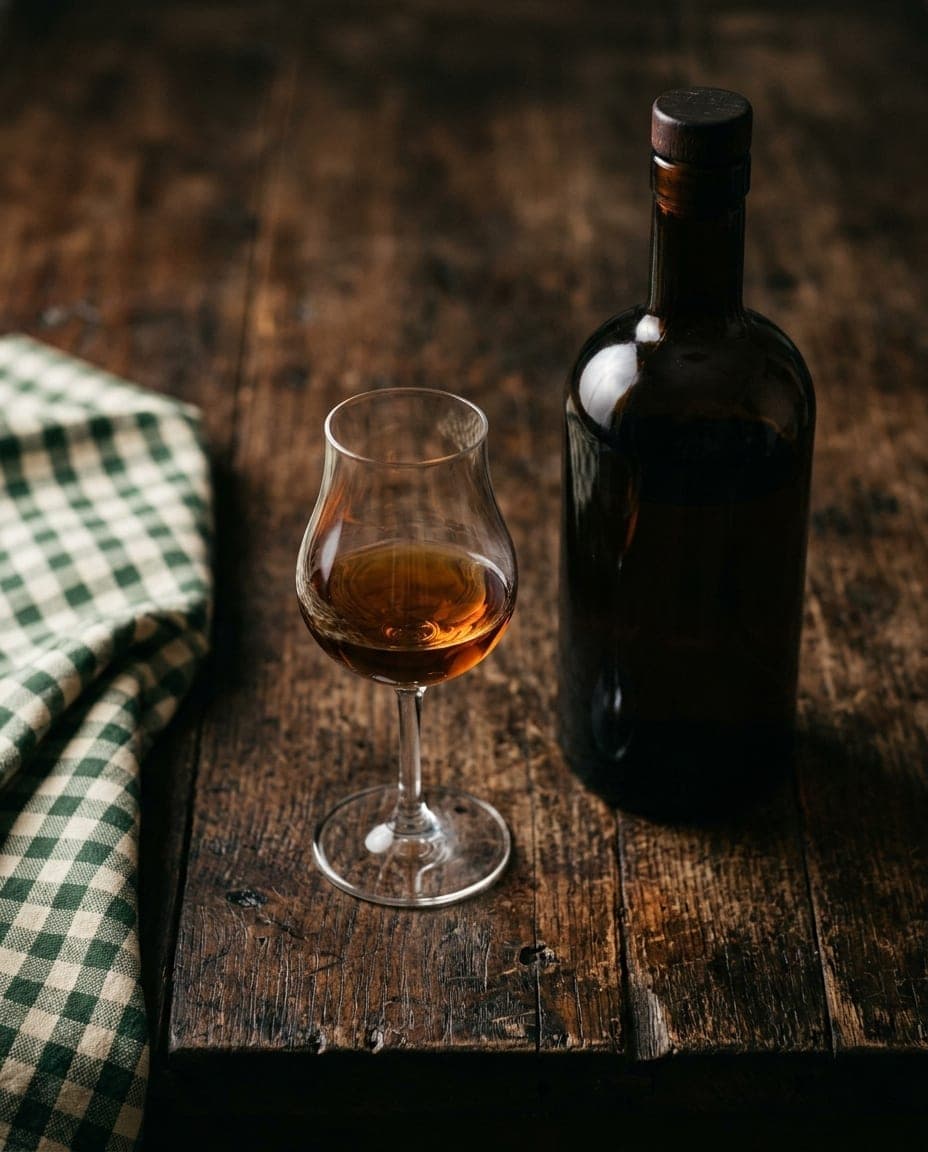
German brandy from Rüdesheim, served neat or in flaming coffee
- Alcoholic
- Local name
- Asbach Uralt
- Served
- Neat or in Rüdesheimer Kaffee
- Best eaten at
- A Drosselgasse wine tavern
- Pairs with
- Coffee
What it is
Asbach Uralt is a German Weinbrand, a spirit distilled from wine and aged in oak casks. It comes from the town of Rüdesheim am Rhein in the state of Hesse, where the company was founded in 1892. The name Uralt means "very old" or "ancient", a reference to the long maturation process rather than a specific vintage year. This is not a brandy made purely from Rhine valley grapes; the base wines come from white varieties such as Ugni Blanc, Silvaner and Müller-Thurgau, and are distilled in Rüdesheim.
The spirit has a smooth, warm character with notes of dried fruit, oak and vanilla. It is bottled at a strength that allows it to be sipped slowly or used as a base for other drinks. In Germany, Weinbrand is a legally defined term, distinguishing it from other spirits like Korn. The Asbach house is widely credited with establishing this category in the early 20th century, creating a distinct style that remains popular today.
The history of a German brandy
The story of Asbach begins in Rüdesheim, a town on the right bank of the Rhine known for its steep vineyards and wine culture. On 11 May 1892 Hugo Asbach, a native of Cologne, founded his company here, taking advantage of the local tradition of wine production. His first product was sold as "Rüdesheimer Cognac".
The choice to call it Weinbrand was significant. Asbach is credited with coining the word, which was registered as a trademark in 1907; the name Asbach Uralt followed in 1908. After the First World War, the Treaty of Versailles barred German producers from calling their brandy "Cognac", and in 1923 Weinbrand became an official category in German wine law. The brandy gained a reputation for quality, and the Uralt label became synonymous with the house.
Over the decades, the distillery has remained in Rüdesheim, producing the same style of brandy; today the brand belongs to the Underberg group. The ageing process takes place in oak casks, which impart colour and flavour to the clear spirit. This method ensures a consistent profile that has been enjoyed by locals and visitors for over a century.
How it is made
The production of Asbach Uralt follows a specific path from grape to glass. The base wines are fresh, light white wines, selected for their ability to produce a clean, aromatic spirit. They are distilled twice in copper pot stills in Rüdesheim, a traditional method that preserves the delicate flavours of the grapes. The heart of the resulting clear spirit is then transferred to small Limousin oak casks, and later to large vats of Spessart oak, where it matures and gains its characteristic colour and depth.
The ageing process is key to the final product. Much of the maturation takes place in the company's large cask warehouse at Ottersweier in Baden. Over time, the spirit absorbs compounds from the wood, developing notes of vanilla, caramel and dried fruit. The distillery blends different batches to maintain a consistent style, ensuring that every bottle meets the expectations of regular drinkers.
The Uralt bottling is the standard version of this brandy, known for its smoothness and warmth. It is not a single-vintage spirit but a blend of around twenty distillates, aged well beyond the legal minimum and designed to reflect the house style. The result is a drink that can be enjoyed on its own or used as an ingredient in other preparations.
How it is served
Asbach Uralt is typically served neat in a small glass, allowing the drinker to appreciate its aroma and flavour without dilution. It is often enjoyed after a meal or as an evening drink.
The most famous way to enjoy the brandy is in Rüdesheimer Kaffee, created in 1957 by the television chef Hans Karl Adam. Sugar cubes and brandy are flambéed in a special cup, then topped up with hot coffee, whipped cream and grated chocolate. The flame burns off some of the alcohol and caramelises the sugar, leaving a warm, aromatic drink that is both comforting and dramatic. The preparation is often performed at the table in the town's cafés and taverns.
Another way to experience the brandy is through brandy-filled chocolates, which Asbach introduced in 1924. These are a popular souvenir and a convenient way to taste the flavour without needing a glass.
Where it belongs
The drink is most at home in the Drosselgasse, a narrow alley in Rüdesheim lined with wine taverns. These establishments are known for their lively atmosphere, live music and local food. The Drosselgasse is the natural setting for Asbach Uralt and Rüdesheimer Kaffee, even if it is also one of the busiest tourist streets on the Rhine.
Visitors to Rüdesheim often find themselves in one of these taverns, where the brandy is offered alongside coffee or as a digestif after dinner. For a quieter glass, the side streets and cafés away from the alley are the better choice.
Curious facts
- The name means "very old". Uralt translates to "ancient" or "very old", referring to the long ageing process rather than a specific year of production.
- A word born of a treaty. After 1919 German producers could no longer call their brandy "Cognac", and Asbach's Weinbrand became the official German term.
- Flaming coffee. Rüdesheimer Kaffee involves setting the brandy alight in hot coffee, a 1957 creation that has become Rüdesheim's signature drink.
- Chocolate with spirit. Since 1924 the brandy has been used to fill chocolates, a sweet way to taste the flavour.
- A local category. The term Weinbrand was coined by Asbach, helping to define a specific type of German grape brandy.
Where to try it
1 destination
 Castles
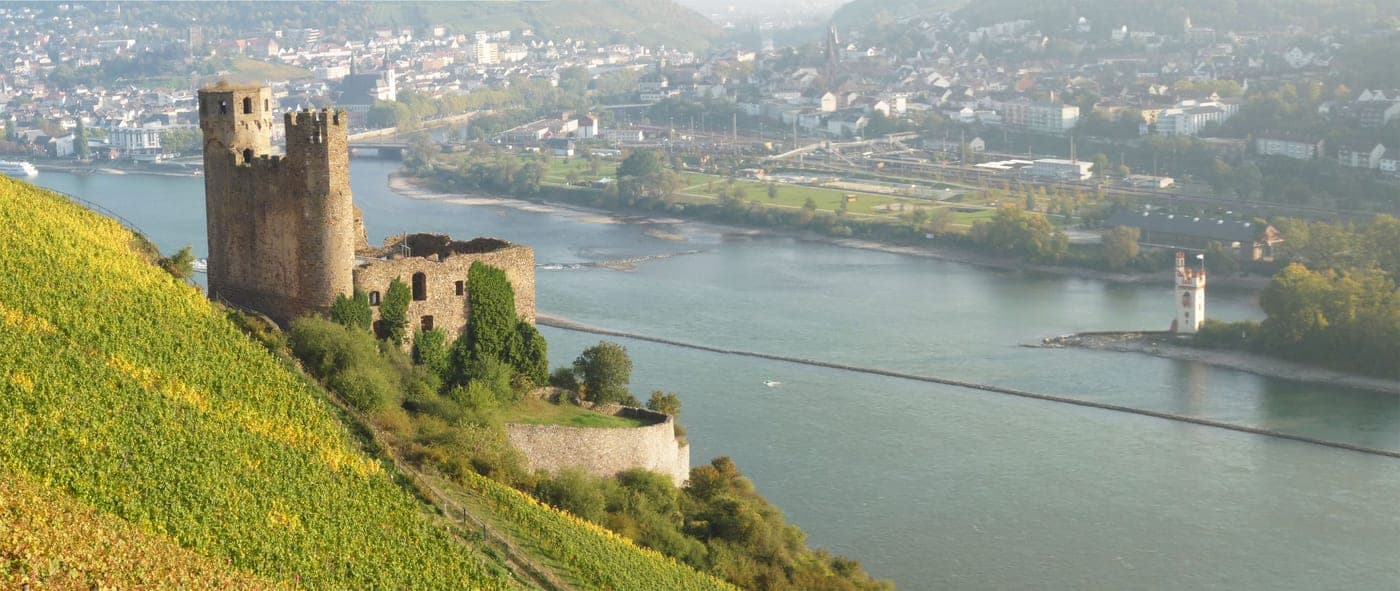
Rüdesheim am Rhein
Famous Rhine wine town at the gateway to the UNESCO-listed Rhine Gorge, with Germany's largest wine museum inside the 1,000-year-old Brömserburg castle.
CastlesHiking
1 region
 Castles5 destinations
Hesse
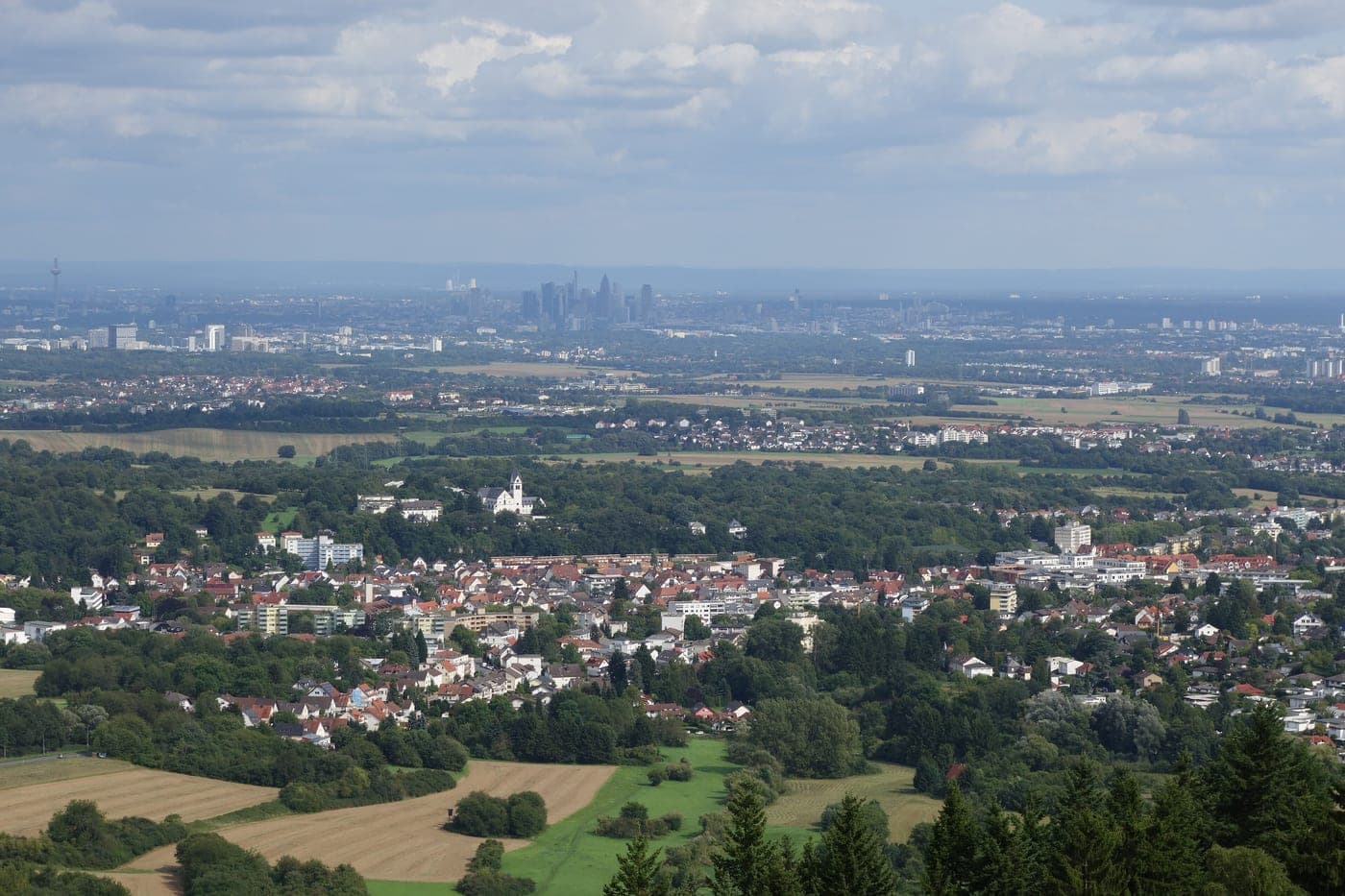
Hesse sits at the middle of Germany, and its landscape shows that in-between position clearly: river valleys lined with vineyards, forested hills that rise into proper mountain trails, and old market towns that never grew into cities. The pace here is set by the land itself. Along the Rhine, in the district known as the Rheingau, steep slopes have carried vines for centuries. Riesling is the grape that defines the area, grown on terraces above towns such as Rüdesheim, Eltville, and Geisenheim, where the river bends and the hills catch the afternoon sun. Marked cycling paths follow the water through the vine rows, past wine presses and small cellar doors that open onto the lane in season. Wiesbaden, the state capital, grew up around its hot springs. The Romans built baths here, and the town's spa culture never really stopped afterward — the same warm mineral water still rises through the ground and feeds the fountains and bathhouses that give the old streets their elegant, slightly formal air. Wide boulevards, stucco façades, and a domed casino all belong to that same spa-town character. Darmstadt, not far south, took a different path. At the start of the twentieth century, a group of artists and architects built the Mathildenhöhe colony there, a hillside cluster of houses, studios, and a wedding tower designed as a single artistic statement. The result is unlike anything else nearby: Jugendstil curves, mosaic tiles, and gardens laid out to match the buildings around them. To the north, the Taunus range folds into wooded ridges and open summits, with the Feldberg as its high point. Paths climb through beech forest and break out onto grassy tops with views back down toward the Rhine and Main valleys. At the foot of the range, Bad Homburg keeps its own spa tradition, with a park landscaped around mineral springs and a Kurhaus at its centre. Marburg lies along the Lahn river, its old town built up a steep hillside beneath a castle that has watched over the crossing for centuries. Narrow lanes climb between half-timbered houses toward the Elisabethkirche, one of the earliest Gothic churches built in Germany, and the university that has shaped the town since the sixteenth century sits woven right through the streets rather than set apart from them. Hesse also carries a strong thread of fairy tale history. The Brothers Grimm worked in Kassel for much of their lives, gathering and editing the folk tales that later spread around the world, and the town where they grew up, Steinau an der Straße, still keeps their family home. Kassel itself holds the Bergpark Wilhelmshöhe, a hillside park built around water cascades and crowned by a huge statue of Hercules, with fountains set running on fixed days through the warmer months. Further east, Bad Hersfeld grew around a Benedictine abbey whose church was left roofless after a fire centuries ago. The ruined nave now hosts an open-air theatre festival each summer, with the half-timbered old town filling up around performance nights. Fulda, close by, keeps its baroque cathedral quarter and a web of quiet lanes built for walking rather than traffic. Wine, water, and woodland repeat across Hesse in different combinations. The Rhine and Lahn valleys both carry cycling routes built along old towpaths, with easy gradients that pass through vineyard villages and under castle ruins. Autumn brings the grape harvest to the Rheingau, with presses running and new wine, still cloudy and sweet, sold by the glass in village squares. Spring and early summer suit the Taunus trails, when the beech woods are freshly green and the ridge paths stay cool. Spa towns like Wiesbaden and Bad Homburg keep their bathhouses open through the year, giving the region a rhythm that does not depend on any single season. What holds Hesse together is this mix of built and grown landscape: castle hills standing over vine terraces, spa parks laid out beside forest ridges, and small towns where the half-timbered centre and the surrounding countryside read as one continuous place rather than a destination and its outskirts.
CastlesCamper Van RentalsHiking