Regensburger Wurst
The short, thick smoked pork sausage of Regensburg, served warm with mustard or cold in salad
- Local name
- Regensburger (locally also Knacker)
- Served with
- Sweet mustard, bread or Wurstsalat
- Best eaten at
- A Bavarian beer-garden Brotzeit
- Pairs with
- Bavarian Helles
What it is
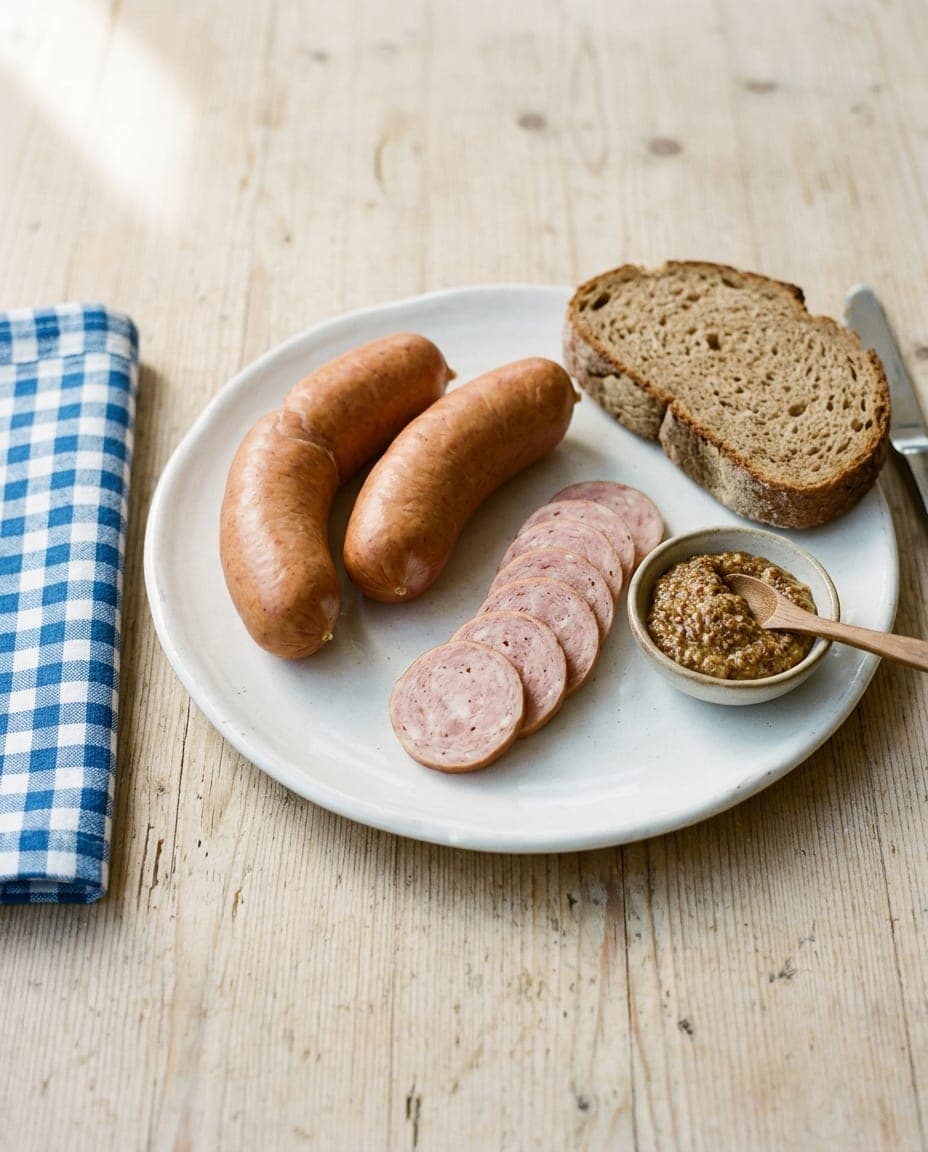
The Regensburger, often called the Regensburger Wurst, is a distinctive cured sausage from the Bavarian city of Regensburg. It is a short, thick sausage, roughly 10 cm long and 4 cm across, made from pork and notable for its coarse texture, where visible pieces of meat sit within a finer emulsion. Unlike many sausages that are grilled or fried fresh, this one is smoked and scalded during production, meaning it arrives at the table already cooked and ready to eat. In Regensburg itself it is often simply called a Knacker.
It is a regional speciality rather than a national icon, bound up with the city of Regensburg on the Danube, where it is generally said to have been created in the second half of the 19th century. The sausage is tied off into short, stubby links. The name is not a registered geographical indication: Regensburger appears in the German Food Code (Leitsätze für Fleisch und Fleischerzeugnisse) as a recognised type of sausage, so butchers elsewhere in Germany also make it. The result is a dense, smoky meat with a firm bite, quite different from the small grilled sausages the city is also known for.
How it is made
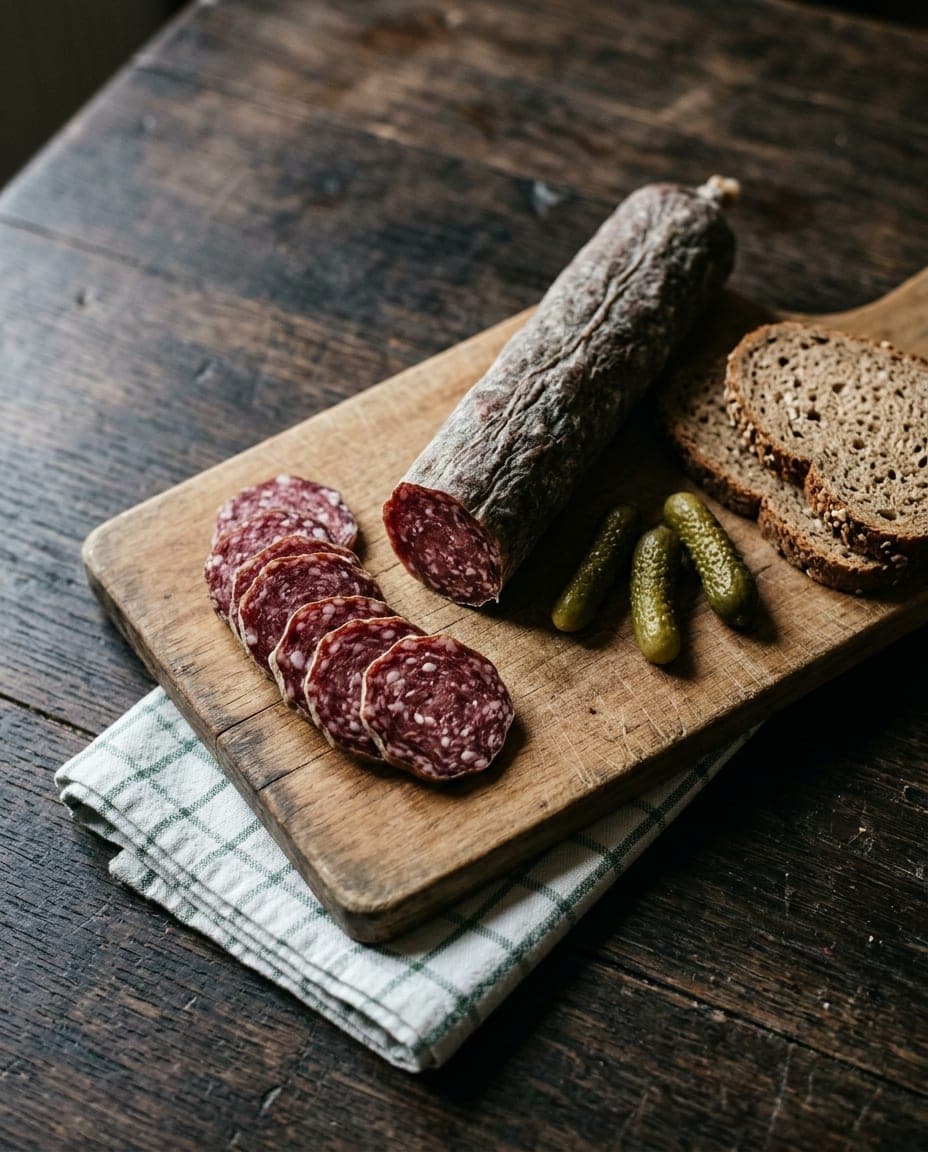
The Regensburger belongs to the family of Brühwurst, or scalded sausages. The process begins with lean pork that is finely ground into a smooth base, seasoned with salt and spices. Unlike fine emulsions where every grain disappears, this mixture is studded with small pieces of pork, giving the sausage its characteristic look when sliced. The filling is packed tightly into natural beef casings and tied into short links.
The sausages are then smoked, which adds depth and aids preservation, and finally scalded in hot water rather than boiled hard or baked. The smoking is traditional but varies by producer, contributing a subtle aroma that pairs with the savoury taste of the pork. Because it is fully cooked during production, the sausage requires no further cooking. It is safe to eat cold or warm, making it versatile for different meals throughout the day.
How it is eaten
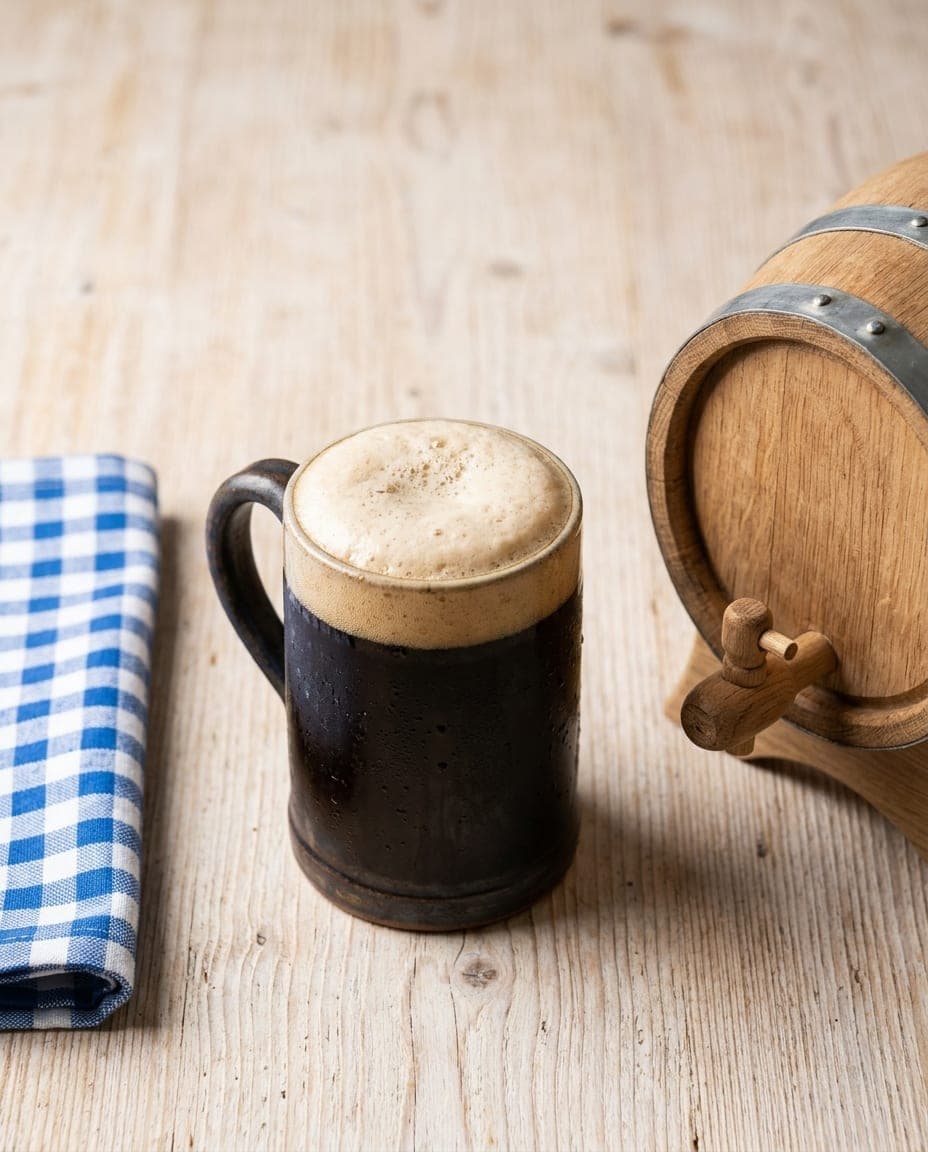
The Regensburger is a staple of Bavarian beer gardens and traditional Brotzeit spreads. In these settings, it is often served warm, whole or halved, alongside dark rye bread or pretzels. The essential accompaniment is mustard, very often the sweet Bavarian kind. A glass of Bavarian Helles, a pale lager brewed in the region, is the standard drink to wash it down. A popular snack version is the Regensburger Semmel: the sausage grilled, halved and tucked into a bread roll with sweet mustard, horseradish and pickled gherkin.
When served cold, the sausage finds its place in Wurstsalat, a classic Bavarian salad. Here, the Regensburger is sliced into thin strips or rounds and tossed with raw onions, vinegar, oil and often a little mustard. The sharp acidity of the dressing balances the smoky fat of the meat. This version is often eaten as a light lunch or an evening Brotzeit.
The Regensburger should not be confused with the Regensburger Bratwürste, the small, thin sausages grilled over charcoal at the historic sausage kitchen beside the Stone Bridge. While the names sound similar, the textures and preparation methods differ entirely. The Regensburger is a cured, smoked and scalded product; the Bratwurst is fresh meat meant for the grill.
Curious facts
- A type, not a protected name. Regensburger is listed in the German Food Code as a sausage type, alongside names such as Augsburger and Pfälzer, rather than being a protected geographical indication.
- A local nickname. In Regensburg, the sausage is commonly known as a Knacker, a name usually linked to the snap of its casing.
- No cooking required. As a Brühwurst, it is fully cooked during production and does not need heating, though warming it brings out the smoky aroma.
- Street snack too. Grilled and stuffed into a roll as a Regensburger Semmel, it doubles as a quick bite on the go.
- Distinct from Bratwurst. The similarity in name often confuses visitors, but the Regensburger is a cured, scalded product, while the Bratwurst is fresh and grilled.
Where to try it
The best place to eat a Regensburger is a traditional beer garden or a Brotzeit counter in Regensburg itself. A simple plate of warm sausage with sweet mustard and dark bread offers the most authentic experience. For the salad version, a casual tavern that prepares fresh Wurstsalat daily is the natural choice.
Where to try it
1 destination
 Camper Van Rentals
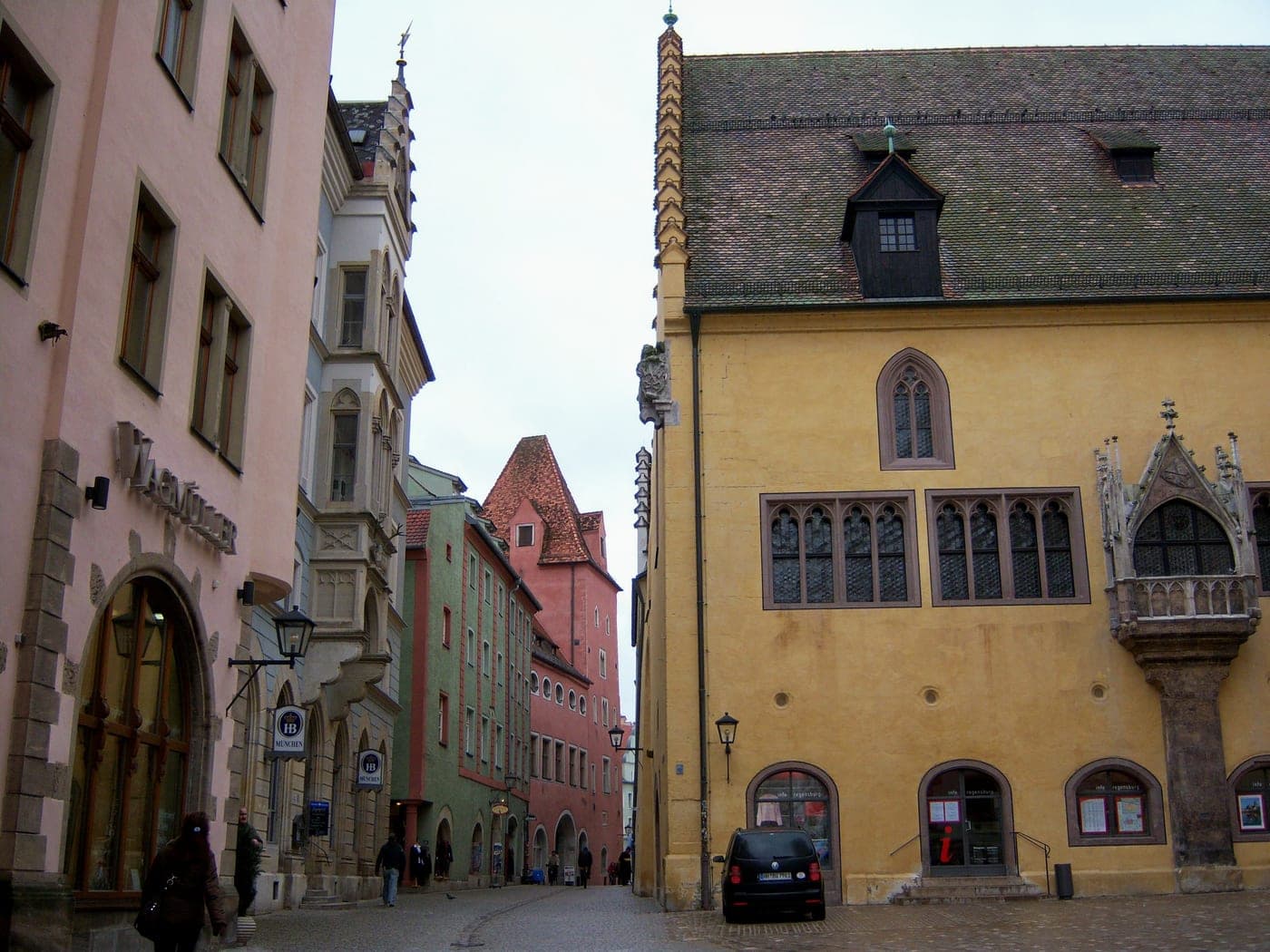
Regensburg
Medieval Bavarian city on Danube with Gothic cathedral and stone bridge.
Camper Van RentalsHiking
1 region
 Cabins31 destinations
Bavaria
Bavaria is Germany's largest state, and one of its most varied. In the south, the land rises into the Alps, with peaks above Berchtesgaden and Garmisch-Partenkirchen, and lakes such as the Chiemsee and the Königssee nearby. Further north, the hills flatten into the Franconian wine country, where Silvaner and Müller-Thurgau vines cover slopes above the Main river. Between these two landscapes sit market towns, river cities, and castle villages that reward slow attention. Munich, the state capital, has its beer gardens, its baroque churches, and its markets selling Weißwurst in the morning. But much of Bavaria's character lives outside the capital, in places built for a quieter pace. Regensburg, on the Danube, keeps a medieval old town of narrow lanes, stone bridges, and merchant houses that once served river trade. Bamberg spreads across seven hills and several arms of the Regnitz river, and is known for its smoked Rauchbier, brewed in local taverns much as it always has been. Rothenburg ob der Tauber sits inside its own medieval walls, with half-timbered houses and a walkway along the ramparts that circles the whole old town. Franconia, in the north, is Bavaria's wine country. Vineyards climb the terraces above Würzburg and along the Main, and small wine villages sell their own vintages from cellar doors and courtyard taverns. The wine here is usually bottled in the round Bocksbeutel flask, a shape associated with the region. Cycling paths follow the river through the vines, linking one village to the next at an easy, level pace, past chapels, wine presses, and stone crosses set among the rows. In the Allgäu, close to the Austrian border, the town of Füssen sits below the castle hill of Neuschwanstein, built by King Ludwig II in the nineteenth century. The castle draws attention, but the surrounding countryside holds its own appeal: lakes, foothills, and villages where farming and dairy traditions continue much as before. Bavaria's lakes add another layer of slowness. The Chiemsee, the largest, can be crossed by boat to its island monasteries, where former royal buildings and quiet cloisters sit surrounded by water and reed beds. Smaller lakes near the Alpine foothills, such as the Staffelsee and the Ammersee, are ringed by paths used for walking and cycling rather than for speed. Food and drink run through the region's identity. Beer gardens, some centuries old, work on a simple principle: food brought from home, a beer ordered at the counter, a seat under chestnut trees for as long as the weather allows. Franconian taverns serve local wine alongside dishes built around potatoes, dumplings, and river fish. Bakeries sell pretzels still warm from the oven, and markets in towns like Nuremberg keep old traditions of spiced gingerbread and roasted sausages. A morning market in Regensburg, an afternoon among the Franconian vines, an evening in a Bamberg tavern: each has its own pace. Villages across Bavaria keep their own customs — wine festivals in Franconia, woodcarving and dairy traditions in the Alpine foothills. Mountains and vineyards, river cities and castle villages: Bavaria fits them into a single state, each within reach of the next.
CabinsCastlesHikingCamper Van Rentals