Linsen mit Spätzle und Saitenwürstle
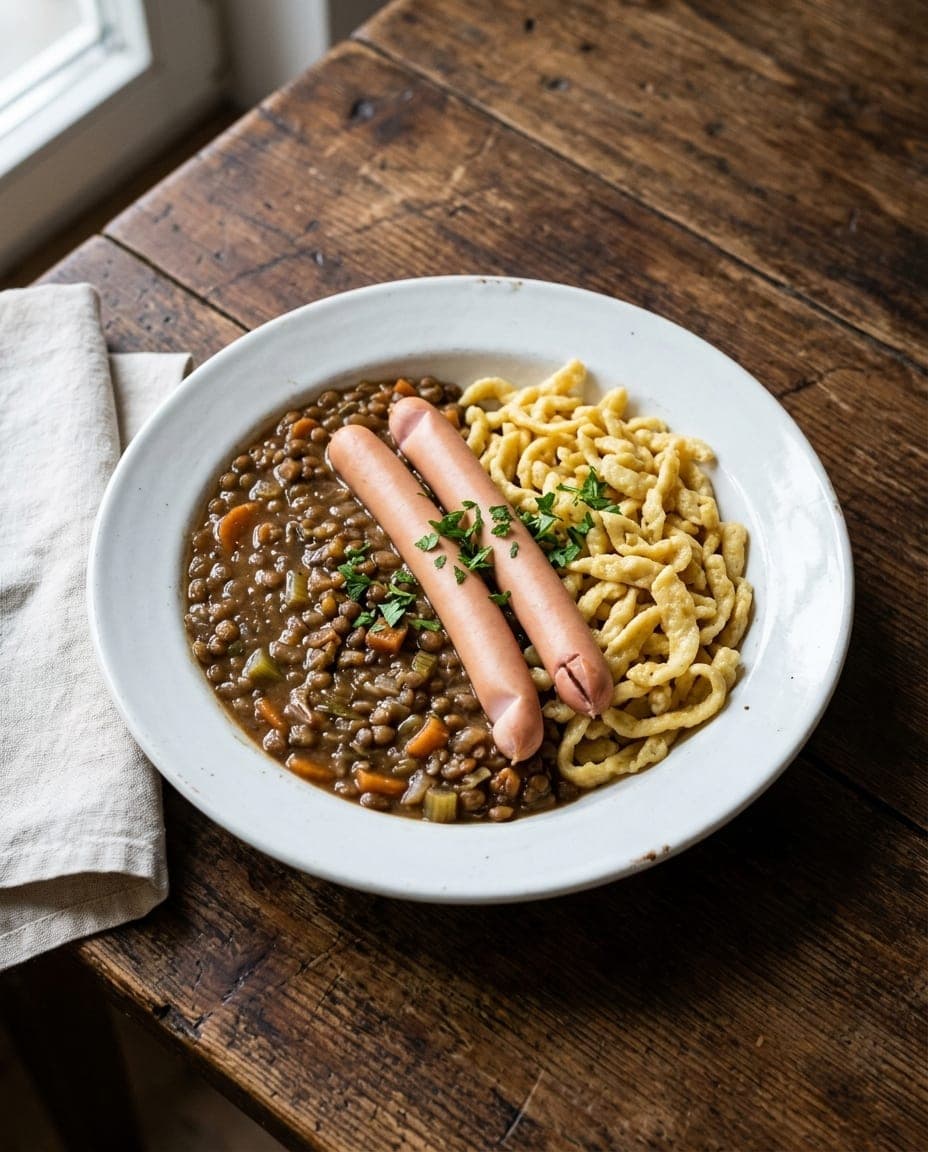
Swabian brown lentils, egg noodles and thin Wiener-style sausages
- Local name
- Linsen mit Spätzle und Saitenwürstle
- Served with
- Vinegar
- Best eaten at
- A Swabian Gasthaus
- Pairs with
- Württemberg Trollinger
What it is
Linsen mit Spätzle und Saitenwürstle is a dish that defines the everyday cooking of Swabia, the region covering much of Baden-Württemberg in south-west Germany. It is a plate of humble origins, built on three simple elements: a thick stew of brown lentils, a helping of soft egg noodles known as spätzle, and a pair of thin sausages called Saitenwürstle. The dish is not a festive feast for special occasions, but rather a staple that appears on menus year-round across Württemberg, from Stuttgart to Ulm and the villages of the Swabian Alb. It is often called the Swabian national dish, a title it contests with Maultaschen.
The character of the dish lies in its balance. The lentil stew is rich and earthy, yet it is sharply soured with vinegar to cut through the heaviness. This acidity is not an optional extra; a traditional bowl is meant to be tangy. A bottle of vinegar often sits on the table for diners who wish to adjust the flavour to their liking. The spätzle provide a soft, neutral base that soaks up the savoury broth, while the Saitenwürstle offer a mild, salty contrast.
The Swabian roots of the plate
Swabia has long been an agricultural region where practicality ruled the kitchen. The combination of lentils, root vegetables and pork reflects what was available in local larders: hardy crops that store well through the winter and meats that could be preserved or smoked. Lentils were long grown on the poor soils of the Swabian Alb; cultivation there faded in the 20th century but was revived from 1985, and the old Alb lentil varieties, rediscovered in a seed bank in St Petersburg in 2006, have been sold again since 2011. While the dish is now a recognised regional speciality, it began as an everyday meal for farmers, workers and families who needed a substantial plate without spending much on ingredients.
The doubling of starch, lentils and noodles on one plate, has long amused outsiders; the Swabian writer Thaddäus Troll called the pairing a mésalliance. Locals are unbothered. When visitors ask Swabians what they actually eat in their daily lives, the answer often includes this specific combination, and it is a point of pride to serve it well, as the quality of the stew and the texture of the spätzle are easy to judge.
How it is made
The preparation of Linsen mit Spätzle und Saitenwürstle follows a straightforward rhythm. The brown lentils are simmered until tender, typically for around half an hour to 45 minutes, with salt added only at the end so the skins do not toughen. Root vegetables such as carrots, onions and sometimes celery form the base, adding sweetness to the earthy lentils. To build depth, cooks often add a piece of smoked pork or bacon to the pot, allowing the fat to render into the stew.
The spätzle are prepared separately. These are soft egg noodles made from flour, eggs, salt and water. The dough is scraped directly into boiling water from a wooden board with a knife or pressed through a spätzle press, creating irregular shapes that hold sauce well. The Saitenwürstle are thin sausages in a sheep-gut casing, the Swabian name for what elsewhere in Germany is called a Wiener. They are not boiled; instead, they are gently warmed in the stew or in hot water so they remain firm and do not split open.
The final touch is the vinegar. A generous splash of wine vinegar or cider vinegar is stirred into the hot stew just before serving. This step transforms the dish from a simple lentil stew into something with a sharp, bright edge, and the acidity balances the fat from the pork.
What goes into it
There is no single official recipe, yet certain components appear in almost every kitchen:
- Brown lentils, which provide the body of the stew and a nutty, earthy flavour.
- Root vegetables, typically carrots, onions and celery.
- Pork products, often smoked belly, bacon or a ham hock, used to season the lentils with salt and smoke.
- Spätzle, the soft egg noodles made from flour, eggs, salt and water.
- Saitenwürstle, thin sausages that are warmed gently to keep their snap.
- Vinegar, usually wine vinegar or cider vinegar, added at the end.
How it is eaten
Linsen mit Spätzle und Saitenwürstle is typically served as a main course at lunch or early dinner. In a Swabian Gasthaus, the dish arrives in a deep plate, with the lentils and spätzle side by side or one ladled over the other, and the two Saitenwürstle placed on top. A small bottle of vinegar often accompanies the meal, allowing diners to adjust the sourness to their preference.
Diners scoop up the lentils and spätzle together, so each bite contains the stew and the soft noodles, while the sausages are eaten alongside or cut into the mix. A glass of Württemberg Trollinger, a light, fruity red wine, pairs naturally with the dish, as does a cold beer from a local brewery.
Curious facts
- The vinegar is essential. Unlike many stews where acid is an afterthought, a Swabian lentil stew is defined by its sourness. Swabians like their lentils with plenty of vinegar, and a bottle is standard on the table.
- A contested national dish. Linsen mit Spätzle and Maultaschen are the two usual candidates for the title of Swabia's national dish.
- Saitenwürstle are thin. These sausages are thinner than many German boiling sausages, with a natural casing that gives a distinct snap.
- A regional identity. While lentils and spätzle appear elsewhere in Germany, this specific combination is strongly identified with Swabia.
Where to try it
The most authentic version of Linsen mit Spätzle und Saitenwürstle can be found in a Swabian Gasthaus in Stuttgart, Ulm, Tübingen or the villages of the Swabian Alb. Many are family-run and focus on traditional regional cooking.
Where to try it
1 destination
 Camper Van Rentals
Ulm
Danube city with world's tallest church spire and Einstein's birthplace.
Camper Van RentalsHikingLocal Cuisine