Leipziger Allerlei
A Saxon spring plate of young vegetables, morels and crayfish in butter
- Local name
- Leipziger Allerlei
- Pairs with
- Saxon Müller-Thurgau
What it is
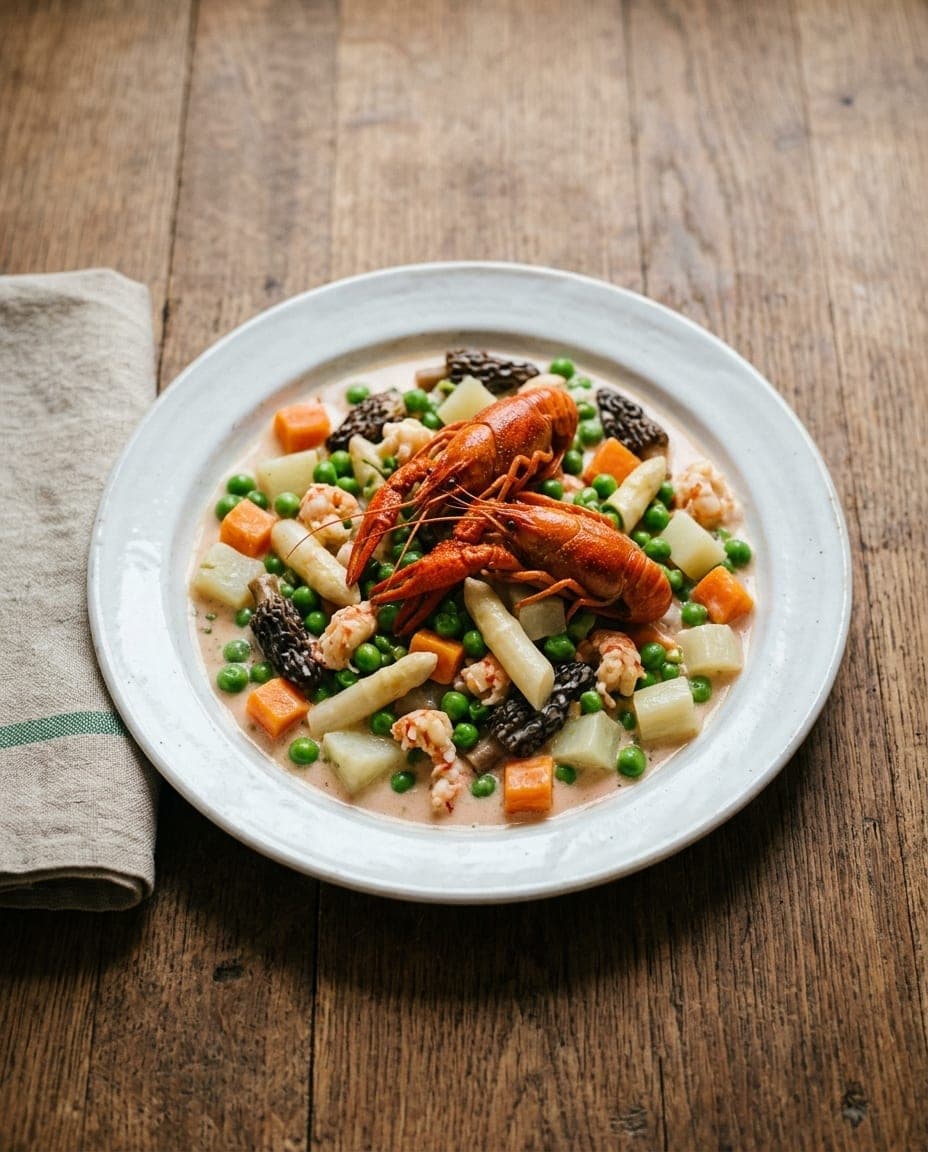
Leipziger Allerlei, literally "Leipzig all sorts", is the signature spring dish of the city of Leipzig in Saxony. It is a plate of young vegetables cooked briefly to preserve their texture, served in a pale butter sauce and, in its classic form, enriched with crayfish tails and morels. The dish relies on the seasonality of its ingredients: the original belongs to spring, when the asparagus season begins and crayfish come back into season.
In its grandest form, the dish includes a sauce made with crayfish butter, whole crayfish tails and small bread dumplings, a version once served at the city's finest tables. The everyday version, common in home kitchens and taverns, is a colourful medley of carrots, kohlrabi, peas, asparagus, cauliflower and young beans, cut into small pieces, sometimes with button mushrooms in place of morels. Both are united by a light sauce that coats rather than overwhelms the vegetables, allowing their fresh, sweet flavours to dominate. It is not a heavy stew but a celebration of the first harvest.
Outside Saxony the name is best known from tinned mixed vegetables sold across Germany, which bear little resemblance to the original.
The story of the beggar's plate
The most persistent tale about Leipziger Allerlei involves a display of feigned poverty. Local legend says that after the Napoleonic Wars, Leipzig's citizens wished to discourage the beggars and tax collectors who arrived in large numbers. To appear poor, they hid their meat and bacon and served a humble dish of vegetables instead, in the hope that the unwelcome visitors would move on to other towns.
Historians treat this account as folklore. The dish is in fact older than the legend: a recipe already appears in an 18th-century Leipzig cookbook. What is certain is that the area around Leipzig produced good vegetables and that local cooking valued seasonal produce. The word Allerlei simply means "all kinds" or "variety", reflecting the practice of combining several fresh vegetables in one dish.
What goes into it
The foundation of the dish is the vegetable mix, which changes slightly depending on the harvest but always features young, tender varieties:
- Carrots, peeled and cut into small rounds or sticks, providing sweetness.
- Asparagus, usually white, trimmed and cut to match the other vegetables.
- Kohlrabi, peeled and diced, adding a mild, cabbage-like note.
- Peas, shelled fresh from the pod for their bright colour and sweetness.
- Cauliflower, separated into small florets that hold their shape in the sauce.
- Young beans, cut into short lengths.
For the classic version, cooks add morels, the prized spring mushrooms, and crayfish tails. Krebsbutter (crayfish butter) is used to make the sauce, giving it a pale pink hue and a savoury depth, and small Semmelklößchen (bread dumplings) are added as a garnish. The vegetables are cooked just until tender but still with a slight bite.
How to eat it
Leipziger Allerlei is served as a side dish or a light main course in spring. It often accompanies fish, veal or poultry, though the vegetable version can stand alone; it is only vegetarian when made without meat stock and without the crayfish. Boiled new potatoes are a common accompaniment, soaking up the buttery sauce.
The dish pairs well with local white wines, particularly Saxon Müller-Thurgau, whose crisp acidity cuts the richness of the butter and complements the sweetness of the vegetables. It is not a dish for heavy red wines or strong spices; the goal is to highlight the natural flavour of the spring harvest.
Curious facts
- A seasonal window. The original is a spring dish, appearing when the asparagus season starts and the vegetables are young and tender.
- Vegetable variety. While the core ingredients remain consistent, the exact mix varies by kitchen and year, depending on what the market offers.
- Crayfish origin. The crayfish tails and butter recall a time when freshwater crayfish were plentiful in the rivers around Leipzig.
- Two reputations. In Leipzig the name stands for a refined spring dish; elsewhere in Germany it is often associated with tinned mixed vegetables.
- No fixed recipe. There is no single official version; cooks adjust the proportions based on what is available at the market that week.
Where to try it
The best place to find authentic Leipziger Allerlei is in Leipzig itself, where traditional restaurants serve the classic version with crayfish and morels during the spring season. Some establishments feature it as a seasonal special alongside asparagus dishes, and versions can also be found elsewhere in Saxony.
Where to try it
1 destination
 Camper Van Rentals
Leipzig
Saxony's creative city with Bach heritage and vibrant arts scene.
Camper Van RentalsHiking
1 region
 Camper Van Rentals3 destinations
Saxony
Saxony sits in the eastern corner of Germany, where the Elbe river cuts through sandstone cliffs before opening onto vineyard slopes, old market squares and quiet river towns. Its landmarks stand close enough together that a slow route through the region tends to follow the water itself, from wine terraces near Meißen to the rock plateaus above Dresden and the old craft towns further east. Between Pirna and Meißen the Elbe valley softens into one of Germany's smallest wine regions, a narrow band of terraced vineyards known locally as the Sächsische Weinstraße. Riesling and Müller-Thurgau grow on steep slopes above the river, alongside Goldriesling, a grape found almost nowhere else. Small wineries around Radebeul and Diesbar-Seußlitz open their cellars for tastings, and cycling paths thread through the vines past baroque villas and old wine presses built into the hillside. Dresden's rebuilt old town gathers around the Elbe's curve. The Frauenkirche's stone dome rises over a square lined with baroque facades, the Zwinger holds courtyards once used for royal festivities, and the Semperoper stages opera beside collections of old master paintings and porcelain built up by Saxony's electors. The riverside terraces on either bank give a clear view of the skyline and are used for walking rather than for any particular sight. A short stretch upstream, Meißen has made porcelain since 1710, and its manufactory still marks pieces with the blue crossed swords first used to guard the recipe. Workshops there remain open for viewing, and the town's own hilltop cathedral and castle look down over the river from above the vineyards. West of the Elbe, the wooded Erzgebirge hills carry a different craft tradition: turners and carvers in towns such as Seiffen have shaped nutcrackers, incense smokers and candle pyramids for generations, work that fills the region's Christmas markets each winter. South-east of Dresden, the sandstone plateaus of Saxon Switzerland rise straight out of the forest. Deep gorges cut between the flat-topped hills, and paths climb to viewpoints such as the Bastei, where the sandstone has weathered into towers, arches and narrow ridges. Painters of the German Romantic period worked from these same outcrops, and the light across the plateau still shifts through the day in a way that made the landscape famous long before it became a national park. West of Dresden, Leipzig tells a different part of Saxony's story. Bach directed music at the Thomaskirche for almost three decades, and the church still holds regular concerts drawing on that tradition. The city built its wealth on trade fairs and publishing rather than a royal court, and that older commercial energy now shows in a large student population, independent bookshops and cafes, and former cotton mills and rail yards converted into galleries and studios. Further east, Bautzen keeps its old town wall and a line of towers above the Spree river, and remains one of the centres of Sorbian culture, a Slavic minority whose language, dress and Easter egg traditions are still visible around the town, especially at Easter. Near the Polish border, Görlitz preserves long streets of Gründerzeit and older facades that survived the twentieth century largely undamaged, giving its old town an unusually complete and continuous look. Festivals mark the Saxon year in different corners of the region: organ and choral concerts fill Dresden's and Leipzig's churches, autumn wine festivals bring open cellars to the Elbe valley towns, and lit wooden pyramids and carved figures fill Erzgebirge markets through December. Moving between the wine slopes, the sandstone hills and the old craft and university towns, Saxony reads less like a single sight and more like a set of related landscapes, each shaped by a particular trade or river bend, and each within easy reach of the next.
Camper Van RentalsHikingCabins