Ser koryciński
A herb-flecked farm cheese with a dimpled rind
- Local name
- Ser koryciński swojski
- Served with
- Bread, honey, radishes
- Best eaten at
- The Korycin cheese festival
What it is
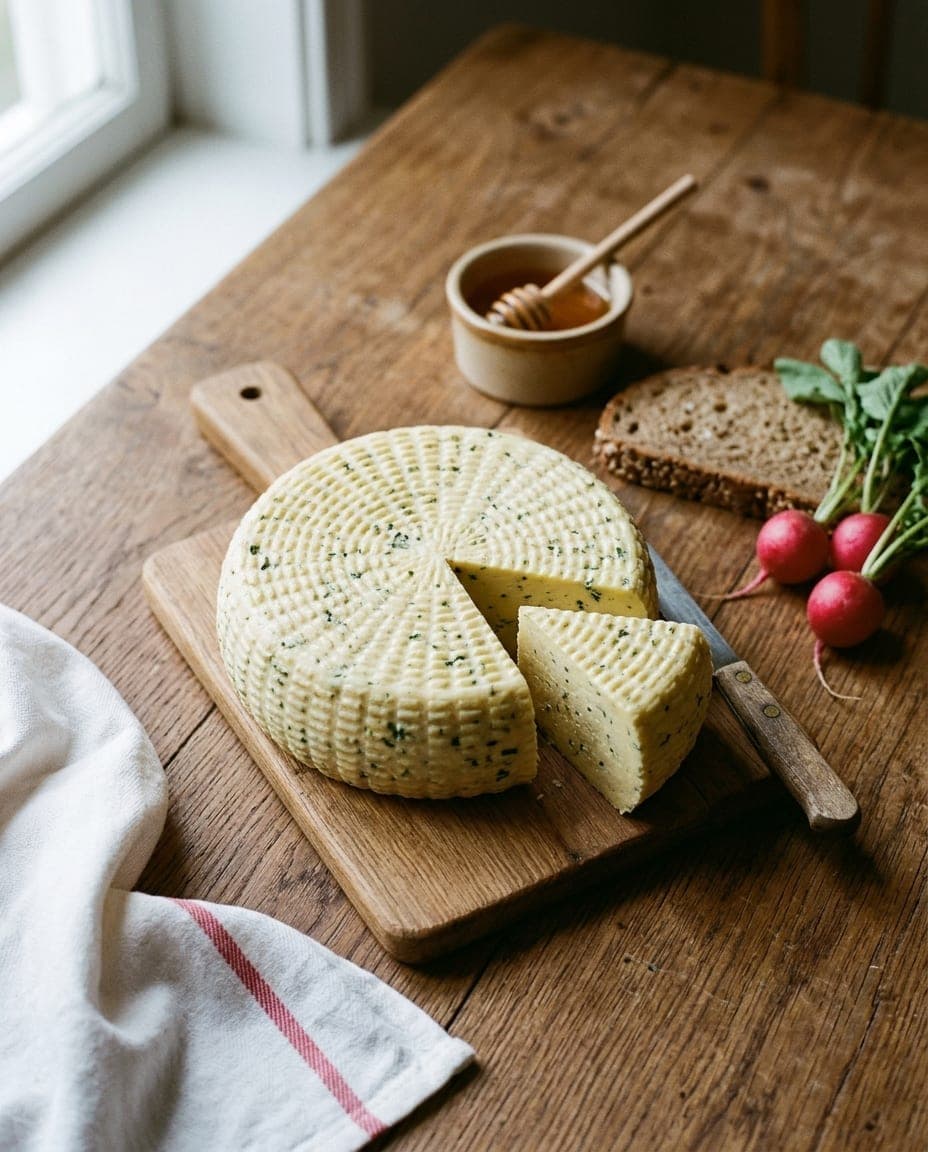
Ser koryciński is a farmhouse cheese from the village of Korycin in the Podlaskie region of north-east Poland. It is a raw cow's milk cheese registered in the EU in 2012 as a PGI (Protected Geographical Indication) under the name ser koryciński swojski, which protects the name and the traditional methods used in the gminas of Korycin, Suchowola and Janów. The cheese appears as a large, flattened round of 2.5 to 5 kg with a distinctive fluted surface created by the strainer-like moulds used during draining.
The texture varies depending on how long the cheese is aged: it is sold fresh after a few days, matured, or ripened for more than two weeks. When eaten young, it is soft, springy and mild, often described as creamy with a slight tang. As it matures, the interior becomes firmer and the flavour deepens, developing a sharper, more savoury character. What sets this cheese apart from many other Polish varieties is the frequent inclusion of fresh herbs. Garlic, dill, chives, pepper or paprika are often worked into the curd before moulding, giving the cheese a speckled appearance and an aromatic quality that is unusual for the region's standard white cheeses.
The dairy tradition of Podlaskie
The cheese comes from the Podlaskie region, an area known for its flat landscapes, forests and numerous small rivers. This part of Poland has a long history of small-scale farming where families kept cows for milk and made their own products to feed themselves or sell locally. Korycin sits in the heart of this agricultural zone, where the dairy tradition remains central to village life.
Unlike large industrial factories, the production of ser koryciński typically takes place on individual farms. The milk is raw, meaning it has not been pasteurised, and is processed using methods passed down through generations. The use of perforated moulds gives the cheese its characteristic ridged surface, which helps the whey drain away while leaving the curd with a unique surface structure. This method produces a cheese that feels substantial in the hand and looks rustic on the table.
What goes into it
The list is the farm larder and nothing else. The base is always fresh, raw cow's milk from the region, set with rennet. Salt is added to taste and to aid preservation. Beyond these basics, many versions include a generous amount of chopped green herbs or seeds. Common additions include:
- Garlic, adding a sharp, pungent aroma.
- Dill, which gives a fresh, grassy note.
- Pepper, chilli or paprika, providing warmth.
- Chives or other garden herbs, depending on the season and what is available on the farm.
The result is a cheese that is as much about the greenery as it is about the milk. The herbs do not dominate the flavour but rather lift it, creating a complex profile that changes with the harvest. Some versions may include dried mushrooms or other local additions, but the herb-flecked variety remains the most recognisable form of ser koryciński.
How to eat it
This cheese is best enjoyed as part of a casual meal rather than a formal course. It is commonly served at room temperature to allow the aromas to rise. The traditional way to eat it involves breaking off a chunk and pairing it with local bread, which acts as a neutral base for the strong flavours. Honey is a classic accompaniment; the sweetness of the honey balances the saltiness and the sharpness of the herbs. Sliced radishes are also frequently served alongside, adding a crisp, peppery crunch that cuts through the creaminess of the cheese.
The cheese is often sold at farm gates or local markets in Podlaskie. In Korycin itself, an annual cheese festival, the Święto Sera Korycińskiego, has been held since 2004, where farmers display their latest batches. This event is a gathering point for locals and visitors alike, offering a chance to taste fresh versions straight from the producer. It is rarely on a city menu; it belongs to a farm table or a market stall.
Curious facts
- A dimpled surface. The perforated moulds used for draining leave the cheese with a textured, pitted rind that is distinct from the smooth skin of many other European cheeses.
- Herbs in the curd. While some Polish cheeses are plain white, ser koryciński often contains visible flecks of herbs or spices mixed into the curd before moulding.
- Raw milk tradition. The PGI rules require raw cow's milk, a practice that gives the cheese a deeper flavour but requires careful handling to ensure safety.
- A cheese festival. The annual cheese festival in Korycin is a key event where fresh batches are sold and tasted, often drawing visitors from across the region.
- Not a national dish. This cheese is specific to Korycin and the surrounding Podlaskie area; it does not have the same recognition as Poland's best-known regional cheese, oscypek.
Where to try it
The most authentic experience of ser koryciński is found in Korycin itself, particularly at the village cheese festival. Local farms in the surrounding countryside also sell their versions at farm gates or small local markets. It turns up in delis elsewhere in Poland, but it is easiest to find where it is made. A trip to Podlaskie offers the chance to taste fresh, herb-flecked rounds straight from the source, paired with honey and radishes on a simple wooden table.
Where to try it
1 region

Podlaskie
Podlaskie, the largest region in northeastern Poland, is characterized by its lush landscapes, diverse wildlife, and rich cultural heritage. The Białowieża Forest, a UNESCO World Heritage site, is home to the European bison and offers extensive hiking trails. The region's unique mix of Polish, Belarusian, and Lithuanian influences is evident in its architecture and local traditions. Cities like Białystok, the capital, feature historic market squares and vibrant parks. Notably, the area is known for its wooden Orthodox churches, and the nearby Tykocin offers a glimpse into the past with its well-preserved synagogue. Podlaskie's natural beauty is complemented by its traditional cuisine, including regional specialties like sękacz, a unique cake made from a rotating spit.