Ventricina
Ventricina vastese is a coarse, chilli-spiced pork salami from the Vasto hills of Abruzzo
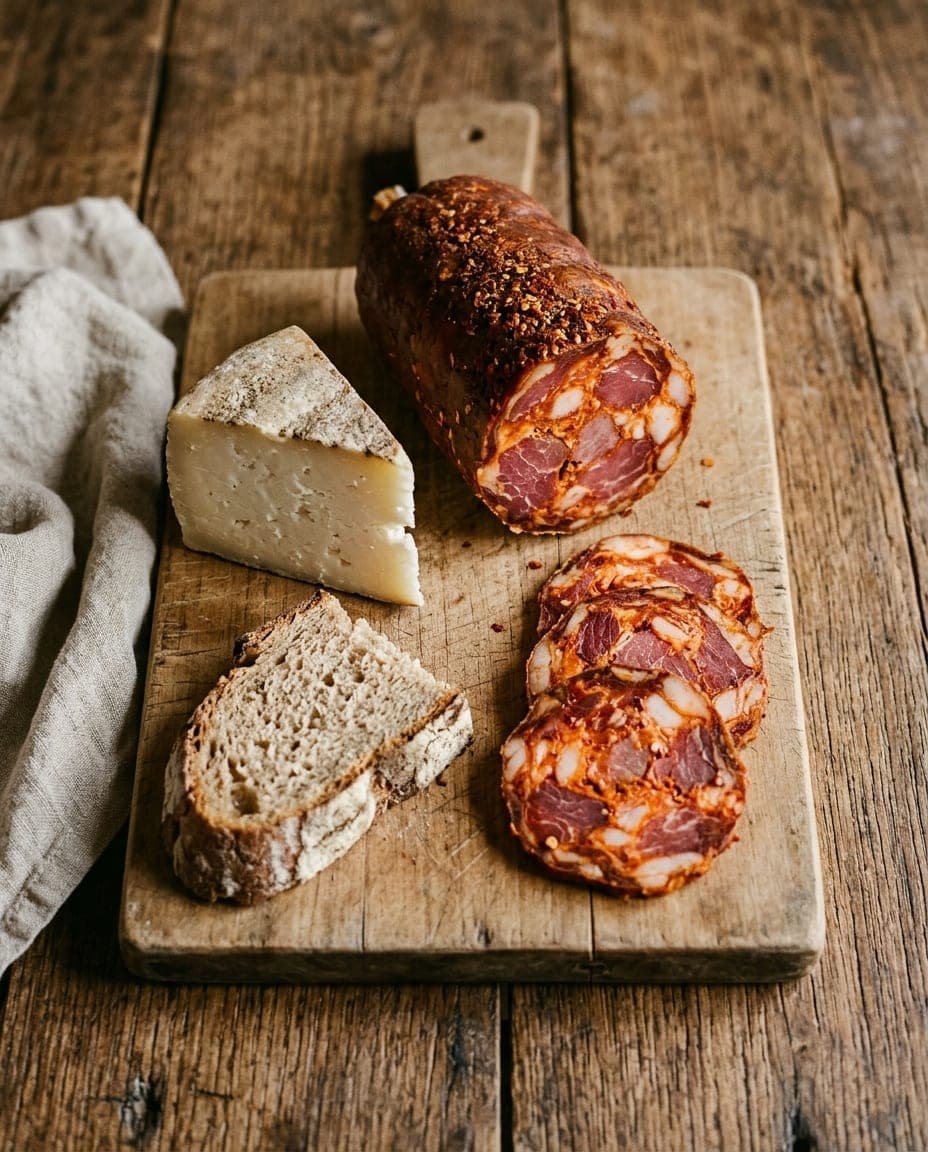
- Local name
- Ventricina vastese
- Served with
- Bread, pecorino
- Best eaten at
- An Abruzzo agriturismo
- Pairs with
- Montepulciano d'Abruzzo
What it is
Ventricina vastese is a distinctive cured meat from the hills surrounding Vasto, in the southern part of the Abruzzo region on Italy's Adriatic coast. It is not a ground salami like those found in Tuscany or Lombardy, but rather a coarse, rustic sausage where large pieces of pork remain visible as distinct cubes within the casing. The mixture is flavoured generously with powdered sweet pepper, chilli and wild fennel, giving the meat a deep orange-red hue that stands out against the white fat.
The name comes from ventre, belly or stomach, which refers to the traditional casing made from a cleaned pig's stomach or bladder and to the rounded shape it gives. This natural skin allows the meat to breathe slowly while it matures for at least three months in cool cellars. The result is a dense, savoury product with a texture that is both chewy and crumbly, holding its shape when sliced thickly but melting slightly on the tongue.
Unlike many industrial meats, ventricina vastese remains a small-scale farmhouse product, rarely found outside the Vasto hinterland. It is listed among Abruzzo's traditional agri-food products (PAT).
How it is made
The preparation begins with high-quality pork, typically from pigs raised locally in the Abruzzo countryside. Lean cuts such as ham and loin, with a smaller share of fat from the belly, are cut by hand into rough cubes using a knife rather than passed through a grinder. These chunks are then tossed with a generous blend of powdered sweet pepper, chilli, salt, garlic, pepper and wild fennel. The mixture is packed tightly into the cleaned pig's bladder or stomach, which acts as both a container and a protective skin during the long curing process.
Once stuffed and tied into a ball of roughly one to three kilograms, the ventricina is hung in cool, airy spaces where it matures for months. The slow drying time allows the flavours to deepen and the texture to firm up without becoming dry or hard.
The process requires patience and careful monitoring of humidity and temperature. If the air is too dry, the casing can crack; if it is too damp, the meat may spoil. This is one reason the product has remained largely in the hands of small producers.
How to eat it
Ventricina vastese is rarely used as an ingredient in cooking; instead, it is eaten raw as part of an antipasto or alongside bread and cheese. The meat is sliced thickly to showcase the visible cubes of pork and the bright red flecks of pepper. These slices are often arranged on a wooden board with local bread, such as a rustic sourdough, and accompanied by pecorino cheese from the Abruzzo mountains.
A traditional pairing is Montepulciano d'Abruzzo, a robust red wine from the same region that complements the spicy, salty notes of the cured meat. The combination works well because the wine's tannins cut through the fat while the chilli in the ventricina adds warmth to the drinker's palate.
For those visiting the area, the best place to try it is at an Abruzzo agriturismo, a working farm that often serves its own produce directly to guests. Here, the meat is likely freshly sliced and still carries the scent of the cellar where it was cured.
Curious facts
- The name comes from the casing. The word ventricina derives from ventre, meaning stomach or belly, referring to the pig's stomach traditionally used as the natural skin for curing.
- Cubes, not mince. Unlike most salamis, ventricina vastese is defined by its large, visible chunks of pork rather than a uniform ground texture.
- Two versions exist. While the Vastese version is firm and sliceable, the ventricina teramana from the Teramo area is finely minced, fattier and spreadable, closer to 'nduja in consistency and use.
- A regional speciality. Ventricina vastese is specific to the Vasto hills, not a product found widely across Italy.
Where to try it
The most authentic experience of ventricina vastese is found in the small towns and hamlets around Vasto, particularly at an Abruzzo agriturismo where local farmers produce their own cured meats. These farms often welcome visitors for tours or simple meals featuring their own products. While the dish may appear on menus in nearby coastal restaurants, the true character of the meat is best appreciated when it comes directly from the producer's cellar.
Where to try it
1 region
 Wine Tasting1 destination
Abruzzo
Nestled between the Apennine mountains and the Adriatic Sea, this region is known for its diverse landscapes, ranging from rugged mountains to sandy beaches. It is the only region in Italy with access to both mountains and coastline, making it a unique destination. L'Aquila, the capital, features stunning medieval architecture and is surrounded by natural parks. The region is famous for its truffles, Montepulciano d'Abruzzo wine, and the ancient practices of shepherding. Explore off-the-beaten-path towns like Sulmona, known for confetti (sugar-coated almonds), and the remote Gran Sasso National Park, home to Italy's highest peak. Local festivals celebrate traditional crafts and culinary delights, providing a deep cultural connection to the land.
Wine Tasting





