Vastedda della Valle del Belice
A rare stretched-curd sheep's cheese from Sicily's Belice valley
- Local name
- Vastedda della Valle del Belice
- Served with
- Bread, olive oil, tomatoes
- Best eaten at
- A Belice valley caseificio
- Pairs with
- Grillo or Catarratto
What it is
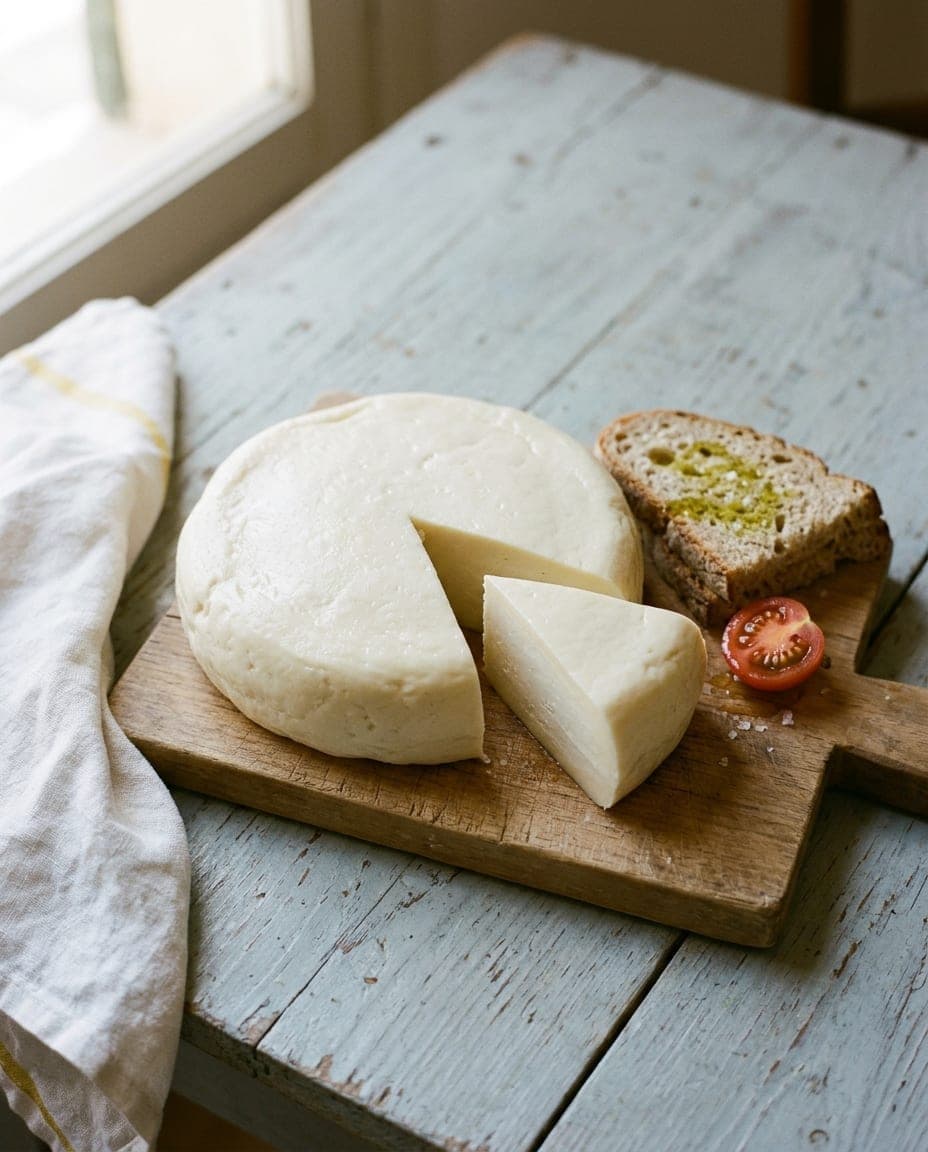
The vastedda della Valle del Belice is a small, flat round of cheese from the Belice valley in western Sicily. It belongs to the family of pasta filata cheeses, where the curd is stretched in hot water before being shaped, but it is distinct because it is made exclusively from sheep's milk rather than the cow or buffalo milk used elsewhere in Italy. It is a protected PDO cheese, made in a defined group of towns in the provinces of Trapani, Agrigento and Palermo, such as Santa Ninfa, Partanna and Gibellina, and is rarely seen on shelves in major cities.
The cheese is white, soft and without a rind. It has a faintly sour taste with a clear sheep's-milk character that does not linger aggressively. Because it is made from fresh milk and meant to be eaten young, it has a short life. It is best consumed within a few days of production, when the texture remains delicate and the flavour is at its most honest. The name itself is debated: it is usually linked to the shallow ceramic dishes, vastedde, in which the cheese is shaped like a flat loaf, while another theory connects it to vasta, "spoiled".
How it came to be
According to the most common account, the cheese is tied to a practical problem faced by shepherds in the hot Sicilian summer. Traditional sheep's-milk cheeses from the region often spoiled quickly in the heat before they could be sold or eaten. To rescue the milk, producers began applying a technique usually reserved for cow's milk: stretching the curd in very hot water, the pasta filata method.
Over time, what began as a way to save the harvest became a cheese in its own right. The Valle del Belice sheep, a local breed, supply the milk, and the result stands on its own as a regional speciality.
What goes into it
The ingredients are minimal, relying on the quality of the local sheep's milk and the skill of the cheesemaker. There is no single factory producing this cheese; it remains a small-scale craft found in farm dairies, or caseifici, throughout the valley. The list of components is short:
- Raw sheep's milk from the local Valle del Belice breed, worked within 48 hours of milking.
- Lamb rennet paste, made from the stomachs of suckling lambs, to curdle the milk; the curd then sours naturally before stretching.
- Hot water used to stretch and knead the curd into its characteristic flat shape of 500 to 700 g.
- Salt, added for flavour and preservation in the final stages.
The lack of additives means the cheese reflects the season and the pasture where the sheep grazed. A batch made in early summer will taste different from one made in autumn, as the pasture changes.
How to eat it
This cheese is designed for simplicity. It is eaten fresh, often as part of a light meal or an afternoon snack. The traditional way is to tear off a piece of the soft white disc and place it on a slice of rustic bread. A drizzle of local olive oil is added, followed by fresh tomatoes from the same valley, perhaps with a pinch of sea salt.
The cheese softens slightly on warm bread, releasing its faint sour notes. It is a light food, meant to refresh rather than fill.
Curious facts
- A rare combination. While pasta filata cheeses like mozzarella are common in Italy, a stretched-curd cheese made from sheep's milk is very unusual.
- Not vegetarian. The milk is curdled with lamb rennet paste, as the PDO rules require.
- No rind. Unlike many Italian cheeses that develop a hard or soft skin over time, the vastedda has no rind at all, remaining soft and white throughout its short life.
- Local breed link. The quality of the cheese depends on the Belice sheep, a local breed adapted to the valley's terrain and climate.
- Simple pairings. The cheese is traditionally eaten with bread, olive oil and tomatoes.
Where to try it
The best place to eat vastedda della Valle del Belice is in the valley itself, specifically at a small caseificio, a farm dairy that makes the cheese on site. It is seldom found far from the source. Dairies in towns such as Santa Ninfa, Partanna and Poggioreale make it, and some let visitors see the stretching process.
At a local caseificio it is typically tasted fresh with bread, oil and tomatoes; the experience is about the connection between the land, the sheep and the cheesemaker.
Where to try it
1 destination
 Wine Tasting
Santa Ninfa
Wine town in Trapani province with cooperative wineries and olive groves.
Wine Tasting





