Tortellini
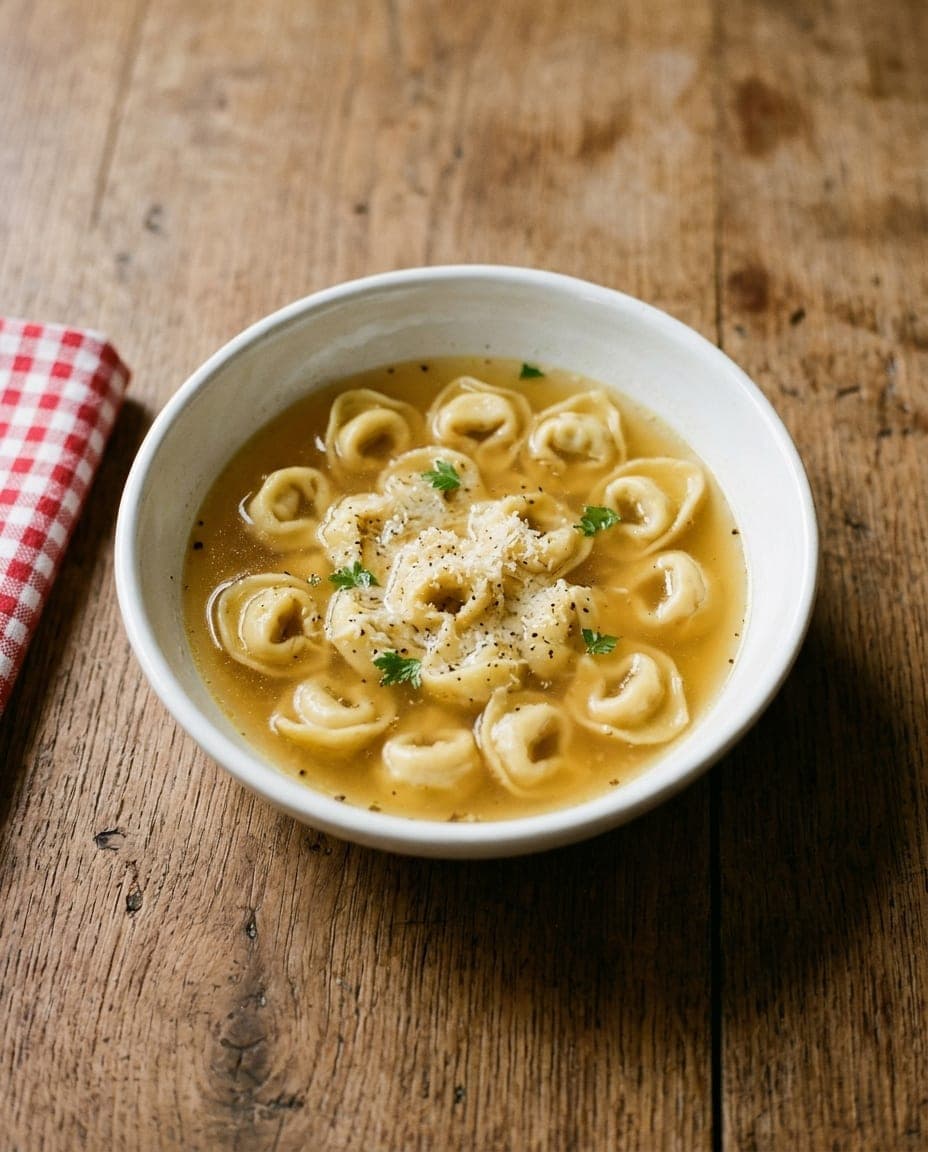
Hand-folded pasta rings served in capon broth, a Christmas staple of Bologna
- Local name
- Tortellini in brodo
- Served with
- Capon broth, grated Parmigiano
- Best eaten at
- A Bologna trattoria
- Pairs with
- Lambrusco
What it is
Tortellini in brodo are small, ring-shaped pasta parcels filled with a mixture of pork and cheese, served floating in a clear, golden broth. They are the signature dish of Bologna and Modena, two neighbouring cities in the Emilia-Romagna region of northern Italy. While stuffed pasta appears in many forms across the country, these particular rings are distinct for their size, their specific filling, and the way they are traditionally presented: not with a heavy cream sauce, but swimming in a light, savoury stock.
The dish is known locally as tortellini in brodo, where brodo means broth. The pasta itself is small, roughly the size of a thumb tip, and folded by hand into a tight ring with a central hole. It is often likened to a navel in shape, a detail that anchors the most famous story told about them.
The name has a plainer origin: tortellino, Bolognese turtlén and Modenese turtlèin, is a diminutive of tortello, itself from torta, a word long used for stuffed pasta. Tortellini in brodo are recorded as a Christmas dish at least since 1708, when a "minestra di tortellini" appeared on the Christmas lunch menu of the monks of San Michele in Bosco in Bologna, and they are still traditionally eaten as a first course on the Christmas table.
The legend of the navel
The story most commonly told about tortellini is set in Castelfranco Emilia, a town on the old Via Emilia between Modena and Bologna, and long disputed between the two. In the best-known version, popularised by a twentieth-century mock-heroic poem, the gods Venus, Mars and Bacchus stop at an inn in Castelfranco. Venus, left alone, summons the innkeeper, who finds her half-undressed. Struck by the perfect shape of her navel, he hurries to the kitchen and creates a pasta to imitate it. Other retellings replace the goddess with a beautiful noblewoman glimpsed through a keyhole.
The tale is appealing and widely repeated in menus and guidebooks, but it remains a story rather than a historical record. Neither Bologna nor Modena can prove which city invented the dish, and the dispute is part of the local culture. What is certain is that the navel story has become inseparable from the image of the pasta itself.
How they are made and what goes inside
The structure of tortellini relies on two essential components: the dough and the filling. The dough is made simply from flour and eggs, rolled out until it is paper-thin. The filling is more complex, combining several types of pork with cheese and spice. On 7 December 1974 the Dotta Confraternita del Tortellino deposited what it called the original recipe with the Bologna Chamber of Commerce; its filling is pork loin, prosciutto crudo, mortadella, Parmigiano Reggiano, egg and nutmeg.
Mortadella, the smooth, cooked pork sausage of Bologna, gives the filling a subtle sweetness and distinctive character. The meat is finely chopped or minced before being mixed with the grated cheese, egg and a pinch of nutmeg. Family recipes vary in the details, but the core ingredients remain consistent across the area.
The making of the pasta is a manual process that cannot be rushed. A cook places a small amount of filling on a small square of dough, folds it into a triangle, and then wraps it around a finger, pinching the ends together to create the ring. In the days before Christmas, when demand for the dish peaks, households gather to roll, fill and fold the pasta together.
The broth that holds them
The brodo in which the tortellini swim is as important as the pasta itself. In Emilia-Romagna, the gold standard is a capon broth, made by slowly simmering a castrated rooster with vegetables such as carrots, celery and onions; many cooks combine hen or capon with beef. The result is a liquid that is golden in colour, aromatic and deeply savoury without being heavy.
The meat from which the broth was made is often served afterwards as bollito, boiled meat, ensuring that nothing goes to waste. The tortellini are cooked briefly in the simmering broth until they float to the surface. They should be tender but retain a slight resistance when bitten. A generous grating of Parmigiano Reggiano is added at the table, melting slightly into the hot liquid.
Why Christmas matters
Tortellini in brodo are most closely associated with Christmas Day in Bologna and Modena, when they open the long family lunch on 25 December. The pasta is usually folded in the days beforehand, often on Christmas Eve, with several generations working side by side at the table. The resulting meal becomes a marker of family unity and regional identity.
How to eat it
Tortellini in brodo are treated as a first course rather than a main meal. They are served in deep bowls or soup plates, with enough broth to float the pasta comfortably, and eaten with a spoon so that the filling and the broth are tasted together.
Grated Parmigiano Reggiano is added just before eating; it melts into the hot broth, enhancing its savouriness without thickening it. A glass of Lambrusco, the slightly sparkling red wine of the area, is a common companion. Its acidity and bubbles cut the richness of the filling and cleanse the palate between spoonfuls. The portion is usually modest, leaving room for the meat course that follows.
Curious facts
- The 1974 deposit. The Dotta Confraternita del Tortellino recorded its "original" recipe with the Bologna Chamber of Commerce on 7 December 1974, fixing the traditional filling ingredients.
- Broth first. Tortellini are also served with cream or meat sauce, but in Bologna and Modena the broth is regarded as the one true way.
- Small but mighty. Tortellini are much smaller than tortelloni, the larger stuffed pasta often filled with ricotta and greens and usually served with butter and sage.
Where to try it
The best place to eat tortellini in brodo is a traditional trattoria in Bologna or Modena, particularly one that still folds the pasta by hand rather than using machine-made versions.
Where to try it
2 destinations
 Wine Tasting
Valeggio sul Mincio
Medieval village near Lake Garda with Custoza wine production and scaligero castle.
Wine TastingHiking Camper Van Rentals
Bologna
Medieval city known for its towers, vibrant cuisine, and rich history.
Camper Van RentalsLocal Cuisine
1 region
 Wine Tasting9 destinations
Emilia-Romagna
This region in Italy is renowned for its diverse landscapes, ranging from the Apennine Mountains to the Adriatic coastline. It is the only Italian region with a significant stretch of coastline, featuring vibrant seaside towns like Rimini. Bologna, the capital, is famous for its medieval architecture and culinary heritage, being the birthplace of tagliatelle al ragù. The region is also known for its rich history, with towns like Modena showcasing UNESCO-listed sites such as its cathedral and the renowned balsamic vinegar. Slow travelers can explore hidden gems like the medieval village of Dozza, known for its painted walls, or the thermal baths in Salsomaggiore Terme. Emilia-Romagna is the largest region in northern Italy, offering a blend of art, culture, and gastronomy that invites deeper exploration.
Wine TastingHikingCamper Van RentalsLocal Cuisine





