Tartufo di Pizzo
- Vegetarian
- Local name
- Tartufo di Pizzo
- Best eaten at
- A Pizzo piazza gelateria
What it is
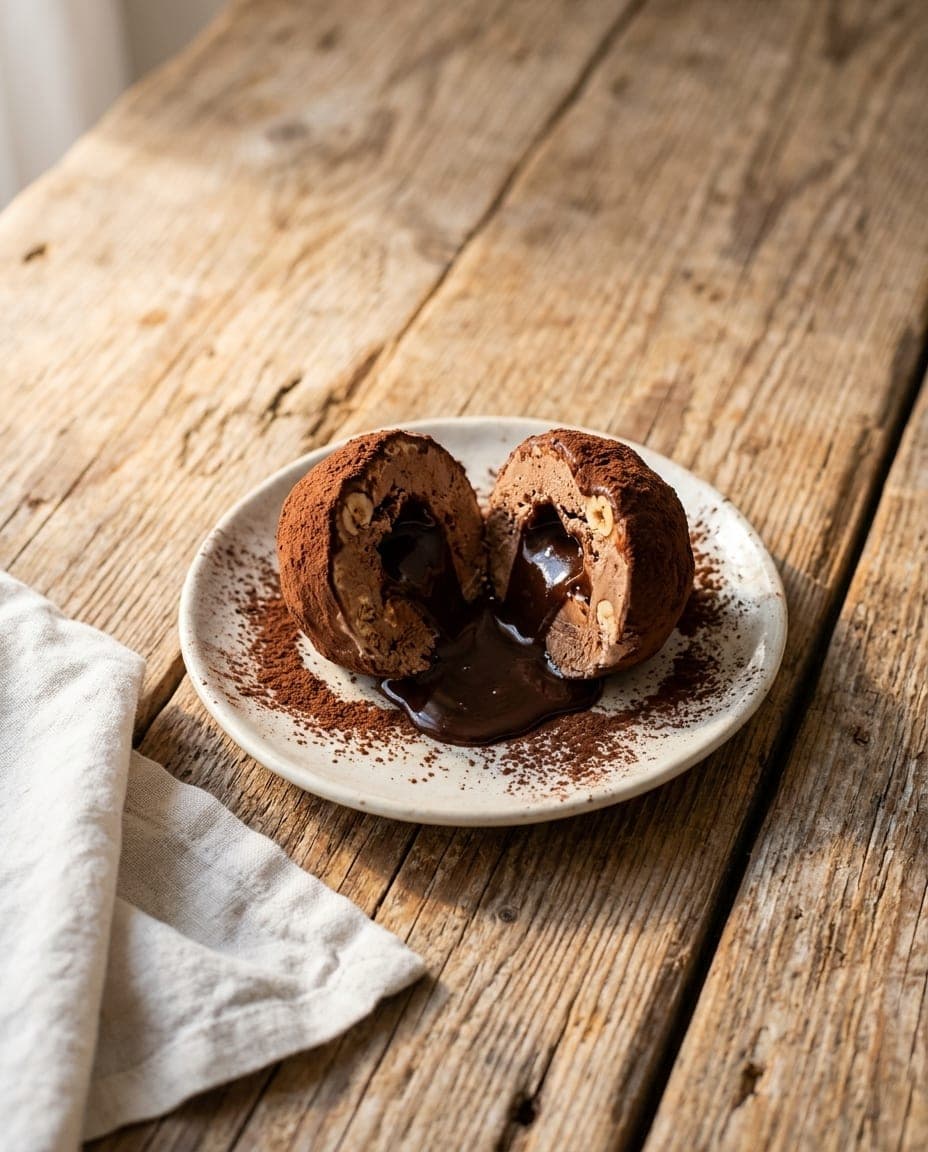
The tartufo di Pizzo is a distinctive sweet from the town of Pizzo on the Calabrian coast of southern Italy. It looks like a rough sphere of dark brown ice cream, dusted with cocoa powder, but its interior holds a surprise. The treat consists of two flavours of gelato, hazelnut and chocolate, hand-moulded around a core of liquid chocolate that flows out when the ball is cut open.
Unlike mass-produced ice creams found in supermarkets, the classic tartufo di Pizzo is shaped by hand rather than in a mould. The result is never perfectly round; each one has a slightly irregular shape that marks it as handmade. When served, the ball is cut open, revealing the dark, runny centre that spills onto the plate.
The dessert is so closely tied to its place of origin that it carries a protected geographical indication (PGI). While variations of chocolate-filled ice cream exist elsewhere, the tartufo di Pizzo remains a local speciality, celebrated for the contrast between the cold, nutty gelato and the flowing chocolate heart.
The story of the noble wedding
The most common account dates the tartufo to 1952 and credits Giuseppe De Maria, a local ice-cream maker known as Don Pippo. According to the best-known version, he was preparing desserts for a grand wedding attended by members of the nobility (some tellings speak instead of a feast for a visiting prince) and ran short of moulds for the individual ice creams.
He improvised: taking hazelnut and chocolate gelato in the palm of his hand, he shaped a rough ball around a spoonful of melted chocolate and dusted it with sugar and cocoa. The result looked like a truffle, which gave the sweet its name. The guests were reportedly delighted, and the tartufo grew from a one-off improvisation into the signature treat of the town.
The details vary from teller to teller and cannot be confirmed in documents, so the story is best taken as local legend. It remains a central part of Pizzo's culinary identity and a reminder that some of the best dishes begin with a moment of improvisation rather than a rigid plan.
How it is made
The process of making a tartufo di Pizzo relies on technique rather than machinery. The confectioner takes a portion of hazelnut gelato, adds chocolate gelato, and presses a hollow into the centre for the liquid chocolate. The ball is then closed and shaped by hand, today often with the help of a sheet of food paper, pressing gently to form it without melting the ice cream.
This hand-moulding means that no two tartufi are identical. After shaping, the balls are dusted with cocoa powder, sometimes mixed with sugar, which gives the treat its earthy colour and its resemblance to a truffle. They are then kept frozen until served.
The chocolate heart is a crucial element. It does not freeze solid like the outer layers but stays soft and semi-liquid, ready to flow as soon as the ball is cut. The result is a dessert that contrasts the cold, creamy hazelnut and chocolate gelato with the rich, flowing core.
What goes into it
The ingredients are simple. The outer layers consist of two gelati: one made with hazelnuts and the other with chocolate. The centre contains a chocolate filling that remains fluid at serving temperature, and the exterior is dusted with cocoa powder.
Traditional producers stress gelato made without artificial additives, and the tartufo is still made in the town's gelaterias. The focus is always on the quality of the base ingredients: milk, sugar, hazelnuts and good chocolate.
How to eat it
The tartufo di Pizzo is best enjoyed in the town itself, especially in the cafés on the main square, which overlooks the Tyrrhenian Sea. The setting is part of the experience: open-air tables, the sea below, and a plate arriving from the gelateria counter.
The tartufo is presented as a whole ball on a small plate. The moment of eating comes when the server or the diner cuts into it with a spoon or knife. As the cut is made, the chocolate heart spills out, mixing with the gelato on the plate.
The texture changes with every mouthful: the dry dusting of cocoa, the smoothness of the gelato, and the sudden rush of the liquid centre. It is a dessert that rewards a slow pace rather than a rushed bite.
Curious facts
- A hand-made sphere. No two tartufi di Pizzo are identical because they are shaped by hand, resulting in irregular shapes and sizes.
- The liquid heart. The chocolate core is not frozen solid; it stays semi-liquid so it flows when the ball is cut open.
- A protected name. The dessert carries a protected geographical indication (PGI).
- Born for lack of moulds. Local tradition credits Don Pippo De Maria with inventing the treat in 1952, when he ran out of moulds during a grand celebration.
- The sea view. The classic place to eat it is the clifftop square of Pizzo, overlooking the Tyrrhenian Sea.
Where to try it
The most authentic experience of the tartufo di Pizzo is in the town of Pizzo itself, particularly in the gelaterias around the main square overlooking the sea. Several have been serving it for decades.
Versions of the dessert can be found elsewhere in Calabria and beyond, but Pizzo is where it was born. The gelaterias often display the cocoa-dusted balls on the counter, and staff are usually happy to explain the process or cut the tartufo at the table so the chocolate flows as intended.
The late afternoon, when the light falls on the sea and the square fills with people, is a fine time to visit. It turns the tartufo di Pizzo into more than just a sweet: it becomes a memory of the place where it was made.
Where to try it
1 region
 Boat Rentals3 destinations
Calabria
Calabria forms the toe of Italy, a narrow strip of land pinched between two seas and lifted into three mountain ranges. This shape is what makes it a region built for slow travel: an hour's drive from a fishing harbour on the Tyrrhenian coast leads into chestnut forests and mountain pastures; another hour reaches olive terraces above the Ionian Sea. Nothing here rewards rushing. A Calabria itinerary works best as a loop through a handful of towns, with two or three nights in each, rather than a checklist of day trips. Food sets the pace as much as geography does. Calabria is one of Italy's strongholds of Slow Food, the movement that began by defending exactly this kind of small-scale, tied-to-the-land cooking. 'Nduja, the spreadable spicy salami, and the sweet red onion of Tropea are both eaten the way they always have been — with bread, in a kitchen, at a pace nobody is timing. The region's wine road runs through the hills around Cirò, where Gaglioppo grapes have long been grown. Agriturismo stays are the natural base for exploring it: working farms with rooms attached, where dinner is whatever came out of the garden or off the hillside that day. The hill towns are where Calabria's unhurried character is easiest to feel. Gerace sits on a limestone outcrop above the Ionian coast, its medieval streets largely unbothered by modern building. Stilo, tucked into the Serre mountains, is known for the Cattolica, a small Byzantine church that has watched over the town for centuries. Bova, high in the Aspromonte massif, is one of the last places where Greko, an ancient Greek dialect, is still spoken by older residents — a reminder that Calabria was part of Magna Graecia long before it was part of Italy. Pentedattilo, built into a rock formation shaped like a hand, was largely abandoned and is now slowly being resettled by artists and craftspeople. The coast has its own rhythm. Tropea, perched on a cliff above the Tyrrhenian, is Calabria's best-known seaside town, its old centre a tangle of stone alleys leading to a clifftop view over the water and, on clear days, the Aeolian Islands. Scilla, further south, is a fishing village split between a castle-topped headland and a beach lined with pastel houses. On the Ionian side, the Aragonese castle at Le Castella stands on its own small island, connected to shore by a narrow strip of sand. History here goes back further than most of Italy. The Riace Bronzes, two full-size Greek statues pulled from the sea off the Ionian coast, are held in Reggio Calabria's archaeological museum and remain among the finest survivals of classical bronze casting. Locri, nearby, preserves the ruins of an ancient Greek city, its temple foundations and theatre still visible among the olive groves. Inland, three national parks give Calabria a green, cool counterpoint to its coastline. The Sila plateau, with its pine and beech forests and glacial lakes, is grazing land for the black pigs that go into the region's cured meats. Aspromonte, the mountain massif at the very tip of the peninsula, holds waterfalls, chestnut woods and the Greek-speaking villages of the Bovesìa. Pollino, shared with neighbouring Basilicata, is wilder still, home to some of the oldest pine trees in Europe. A week to ten days is enough to move through Calabria properly: a few days on one coast, a few in the hills, a few on the other coast, without ever needing to rush the return. Longer stays simply mean slower mornings and more time in each village square.
Boat RentalsWine Tasting





