Spaghetti all'amatriciana
Spaghetti all'amatriciana from Amatrice, Lazio
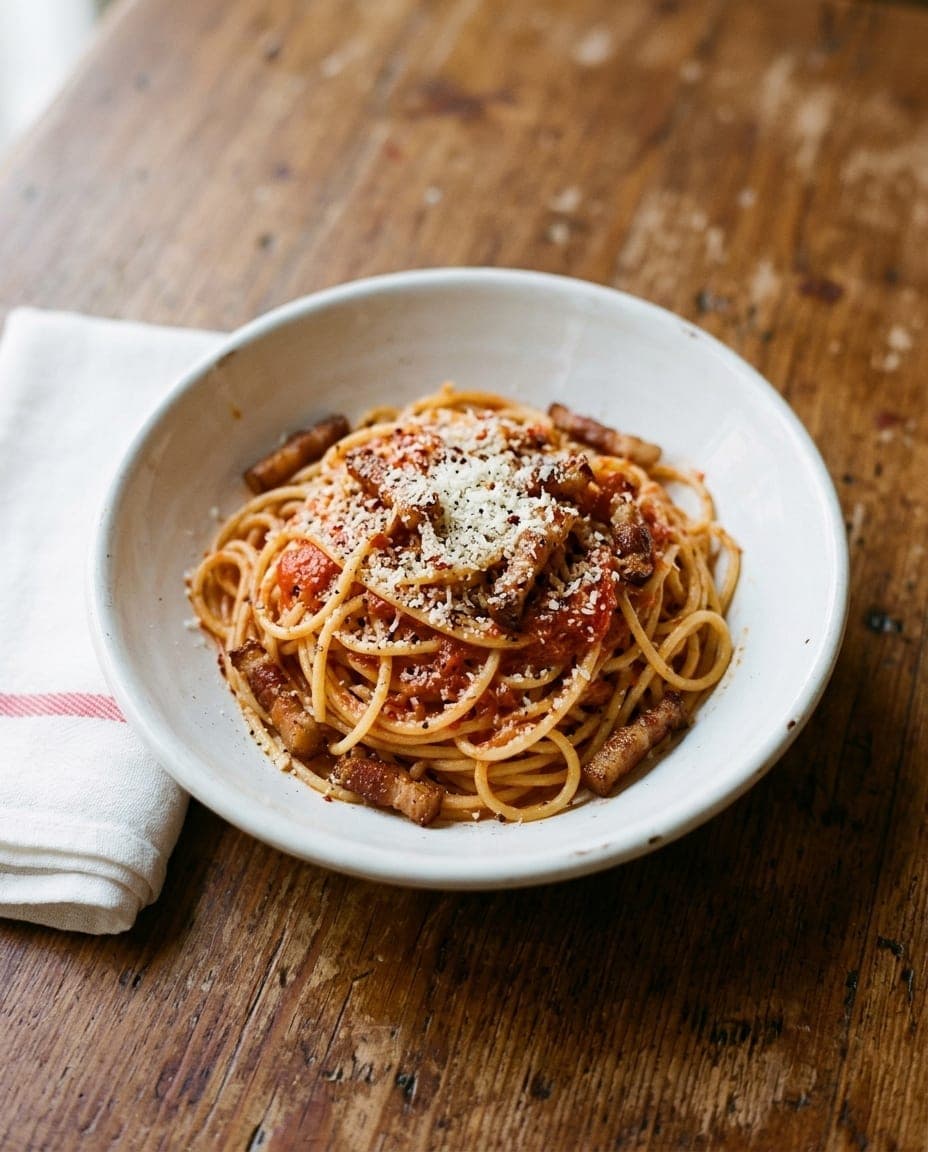
- Local name
- Spaghetti all'amatriciana
- Served with
- Grated Pecorino
- Best eaten at
- A Roman trattoria
- Pairs with
- Cesanese or Montepulciano
What it is
Spaghetti all'amatriciana is one of the four great pasta dishes of Rome, alongside carbonara, cacio e pepe and gricia. It stands apart as the one with the clearest roots outside the city: it comes from Amatrice, a small mountain town in the province of Rieti, right by the border with Abruzzo. The dish turns a handful of simple ingredients into something deeply savoury and rich.
The name tells the story of its birthplace. While many assume it is a Roman invention, the recipe belongs to Amatrice, a town of shepherds and mountain trade routes. The dish arrives as a tangle of spaghetti coated in a glossy, orange-red sauce, flecked with crisp pieces of cured pork and finished with a dusting of sharp cheese. It is not a light pasta, yet the sauce clings to every strand without being heavy.
Unlike carbonara, which relies on eggs to create its creaminess, amatriciana achieves its texture through the emulsion of rendered pork fat and tomato.
The mountain origin
Amatrice lies at the confluence of the Tronto and Castellano rivers, within the Gran Sasso and Monti della Laga National Park. It belonged to Abruzzo, in the province of L'Aquila, until 1927, when it passed to the new province of Rieti and so to Lazio. For centuries, shepherds from the area moved their flocks between the high pastures of the Laga mountains and the lowlands. Their diet was built around what could be preserved, such as salted pork and hard cheese.
The dish that became known as amatriciana evolved from an older shepherds' recipe that is essentially gricia: pasta with guanciale (cured pork jowl), Pecorino and black pepper. At the end of the 18th century, once tomatoes from the Americas had become common in the region, tomato was added and the dish took the name of the town. The new version kept the pork and cheese but added the acidity of the tomato.
While Rome adopted the dish and made it famous worldwide, its true home remains Amatrice. Since 2020 the recipe has been registered in the EU as a Traditional Speciality Guaranteed (TSG, STG in Italian) under the name Amatriciana Tradizionale. This designation protects the method and ingredients rather than the place of production.
What goes into it
The orthodox version of spaghetti all'amatriciana follows a strict set of rules regarding its components, though individual cooks may vary slightly in technique. The ingredients are few, but each one must be of high quality.
- Guanciale: Cured pork jowl, distinct from pancetta or bacon. It is cut into strips or small pieces and cooked slowly until the fat renders and the meat turns golden and crisp. The TSG recipe adds a splash of wine at this stage.
- Tomato: Peeled tomatoes or passata, cooked down so that they blend with the pork fat. No onion or garlic is used in the traditional version, which distinguishes it from many other pasta sauces.
- Pecorino: Pecorino di Amatrice or Pecorino Romano, a hard, salty sheep's milk cheese. It is grated finely and used to finish the dish, melting into the hot sauce.
- Chilli: A small piece of dried chilli, optional in the TSG recipe, gives a gentle heat.
- Spaghetti: While bucatini (a thick, hollow pasta) is often served in Rome, Amatrice itself is associated with spaghetti.
The guanciale is fried first to release its fat, followed by the chilli and the tomato. Once the sauce has reduced and thickened, the cooked pasta is added to the pan, along with a splash of pasta water if needed, to help the sauce cling. Finally, the cheese is stirred in off the heat to prevent it from clumping.
How it is eaten
In Italy, spaghetti all'amatriciana is served as a primo, the pasta course, though it is substantial enough to make a meal on its own. In a traditional Roman trattoria, the pasta arrives in a deep bowl, often still steaming, with the cheese already mixed in and more offered at the table.
The dish is best eaten immediately after plating. As it cools, the fat from the guanciale sets and the sauce loses its glossy sheen. A fork is the only tool required. The experience is one of texture: the crisp edges of the pork contrasting with the soft pasta and the sharp, salty finish of the Pecorino.
The wine needs to stand up to the salt and fat. A glass of Cesanese, a red wine from Lazio with good acidity and notes of dark fruit, is a natural local match. Alternatively, a Montepulciano d'Abruzzo offers similar structure.
The earthquake and the global table
On 24 August 2016 a powerful earthquake struck the area, destroying much of Amatrice and killing more than two hundred people in the town alone. The town's historic centre was reduced to rubble. In the aftermath, the dish became a symbol of resilience and solidarity.
Restaurants across Italy and around the world put spaghetti all'amatriciana on their menus to raise funds for Amatrice, donating part of the price of each plate to the town's recovery. The effort brought international attention to the town and its cuisine. Eating amatriciana became a way of remembering Amatrice and supporting its future.
Curious facts
- No onion or garlic. The traditional recipe leaves out alliums. Adding them is considered a deviation from the authentic style, even though many modern variations include them.
- A protected recipe. Amatriciana Tradizionale has been an EU Traditional Speciality Guaranteed since 2020, fixing the ingredients and method that can bear the name.
- The guanciale rule. Pancetta is often used in home cooking, but it is not guanciale. The cured jowl has a distinct texture and fat content that cannot be replaced without altering the character of the dish.
- Bucatini vs spaghetti. While Rome frequently serves the dish with bucatini, Amatrice itself favours spaghetti.
- A global fundraiser. Following the 2016 earthquake, restaurants worldwide sold the dish to raise money for the rebuilding of Amatrice.
Where to try it
The most direct connection is found in Amatrice itself, where restaurants have reopened since the earthquake, and in the surrounding valleys of the Rieti area.
In Rome, the dish is a staple of any traditional trattoria or osteria and appears on the menu of almost every establishment that serves Roman classics. Versions made with onion or garlic are adaptations rather than the original style; the best results come from kitchens that respect the classic recipe and use high-quality guanciale and Pecorino.
Where to try it
1 destination

1 region
 Camper Van Rentals2 destinations
Lazio
Lazio is Italy's second-largest region, renowned for its rich history and diverse landscapes. The capital, Rome, boasts ancient ruins and vibrant street life, but the surrounding areas are equally captivating. Explore the hill towns like Viterbo, known for its thermal springs and medieval architecture. The region also features the stunning coastline of the Tyrrhenian Sea, offering hidden beaches and charming fishing villages. Lazio is famous for its culinary traditions, including artichokes from Rome and wines from Frascati. The region is home to the beautiful countryside of the Castelli Romani, dotted with vineyards and historic castles, providing a glimpse into local life away from the tourist crowds.
Camper Van RentalsHikingWine Tasting





