Soppressata di Calabria
Pressed Calabrian salami with chilli, served with bread and Cirò wine
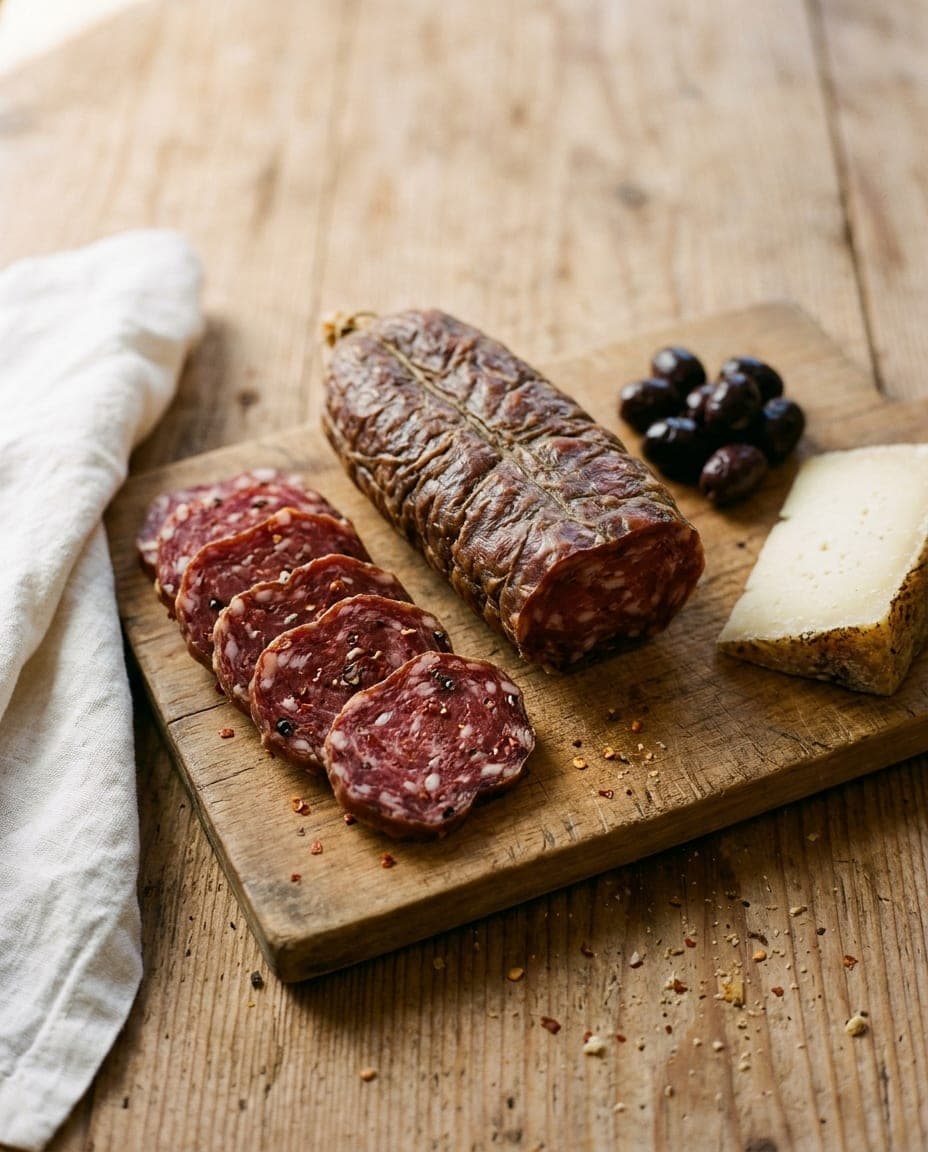
- Local name
- Soppressata di Calabria
- Served with
- Bread, olives, cheese
- Best eaten at
- A Calabrian agriturismo
- Pairs with
- Cirò red
What it is
Soppressata di Calabria is a pressed cured meat from the southern tip of Italy. It is a salami that stands out for its red colour, which comes from a generous use of local red pepper, and for its slightly flattened shape rather than the perfectly round cylinder common to many other salamis. The name describes the method: the verb soppressare means to press down, referring to the weights placed over the meat during curing that flatten it.
This is not a national staple like the northern Italian mortadella or the Tuscan finocchiona. It is a regional speciality tied closely to Calabria. Its DOP status, granted in 1998, protects its name and ensures it follows specific rules about origin and production. It is a savoury, intense meat that demands attention on the plate, often serving as the star of an antipasto or a simple lunch with bread.
How the pressing shapes the salami
The defining feature of this salami is how it is cured. After the pork is minced to a medium grain and mixed with salt and pepper, it is stuffed into natural pork casings, pricked and tied by hand. Once filled, the casings are not simply left to hang freely in the air like many other salamis. Instead, they are pressed under boards or weights for a time as the meat begins to dry.
This pressing process does two things. It flattens the sausage into a slightly squashed cylinder, roughly 15 centimetres long, giving it a distinctive profile that is easy to slice. It also compresses the texture, creating a firm, dense interior where the fat and lean meat are tightly bound together. The result is a slice that holds its shape well but melts in the mouth.
What goes into it
The ingredients are simple, yet the quality of each element matters greatly for the final flavour. The base is pork from the ham and shoulder, with a measured share of hard fat (12 to 15 per cent under the DOP rules). Traditional breeds such as the local Calabrese pig are among those named in the regulations.
The seasoning is where the character comes from. Salt is essential for preservation, and the rest comes from black peppercorns and Calabrian red pepper, either sweet or hot. The hot version gives a noticeable burn and a vivid red colour, while the sweet version is milder but still carries the region's signature colour.
- Pork: Lean ham and shoulder meat with hard fat, minced to a medium grain.
- Red pepper: Sweet or hot, colouring the meat red; the hot version adds heat.
- Black pepper and salt: For seasoning and preservation.
- Natural casing: The pork casing that holds the meat together during drying.
The DOP product is aged for at least 45 days. At home, soppressata is traditionally stored under a layer of lard or in oil to keep it moist and prevent it from drying out too much during long storage.
Where it comes from
Soppressata di Calabria is born from the specific conditions of the Calabrian landscape. The region is known for its rugged hills and warm, dry climate, which suits the curing of meats. But two things define the salami more than any other: the pigs and the pepper.
Calabria has a long tradition of pig-rearing and of curing pork at home. The region is also closely associated with chilli, which runs through its whole cuisine.
The DOP regulations cover the whole of Calabria. The pigs must be born in Calabria or one of the neighbouring southern regions (Basilicata, Campania, Puglia or Sicily), raised in Calabria from a young age, and slaughtered and processed within the region. This link between the land and the product means that a true Soppressata di Calabria tastes distinctly of the south.
How it is eaten
Soppressata di Calabria is rarely eaten on its own. It is designed to be part of a spread. The traditional way to serve it is sliced fairly thick, so the texture and the even distribution of fat and pepper can be appreciated. These slices are placed on a wooden board alongside crusty bread, often from the same region, which acts as a neutral base for the strong flavours.
It pairs naturally with other Calabrian products. Olives from the local groves provide a salty contrast to the meat, while chunks of cheese like Pecorino or Caciocavallo cut through the fat.
For the drink, a Calabrian red wine is the standard companion. Cirò, a robust red made from the Gaglioppo grape, is the classic choice. The tannins in the wine balance the fat and the heat of the chilli, cleansing the palate between bites.
Curious facts
- The name describes the shape. The term soppressata comes from the Italian verb for pressing, referring to the weights used to flatten the salami during curing.
- Red throughout. The red pepper is mixed into the whole mass of meat rather than rubbed on the surface.
- A regional identity. It has been a DOP product since 1998, meaning its name and production methods are legally protected.
- Stored in fat. At home, the salami is often kept under lard or in oil rather than just hanging in the air.
- Not a national dish. While popular across Italy now, it remains a speciality of Calabria and is not found in the same form in the north.
Where to try it
The best place to find authentic Soppressata di Calabria is in the region itself, particularly at a Calabrian agriturismo or a small rural farm shop. It appears on the menu of traditional trattorias in towns like Catanzaro or Reggio Calabria, usually presented as part of a larger antipasto platter, ideally sliced thick to show off the depth of the pepper and the texture of the meat.
Where to try it
1 region
 Boat Rentals3 destinations
Calabria
Calabria forms the toe of Italy, a narrow strip of land pinched between two seas and lifted into three mountain ranges. This shape is what makes it a region built for slow travel: an hour's drive from a fishing harbour on the Tyrrhenian coast leads into chestnut forests and mountain pastures; another hour reaches olive terraces above the Ionian Sea. Nothing here rewards rushing. A Calabria itinerary works best as a loop through a handful of towns, with two or three nights in each, rather than a checklist of day trips. Food sets the pace as much as geography does. Calabria is one of Italy's strongholds of Slow Food, the movement that began by defending exactly this kind of small-scale, tied-to-the-land cooking. 'Nduja, the spreadable spicy salami, and the sweet red onion of Tropea are both eaten the way they always have been — with bread, in a kitchen, at a pace nobody is timing. The region's wine road runs through the hills around Cirò, where Gaglioppo grapes have long been grown. Agriturismo stays are the natural base for exploring it: working farms with rooms attached, where dinner is whatever came out of the garden or off the hillside that day. The hill towns are where Calabria's unhurried character is easiest to feel. Gerace sits on a limestone outcrop above the Ionian coast, its medieval streets largely unbothered by modern building. Stilo, tucked into the Serre mountains, is known for the Cattolica, a small Byzantine church that has watched over the town for centuries. Bova, high in the Aspromonte massif, is one of the last places where Greko, an ancient Greek dialect, is still spoken by older residents — a reminder that Calabria was part of Magna Graecia long before it was part of Italy. Pentedattilo, built into a rock formation shaped like a hand, was largely abandoned and is now slowly being resettled by artists and craftspeople. The coast has its own rhythm. Tropea, perched on a cliff above the Tyrrhenian, is Calabria's best-known seaside town, its old centre a tangle of stone alleys leading to a clifftop view over the water and, on clear days, the Aeolian Islands. Scilla, further south, is a fishing village split between a castle-topped headland and a beach lined with pastel houses. On the Ionian side, the Aragonese castle at Le Castella stands on its own small island, connected to shore by a narrow strip of sand. History here goes back further than most of Italy. The Riace Bronzes, two full-size Greek statues pulled from the sea off the Ionian coast, are held in Reggio Calabria's archaeological museum and remain among the finest survivals of classical bronze casting. Locri, nearby, preserves the ruins of an ancient Greek city, its temple foundations and theatre still visible among the olive groves. Inland, three national parks give Calabria a green, cool counterpoint to its coastline. The Sila plateau, with its pine and beech forests and glacial lakes, is grazing land for the black pigs that go into the region's cured meats. Aspromonte, the mountain massif at the very tip of the peninsula, holds waterfalls, chestnut woods and the Greek-speaking villages of the Bovesìa. Pollino, shared with neighbouring Basilicata, is wilder still, home to some of the oldest pine trees in Europe. A week to ten days is enough to move through Calabria properly: a few days on one coast, a few in the hills, a few on the other coast, without ever needing to rush the return. Longer stays simply mean slower mornings and more time in each village square.
Boat RentalsWine Tasting





