Schüttelbrot
A hard, spiced rye flatbread from South Tyrol's farmhouse ovens
- Vegetarian
- Local name
- Schüttelbrot
- Served with
- Speck, cheese
- Best eaten at
- Törggelen in South Tyrol
- Pairs with
- Vernatsch
What it is
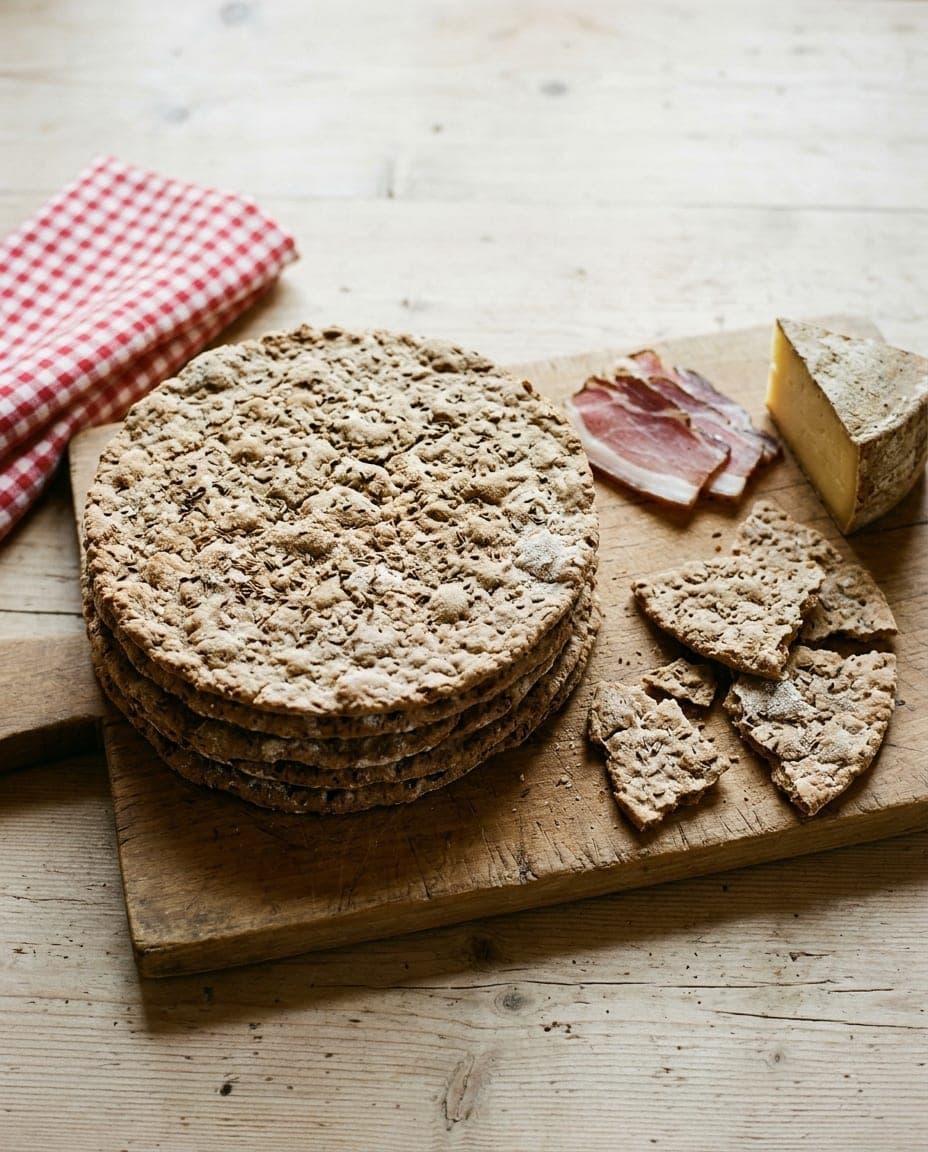
Schüttelbrot is a hard, thin flatbread native to the Italian province of South Tyrol, where German-speaking traditions remain strong in the Alpine valleys. It is not a soft loaf for sandwiches but a brittle disc of rye dough, baked until dry and crisp so that it can be stored for months without going stale. The bread's defining feature is its texture: when broken, it shatters into shards rather than tearing, releasing the aroma of caraway, fennel and sometimes blue fenugreek, known locally as Brotklee.
The name comes from the German verb schütteln, meaning to shake. This describes the method used by bakers in South Tyrol for generations. A ball of soft rye dough is placed on a wooden board and shaken with a rocking motion until it flattens into a thin, irregular disc. The resulting bread is baked dry, creating a preservation method that allowed rural households to stock up on food before the winter snows blocked the mountain passes. The earliest written mention is usually traced to a Tyrolean bakers' ordinance of 1610.
How it is made
The process begins with a simple rye dough, leavened with yeast or a sourdough starter and seasoned with spices, which is mixed until smooth. The baker shapes the dough into a ball and places it on a wooden board. With a rhythmic shaking motion, the baker rocks the dough back and forth, flattening it into a thin disc. This technique gives the bread its characteristic irregular shape and thinness, ensuring it bakes evenly and dries out completely.
Once flattened, the dough is baked, traditionally in a wood-fired oven, until it is hard and brittle. The low moisture content means the bread does not spoil quickly, allowing farm families to bake large quantities only a few times a year. This preservation quality was essential for mountain communities where fresh baking was not always possible during harsh winters. The result is a bread that can be kept for months, often stored in dry, airy places until needed.
The farmhouse snack
Schüttelbrot is traditionally broken by hand rather than cut with a knife. The shards are then paired with local Speck, the smoked cured ham of South Tyrol, and various cheeses. This combination forms the core of the Marende, a mid-morning or afternoon farmhouse snack that has been part of Alpine life for centuries. The crisp bread provides a satisfying crunch against the salty, smoky flavour of the Speck and the creamy texture of the cheese.
The bread finds its most celebrated moment during Törggelen, the autumn custom of visiting farm taverns to taste the new wine. During these gatherings, guests sit around long tables, enjoying roasted chestnuts, hearty dishes and the local wine alongside plates of Schüttelbrot and Speck. The bread's durability makes it ideal for such occasions, as it does not soften quickly even in a humid room.
Where to find it
Schüttelbrot is found throughout South Tyrol's German-speaking valleys, with the Eisack Valley and the Vinschgau known for slightly different styles. It is available in local bakeries, farm shops and traditional restaurants that serve regional specialities. The bread is often sold in bundles or wrapped in paper, ready for storage at home. It is not a nationwide Italian product: since 2020 the name Südtiroler Schüttelbrot has been protected in the EU as a Protected Geographical Indication (PGI), with production limited to the province of Bolzano.
For the most authentic experience, a Törggelen gathering in autumn or a rustic farmhouse inn in the mountains is the place to look. The bread pairs well with Vernatsch, the local red wine, which complements its spicy notes without overwhelming them.
Curious facts
- The name describes the action. The word schütteln refers to the shaking motion used to flatten the dough, a technique closely tied to this bread.
- A winter survival food. Its dry texture allowed mountain families to store it for months without refrigeration or spoilage.
- Broken by hand. Cutting with a knife is uncommon; the brittle shards are meant to be snapped and shared.
- A protected name. Südtiroler Schüttelbrot has been an EU-protected PGI since 2020, reflecting its cultural importance.
- Best in autumn. While available year-round, it shines during the Törggelen season when paired with local wine and cured meats.
Where to try it
1 region
 Wine Tasting6 destinations
Trentino-Alto Adige
This northern Italian region, bordered by Austria and Switzerland, is known for its unique blend of Italian and Central European cultures. The largest city, Trento, is famous for its Renaissance history and the Council of Trent. Bolzano serves as the gateway to the Dolomites, a UNESCO World Heritage site, offering stunning hiking trails and alpine scenery. The region is renowned for its wine production, particularly Gewürztraminer and Pinot Grigio. Visitors can explore lesser-known villages like Ortisei and San Candido, which showcase local crafts and traditions. With its rich history, diverse landscapes, and authentic cuisine, this area is ideal for those looking to explore at a relaxed pace.
Wine TastingHikingCastlesAgritourism





