Scapece gallipolina
Fried fish preserved in saffron breadcrumbs and vinegar from Gallipoli's wooden tubs
- Local name
- Scapece gallipolina
- Best eaten at
- A Gallipoli trattoria or festival stall
- Pairs with
- Salento rosé
What it is
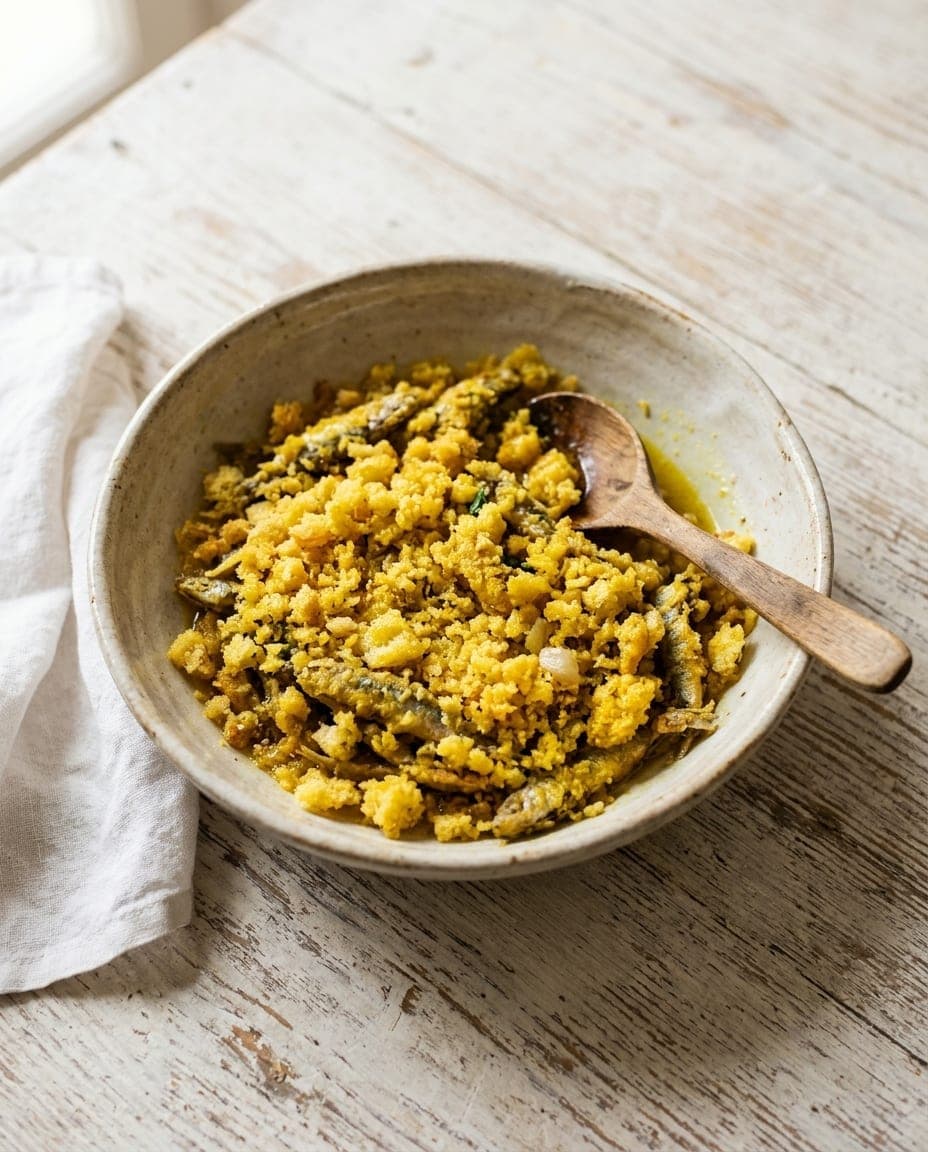
Scapece gallipolina is a preserved fish dish born from the Ionian coast of Puglia, specifically the historic walled town of Gallipoli. It consists of small fried fish, such as zerri (picarel) and boghe (bogue), which are layered in large wooden tubs with breadcrumbs soaked in vinegar and coloured bright yellow by saffron. The result is an intensely sour delicacy in which the softened bones are eaten along with the fish.
This is not a fine-dining dish. It is a popular local speciality, sold at stalls during local feasts and served in the town's trattorias. The method defines the dish: the fish are floured and fried, then arranged in layers with the saffron-infused breadcrumbs, which act as both a preservative and a flavouring agent. The layers are left for at least a day, allowing the vinegar and crumbs to penetrate the fish.
The history of the wooden tubs
The word scapece is usually linked to Spanish escabeche, which in turn goes back to the medieval Arabic sikbāj, a dish of meat or fish cooked with vinegar. Versions of this technique of preserving fried food in vinegar exist in almost every port of southern Italy. In Gallipoli, it evolved into a specific local form that relies on small fish from the nearby Ionian waters and adds saffron and breadcrumbs.
The large wooden tubs (locally often called calette) are central to the dish's identity. Traditionally they allowed the fish to keep for longer, and the sight of the deep yellow layers inside them is part of the dish's appeal at local feasts.
What goes into it
The ingredients are simple but specific, relying on the quality of the local catch and the traditional method of preparation:
- Small fish such as picarel (zerri) and bogue (boghe): Floured and fried whole, bones and all; the bones soften as the fish absorbs the vinegar.
- Breadcrumbs: Used as a layer between the fish, they soak up the vinegar and turn the dish a bright yellow hue.
- Vinegar: The acidic element that preserves the fish and gives the dish its characteristic sharp sourness.
- Saffron: Added to the breadcrumbs to impart a distinct golden colour and a subtle earthy aroma.
The combination creates a dish that is both visually striking and intensely flavoured. The vinegar cuts through the oil of the fried fish, while the saffron adds a warmth that balances the sharp acidity. It is not a light starter but a substantial bite, often eaten as a snack or part of a larger meal.
How to eat it
Scapece gallipolina is scooped out of the tub and served by the portion. The fish are soft enough that the bones can be eaten without difficulty, and the vinegar-soaked crumbs are eaten together with them. It is served at room temperature, after the flavours have had time to meld.
The dish pairs naturally with a glass of Salento rosé, whose crisp acidity stands up to the sourness of the vinegar. At local feasts the atmosphere adds to the experience, with the smell of frying fish and saffron filling the air.
Curious facts
- The wooden tubs are essential. The large tubs are not just containers; traditionally they were what allowed the fish to keep for longer.
- Bones are a feature, not a bug. Unlike many fried fish dishes where bones are removed, here the softened bones are eaten whole, adding texture.
- A festive rhythm. While available year-round, the dish is especially prominent during Gallipoli's religious feasts and fairs.
- A port-by-port dish. Marinated scapece fish exists in many southern Italian ports, but Gallipoli's saffron-and-breadcrumb version is considered one of the most refined.






