Saltimbocca alla romana
Veal escalopes with prosciutto and sage in white wine
- Local name
- Saltimbocca alla romana
- Served with
- Spinach or roast potatoes
- Best eaten at
- A Roman trattoria
- Pairs with
- Frascati
What it is
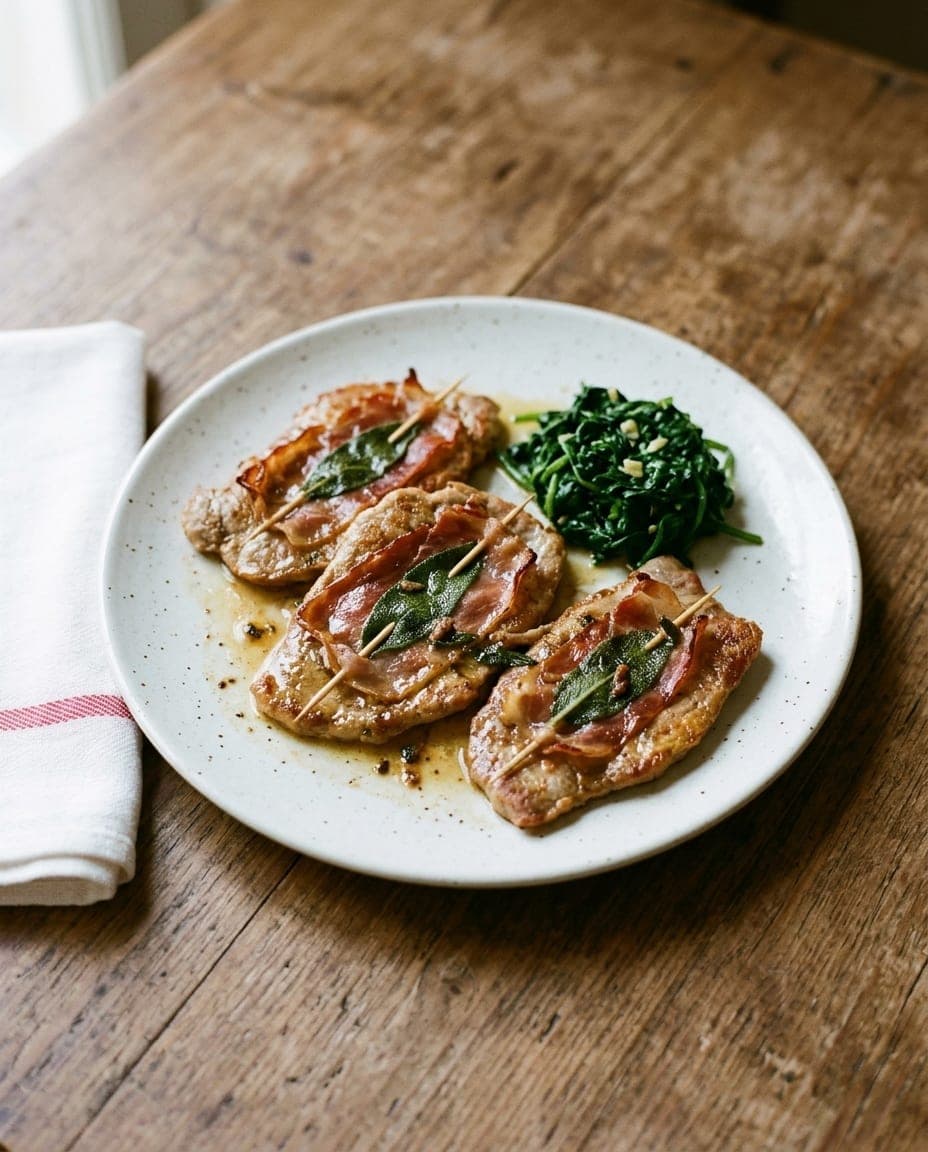
Saltimbocca alla romana is a dish of simple origins that has become one of the most recognised symbols of Roman cooking. It consists of thin slices of veal, each topped with a leaf of fresh sage and a slice of dry-cured ham, usually prosciutto. The ingredients are not rolled into a parcel but kept flat, pressed together so they hold their shape while frying.
The preparation is swift. The meat is dusted lightly with flour, then fried in butter until the veal is cooked through and the sage has released its aroma. A splash of dry white wine is added to the pan to deglaze it, scraping up the browned bits from the bottom to create a light sauce. The dish is served immediately, often still sizzling, because the thin veal would become tough if left in the heat any longer.
There is no hidden complexity or long simmering process; it is a study in timing and the quality of its few components.
The name and the meaning
The word saltimbocca joins salta, "jumps", with in bocca, "in the mouth". While the translation is straightforward, the reason for the name is open to interpretation. Some suggest it describes how quickly the dish is made and eaten. Others argue it refers to the burst of flavour from the sage and ham.
The best-known early written record of the dish appears in Pellegrino Artusi's cookbook La scienza in cucina e l'arte di mangiar bene, first published in 1891. Artusi already calls it saltimbocca alla romana and notes that he ate it in Rome, at a trattoria called Le Venete. Some accounts claim the dish originally came from Brescia, in Lombardy, but this remains unproven, and the dish is firmly identified with Rome.
How it is made and served
The construction of saltimbocca relies on three layers: the veal, the sage, and the prosciutto. The veal must be pounded very thin to ensure it cooks in minutes without drying out. In some kitchens, the sage leaf is placed directly on the meat, followed by the prosciutto, which is then pressed down firmly. A toothpick is usually used to hold the layers together during frying, though some cooks simply press the ingredients firmly together.
The cooking fat is almost always butter, sometimes mixed with a little oil to prevent burning. The goal is to brown the butter and the meat quickly, creating a golden crust while keeping the inside tender. Once the veal is cooked, dry white wine is poured into the pan. The liquid bubbles and reduces rapidly, mixing with the butter and the caramelised bits of flour and meat to form a light sauce.
Saltimbocca is rarely served with a heavy side dish or a complex garnish. It usually comes with its pan sauce and a simple side. A common choice is spinach, usually boiled or sautéed until soft. Roast potatoes are also common, offering a heartier alternative for those who prefer a more substantial meal. The dish is not breaded, and there are no added creams or stocks.
Where it belongs in Roman dining
Saltimbocca is a staple of the Roman trattoria. It appears on the menu of almost every establishment that serves traditional cucina romana, from small family-run osterias to larger restaurants near the historic centre. It is a main course, ordered for lunch or dinner.
The dish fits the rhythm of Roman dining well. It is quick to prepare, which suits the pace of a busy lunch service, yet it carries enough flavour to satisfy a diner looking for something substantial.
It belongs to the secondo course of a Roman meal, following pasta, and a slice of crusty bread is often requested to soak up the remaining sauce.
Artusi's version and the question of origin
Artusi's recipe is close to what Roman trattorias serve today: thin slices of veal, each topped with half a sage leaf and a slice of ham, fixed with a toothpick and cooked in butter. That the dish already bore the name alla romana in 1891 suggests it was well established in Rome by the late 19th century, most likely in the trattorias of the historic centre.
The claim of a Brescian origin surfaces in some modern accounts, but no early source supports it. Elsewhere in Italy and abroad, variants have grown up in which the veal is rolled around the ham and sage, or the wine is replaced with Marsala, while the Roman style generally keeps the layers flat.
How to eat it
Saltimbocca alla romana is best enjoyed in a Roman trattoria, where the kitchen is likely to have a deep understanding of the timing required. The dish arrives hot, often with the sauce bubbling slightly at the edges. It is meant to be eaten immediately, before the butter solidifies and the veal cools.
The traditional pairing for this dish is a glass of Frascati, a dry white wine from the Castelli Romani hills south-east of Rome. The acidity of the wine cuts the fat of the butter and the saltiness of the prosciutto, cleansing the palate between bites.
The thin slices need little cutting; they are designed to be eaten in a few bites.
Curious facts
- The name means "jumps in the mouth". The phrase is usually read as a reference to how quickly it is made and eaten, or to its burst of flavour.
- Usually flat in Rome. Unlike some variations where the meat is rolled into a parcel, the Roman version generally keeps the sage and prosciutto flat on top of the veal, held with a toothpick.
- Artusi ate it in Rome. In his 1891 cookbook, Pellegrino Artusi recorded saltimbocca alla romana after eating it at a Roman trattoria, Le Venete.
- A simple plate. The veal is usually served with just its pan sauce and a plain side such as spinach or roast potatoes.
- The cooking time is critical. The veal is so thin that it cooks in two or three minutes and toughens quickly if left longer.
Where to try it
1 region
 Camper Van Rentals2 destinations
Lazio
Lazio is Italy's second-largest region, renowned for its rich history and diverse landscapes. The capital, Rome, boasts ancient ruins and vibrant street life, but the surrounding areas are equally captivating. Explore the hill towns like Viterbo, known for its thermal springs and medieval architecture. The region also features the stunning coastline of the Tyrrhenian Sea, offering hidden beaches and charming fishing villages. Lazio is famous for its culinary traditions, including artichokes from Rome and wines from Frascati. The region is home to the beautiful countryside of the Castelli Romani, dotted with vineyards and historic castles, providing a glimpse into local life away from the tourist crowds.
Camper Van RentalsHikingWine Tasting





