Salame Felino
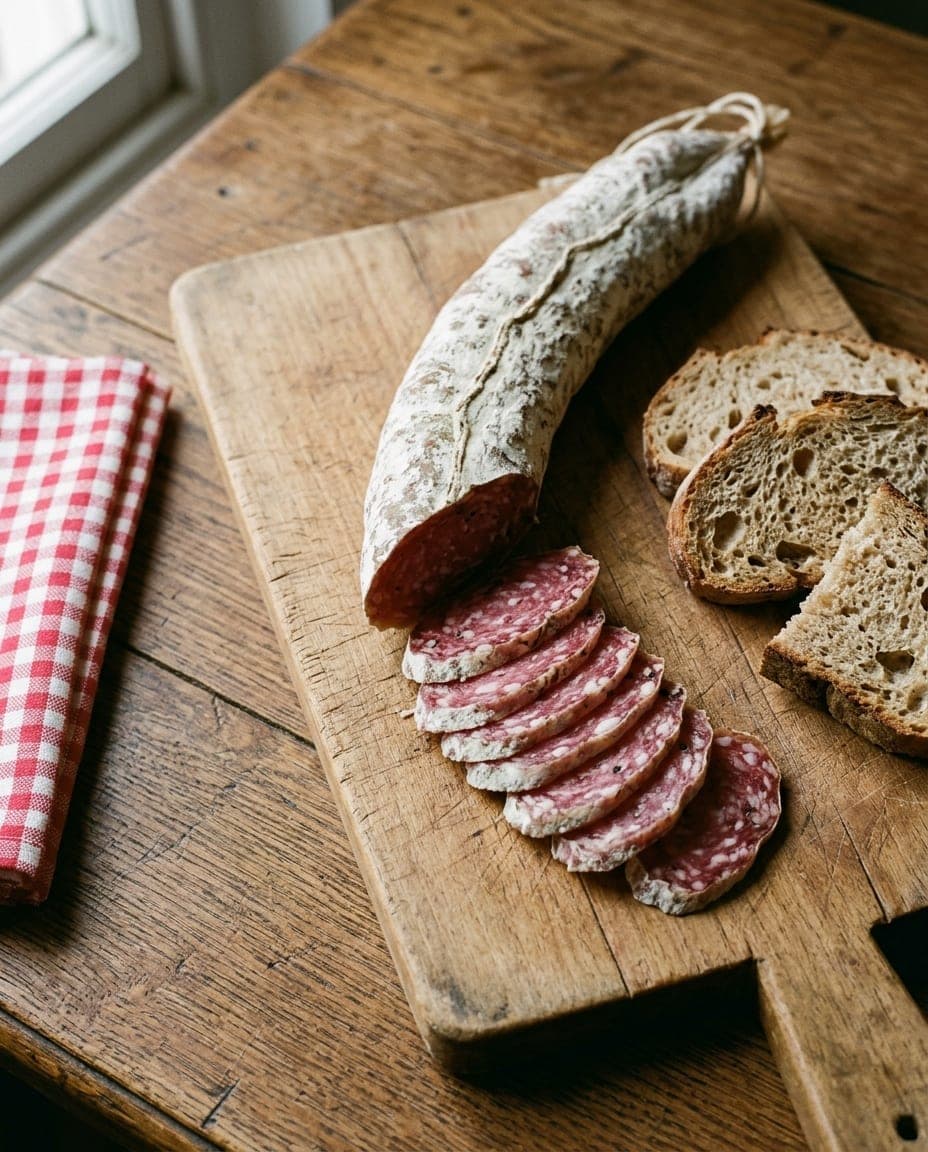
Salame Felino from the hills south of Parma, Italy
- Local name
- Salame Felino
- Served with
- Crusty bread
- Best eaten at
- A Parma hills osteria
- Pairs with
- Lambrusco or Malvasia
What it is
Salame Felino is a cured meat of quiet distinction from the hills south of Parma, specifically linked to the small town of Felino in the province of Parma, Emilia-Romagna. Unlike more robust, heavily spiced salamis, this product is defined by its mildness and a soft, tender texture. It belongs to the family of Italian dry sausages but stands apart through its specific production rules, protected as a PGI since 2013, and its gentle taste.
The sausage is long and slightly irregular in diameter, following the natural casing, and when sliced it shows an intense red with white flecks of fat. Its surface is not smooth; it carries the imprint of the string used to tie it by hand before drying. The meat inside is ground medium-coarse, revealing visible flecks of fat and whole peppercorns rather than a uniform paste.
The story of Felino and the hills
The name comes directly from the village of Felino, situated just south of the city of Parma in the foothills of the Apennines. Felino and neighbouring towns such as Sala Baganza and Langhirano form the historic heart of production, although the protected area today covers the whole province of Parma.
The history of Salame Felino is rooted in the practical needs of rural life. In the past, farmers needed a way to preserve pork through the winter months without refrigeration. The solution was to cure the meat in natural cellars or drying rooms in the hills, where air circulation and humidity followed the seasons. Pig-keeping and salami-making in the Parma area are documented from at least the 15th century, and the product took the name "di Felino" in the late 19th century. Most producers now cure in temperature-controlled rooms.
It is often served alongside Prosciutto di Parma, offering a softer, sweeter counterpoint.
What goes into it
The meat is pork trimmings from the shoulder area (trito da banco), roughly 70% lean to 30% fat. It is ground medium-coarse, ensuring that the final product retains a pleasant texture rather than becoming a dense paste.
The seasoning mix is what defines the sausage's mild character. Salt is used to draw out moisture and preserve the meat, while whole peppercorns add a gentle heat that does not overwhelm the palate. Crushed garlic provides a subtle aromatic note, but it is not dominant. The garlic is steeped in dry white wine, which is mixed into the meat before stuffing and contributes to its soft, delicate character.
The mixture is then stuffed into natural pork casing, traditionally the budello gentile, which helps keep the filling soft during long curing, and tied by hand with string. The salami typically matures for around 40 to 60 days or more, allowing the flavours to develop and the texture to firm up.
How it is eaten
Salame Felino is rarely served as part of a complex dish. Its primary purpose is to be enjoyed on its own or with simple accompaniments that do not compete with its delicate flavour. The traditional way to slice it is on a steep diagonal, into long oval slices about as thick as a peppercorn, revealing the flecks of fat and the peppercorns within the meat.
The most common pairing is with crusty bread, a neutral base that lets the cured meat shine, sometimes alongside other local cheeses or cured meats.
In the Parma area, cured meats are also commonly eaten with torta fritta, squares of fried dough popular in the region, whose warmth softens the fat of the salami. Local osterias serve such platters, where the focus remains on the quality of the ingredients rather than elaborate presentation.
A regional habit of wine and climate
The traditional curing relied on the microclimate of the Parma hills, where seasonal humidity allowed the salami to dry slowly in cellars sheltered from direct sunlight. The white wine in the mixture gives a lighter, more delicate profile, and the salami does not demand a strong wine to balance it; instead, it pairs naturally with the local Lambrusco or Malvasia, both of which offer enough acidity to cut through the fat without overpowering the meat.
Curious facts
- Tied by hand. The salami is tied by hand with natural string, which helps maintain the sausage's shape during drying and is a mark of traditional production.
- White wine, not red. Salame Felino relies on dry white wine, steeped with garlic, for its delicate flavour.
- Sliced on the slant. The traditional cut is a long diagonal oval, roughly twice as long as the salami is wide.
- A salami museum. Felino has a museum devoted to its salami, part of the Parma food museums network.
Where to try it
The best place to experience Salame Felino is in an osteria located in the Parma hills, particularly in or near Felino, the town most closely associated with its production. These small, traditional establishments often serve the salami as part of a simple platter with crusty bread, allowing the diner to taste it in its purest form.
Local markets and small producers in the province also sell it, and PGI-labelled salami is widely available. A glass of Lambrusco or Malvasia completes the experience.
Where to try it
1 destination
 Wine Tasting
Traversetolo
Hilltop village in Parma countryside with wine and food traditions.
Wine Tasting





