Pecorino Romano
The salty sheep's cheese of Rome, made mostly in Sardinia
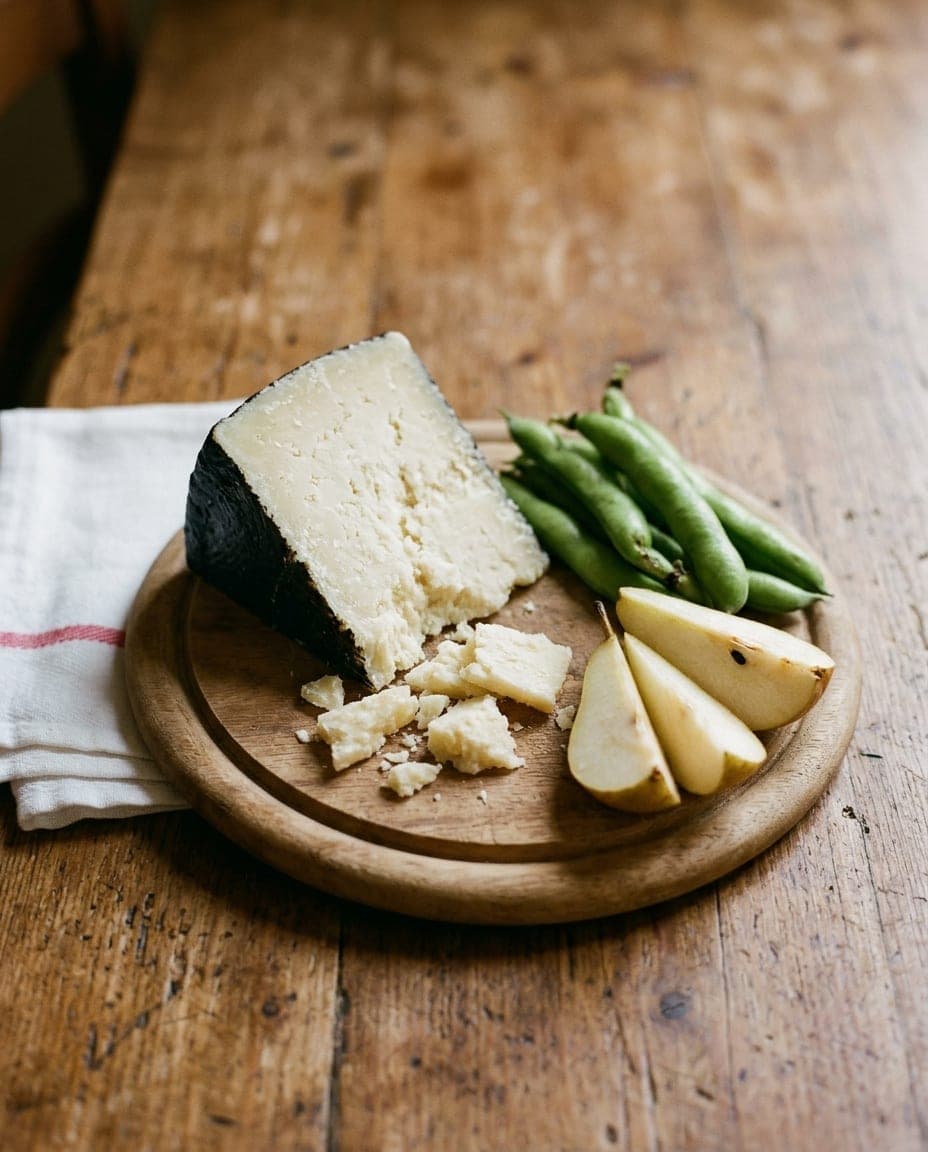
- Local name
- Pecorino Romano
- Served with
- Raw fava beans, pears
- Best eaten at
- A Roman May Day picnic
- Pairs with
- Frascati
What it is
Pecorino Romano is a hard, cooked-curd cheese made from sheep's milk, long considered a defining flavour of Roman cuisine. Despite its name, the vast majority of this cheese is produced on the island of Sardinia, with smaller production in Lazio and the province of Grosseto in Tuscany. The protected designation covers these three areas.
The cheese is well known for its intense saltiness and sharp, piquant character. It has a compact, white paste that hardens further as it matures, developing a granular texture suitable for grating over hot pasta or serving in thin slices with fruit. The natural rind is ivory to straw-coloured, although many wheels are sold with a black protective coating. It is not a soft, spreadable cheese but a firm block that calls for a sturdy grater.
This is not a cheese for casual snacking in large quantities without accompaniment; its salinity demands balance.
The Roman legacy and the move to Sardinia
The history of Pecorino Romano is often traced back to antiquity. Roman writers described hard sheep's cheeses made in the countryside around the city, and tradition holds that a cheese of this kind was part of the legionaries' rations because it kept well on long marches.
While the tradition began in the area around Rome, the production centre shifted over time. In the late 19th century, as demand outgrew the Lazio flocks and Rome banned salting the cheese inside the city in 1884, cheesemakers from Lazio increasingly set up dairies in Sardinia, where sheep's milk was plentiful, and the island has dominated production ever since. When the cheese gained its protected designation, first nationally and then as a European PDO in 1996, the name was tied to this combined area rather than to Rome alone.
The designation now protects both place and method: the milk must come from sheep raised in Lazio, Sardinia or the province of Grosseto, and the cheese must be made and matured within these borders. The name pecorino derives from pecora, the Italian word for sheep, distinguishing it from cow's milk cheeses like Parmigiano Reggiano or Grana Padano.
How it is made
The creation of Pecorino Romano relies on salt and time. The milk is coagulated using lamb's rennet, then the curds are cut and cooked at around 45–48°C before being placed into moulds. The wheels are then salted, dry and/or in brine, over a long period that can last up to about 70 days, drawing out moisture and preserving the interior.
This long salting gives the cheese its distinctive character. It is markedly saltier than its northern Italian counterparts. Under the rules of the designation, the cheese must mature for at least five months to be sold as a table cheese and at least eight months as a grating cheese. During this time, the paste becomes firm and granular, and longer-aged wheels are harder and more intense still, ideal for grating over rich dishes or eating with pears.
The Roman pasta trio
Pecorino Romano is the traditional cheese of three famous pasta dishes from Rome: carbonara, cacio e pepe and amatriciana. It is also used in gricia, guanciale (cured pork cheek) with pecorino and pepper, often described as a white forerunner of amatriciana. In each case, the cheese is not served as a side but is worked into the sauce itself.
For cacio e pepe, the cheese is grated finely and mixed with hot pasta water and black pepper until it forms a creamy emulsion. The sharp saltiness of the pecorino balances the heat of the pepper. In carbonara, it is combined with eggs, guanciale and pasta water to create the sauce that coats the strands. In amatriciana, it is scattered over the tomato and guanciale sauce, adding depth and a salty kick against the acidity of the tomatoes.
Roman cooks are particular here: the cheese is grated, not sliced, and for most it should be pecorino rather than Parmigiano, though some carbonara recipes use a mix of the two.
How to eat it outside the kitchen
While the cheese is most famous in hot pasta dishes, it also shines in simpler forms. A traditional way to enjoy pecorino is during a May Day outing in and around Rome, where it is served alongside raw fava beans. The saltiness of the cheese contrasts with the sweet, grassy flavour of the fresh beans, eaten straight from the pod.
The cheese also pairs well with ripe pears. The sweetness of the fruit softens the sharp edge of the matured pecorino, making it a popular combination at Roman tables and at casual gatherings.
A glass of Frascati, a white wine from the Castelli Romani hills south-east of Rome, is a fitting companion for these pairings. Its crisp acidity cuts through the salt and fat, cleansing the palate between bites of cheese and beans or pears.
Curious facts
- A name that travels. The name refers to the cheese's historical association with Rome, but the majority of production happens in Sardinia.
- Legion rations. Tradition holds that a hard sheep's cheese of this kind was part of the Roman legionaries' daily rations, valued for its keeping qualities.
- Two minimum ages. Table cheese must be aged at least five months, grating cheese at least eight.
- A May Day tradition. In Rome, pecorino is traditionally eaten with raw fava beans on 1 May, a custom that celebrates the arrival of spring.
Where to try it
Rome itself is the natural place to find Pecorino Romano, in markets such as Campo de' Fiori and in traditional delicatessens, the alimentari and norcinerie, where wedges of different ages are cut to order. Most of this cheese comes from dairies in Sardinia or Lazio working under the PDO rules.
For a seasonal experience, Rome on 1 May is the time. Families and friends head to parks or out of town for picnics of raw fava beans with slices of pecorino, often with a bottle of local wine.
Where to try it
1 region
 Camper Van Rentals2 destinations
Lazio
Lazio is Italy's second-largest region, renowned for its rich history and diverse landscapes. The capital, Rome, boasts ancient ruins and vibrant street life, but the surrounding areas are equally captivating. Explore the hill towns like Viterbo, known for its thermal springs and medieval architecture. The region also features the stunning coastline of the Tyrrhenian Sea, offering hidden beaches and charming fishing villages. Lazio is famous for its culinary traditions, including artichokes from Rome and wines from Frascati. The region is home to the beautiful countryside of the Castelli Romani, dotted with vineyards and historic castles, providing a glimpse into local life away from the tourist crowds.
Camper Van RentalsHikingWine Tasting





