Pecorino di Farindola
A rare sheep's cheese from the Gran Sasso, curdled with pig rennet
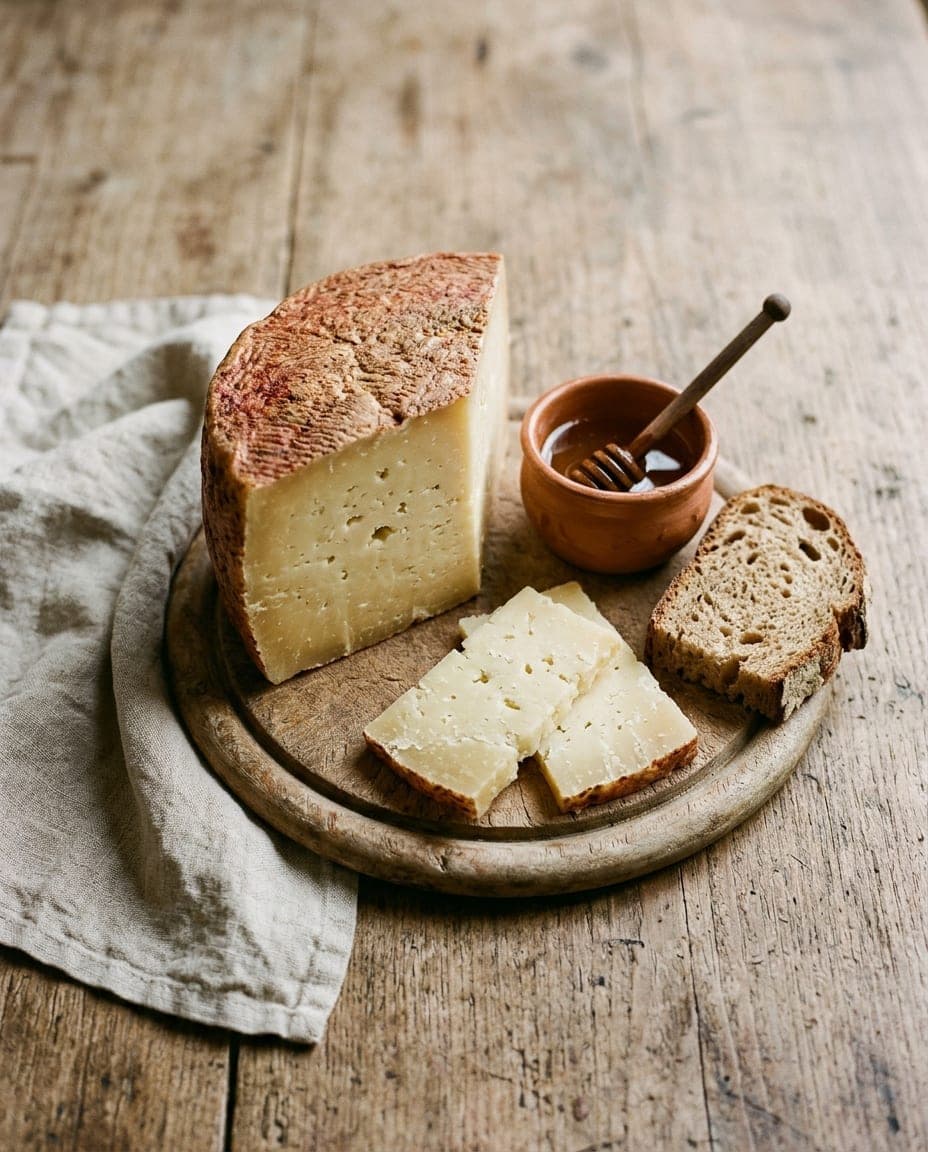
- Local name
- Pecorino di Farindola
- Served with
- Honey, bread
- Pairs with
- Montepulciano d'Abruzzo
What it is
Pecorino di Farindola is a small sheep's cheese from the eastern slopes of the Gran Sasso massif in Abruzzo. It is not a national staple but a local speciality confined to a handful of villages around the town of Farindola, in the province of Pescara, with a few neighbouring communes in the province of Teramo. The cheese stands out immediately for its defining feature: it is curdled with pig's rennet rather than the lamb, kid or calf rennet used almost everywhere else, and is believed to be the only Italian cheese made this way.
The result is a small, compact wheel of one to two kilos, with a pale interior that deepens in colour as it ages. The texture starts firm but grows drier and more crumbly over time, while the taste moves from mild and milky to sharp, salty and spicy. Much of this character is credited to the unusual coagulant, which shapes the way the cheese matures over months.
The production remains a small-scale affair, carried out in farmhouses and small dairies. The cheese has been a Slow Food Presidium since 2001, an acknowledgment of its rarity and the specific practices that keep it alive. It is a product of the region's rugged landscape, where sheep graze on the high slopes and cool rooms allow long maturation.
The pig rennet tradition
The most curious aspect of Pecorino di Farindola is the source of its coagulant. Elsewhere in Italy, cheesemakers rely on the stomachs of young lambs, kids or calves to curdle milk. Here, however, the rennet is prepared from the stomach of a pig, and the cheese is traditionally made by women, so much so that it is sometimes called the women's cheese.
The pig's stomach is cleaned, salted and dried, then left to macerate for months in glass jars with white wine or vinegar, chilli and sometimes pepper. The strained liquid is used to curdle the raw sheep's milk. Recipes for the rennet are passed down from mother to daughter, and each family's version is said to give its cheese a slightly different character.
This method has been handed down through generations in the villages around Farindola, where men traditionally tended the flocks while women handled the milk, the cheesemaking and the ageing. It is a quiet testament to the resourcefulness of local shepherding families.
How it is made and aged
Only raw milk from sheep raised within the small production area may be used. After milking, the milk is warmed slightly before the pig rennet is added to form the curd. The curd is then broken, gathered into small baskets that imprint their pattern on the rind, drained, and salted by hand.
Once formed, the wheels dry for a few weeks until a thin rind develops. They are then rubbed periodically with extra virgin olive oil, often mixed with vinegar, which protects the rind from mould, keeps the paste soft and stops the crust from cracking. The cheese is aged in cool rooms on wooden shelves for anywhere from a few months to a year or more, depending on the desired intensity.
The final product can be sliced thinly or grated when well aged, though many prefer it semi-aged, at four or five months, when its texture is still firm enough to hold a shape but yields easily to the bite.
How it is eaten
Pecorino di Farindola is traditionally served as part of a simple meal or alongside other local products. It is cut into thin slivers or small wedges and paired with local bread, which provides a neutral base for its sharp flavours; the semi-aged cheese is classically eaten with bread and olive oil.
A spoonful of honey is a popular companion, offering a sweet contrast to the salty, spicy notes of the cheese. For those who enjoy wine, a glass of Montepulciano d'Abruzzo is a natural pairing, its red fruit character complementing the savoury depth of the cheese.
It is best enjoyed in the quiet atmosphere of a farmhouse or a small village trattoria in the hills around Farindola, where the cheese is made and often sold directly to visitors. It is not a quick snack but a cheese for slow tasting.
Curious facts
- Pig rennet is rare. While other Italian cheeses use lamb, kid or calf rennet, Pecorino di Farindola is believed to be the only one made with pig rennet.
- A women's cheese. The cheese has traditionally been made by women, and the rennet recipe is handed down from mother to daughter.
- Small production scale. The cheese is made only in a handful of villages on the eastern side of the Gran Sasso, with very limited output.
- Oil rub. The wheels are rubbed with olive oil, often mixed with vinegar, during ageing to protect the rind.
- Slow Food Presidium. The cheese has been protected as a Slow Food Presidium since 2001.
Where to try it
The best place to taste Pecorino di Farindola is in the villages around Farindola itself, where the cheese is produced and sold directly by the makers. Small farmhouses and local dairies in the area often offer it alongside their other regional products. It can also be found in speciality food shops in Pescara and across Abruzzo.
Where to try it
1 region
 Wine Tasting1 destination
Abruzzo
Nestled between the Apennine mountains and the Adriatic Sea, this region is known for its diverse landscapes, ranging from rugged mountains to sandy beaches. It is the only region in Italy with access to both mountains and coastline, making it a unique destination. L'Aquila, the capital, features stunning medieval architecture and is surrounded by natural parks. The region is famous for its truffles, Montepulciano d'Abruzzo wine, and the ancient practices of shepherding. Explore off-the-beaten-path towns like Sulmona, known for confetti (sugar-coated almonds), and the remote Gran Sasso National Park, home to Italy's highest peak. Local festivals celebrate traditional crafts and culinary delights, providing a deep cultural connection to the land.
Wine Tasting





