Pastiera napoletana
The Neapolitan Easter tart of cooked wheat, ricotta and orange blossom
- Local name
- Pastiera napoletana
- Best eaten at
- A Neapolitan Easter table
What it is
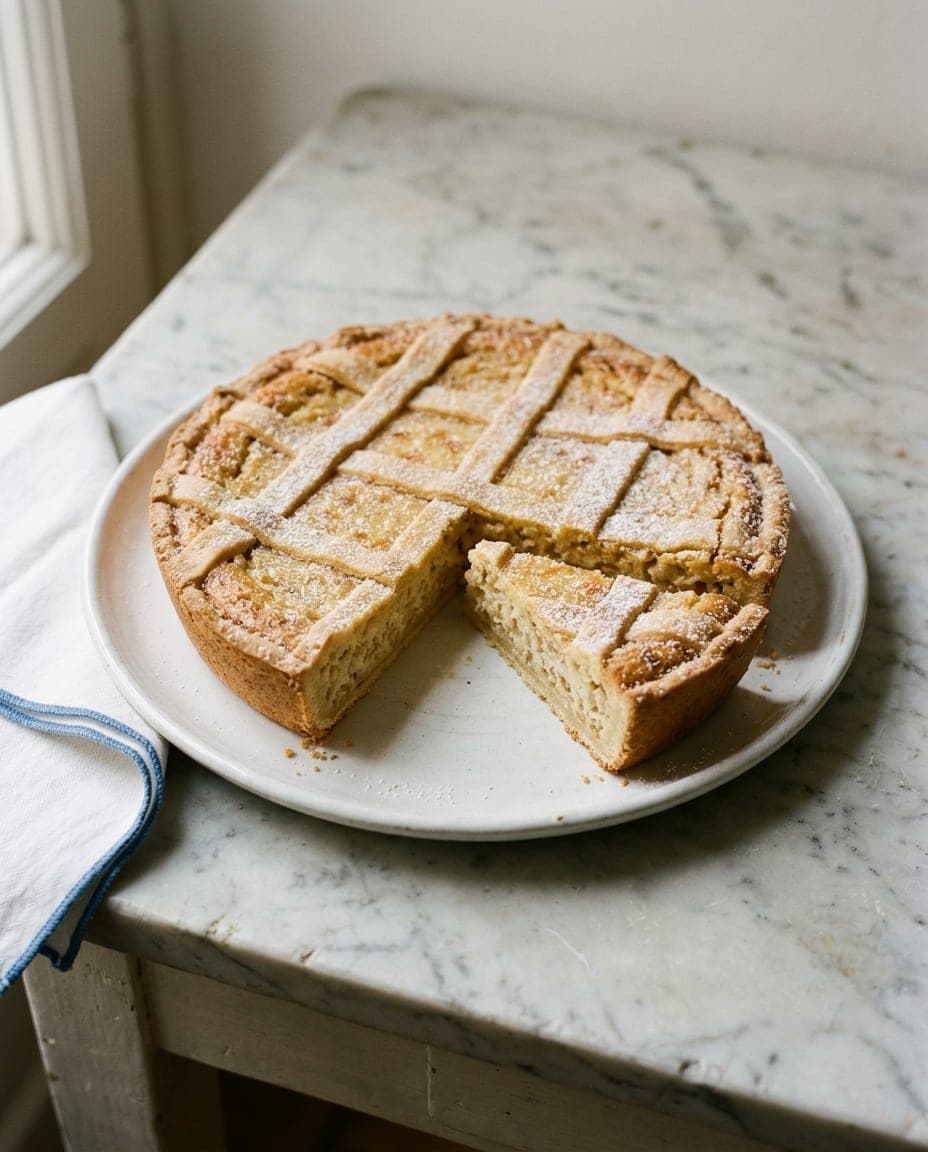
Pastiera napoletana is the definitive sweet of Naples' Easter table, a large round tart that combines a shortcrust pastry case with a filling of ricotta, cooked wheat, eggs, sugar, candied citrus peel and orange-flower water. It is not a light dessert but a substantial offering that sits at the centre of the festive spread, alongside savoury Neapolitan Easter breads such as casatiello. The tart is distinctive for its dense texture and the deep floral aroma of the orange-flower water, which permeates the entire filling.
The visual identity of the pastiera is equally specific. The top is covered with a lattice of pastry strips, traditionally seven, arranged to form diamonds, a design that has become as recognisable as the tart itself. While variations exist across Campania, the Neapolitan version remains the most celebrated and widely reproduced. It is a regional speciality rather than a nationwide staple, bound up with the rituals of Easter in Naples and its surrounding towns.
The wheat and the symbol of rebirth
The heart of the pastiera lies in the cooked wheat, which distinguishes it from almost any other European Easter cake. Whole wheat grains are soaked until they soften, boiled for a long time, and then simmered in milk, often with citrus zest, until creamy and tender. Today many cooks buy the wheat ready-cooked in jars. The wheat is widely read as a symbol of rebirth, linking the Christian celebration of the Resurrection with older traditions that greeted the arrival of spring.
Because the wheat and the filling take time, the pastiera is traditionally made on Holy Thursday or Good Friday. The cooked wheat gives a unique texture that is neither grainy nor mushy, a gentle chewiness against the smooth ricotta.
How it is made and when it is eaten
The preparation follows a seasonal rhythm. Baking on Holy Thursday or Good Friday gives the tart time to rest before Easter Sunday, and this waiting is part of the tradition: the pastiera improves over several days as the ingredients meld and the orange-flower water infuses the ricotta more deeply.
Once baked, the tart keeps well for about a week, making it ideal for the extended Easter celebrations that follow. Families often bake several tarts to share with relatives and neighbours, and it appears on tables throughout Easter week. It is eaten from Easter Sunday onwards, marking the end of the Lenten fast.
What goes into it
The ingredients of pastiera are simple but require careful preparation. There is no single official recipe, and each kitchen guards its own variation, yet the core components remain consistent across Naples.
- Shortcrust pastry, traditionally made with lard or butter, forms the base, sides and lattice.
- Fresh ricotta, drained well, provides the creamy foundation of the filling.
- Cooked wheat, simmered in milk until tender, offers texture and symbolic meaning.
- Eggs and sugar bind the filling and give it structure.
- Candied citrus peel, usually citron and orange, adds sweetness and a chewy contrast.
- Orange-flower water, the essential aromatic that defines the scent of the tart.
The combination is rich yet balanced, with the floral notes cutting through the heaviness of the ricotta and eggs, the candied peel adding bursts of citrus, and the wheat a subtle nuttiness.
The seven strips and their meaning
The lattice on top usually consists of seven strips of pastry, four laid one way and three across them, forming diamonds. A popular explanation holds that they recall the street plan of Naples' historic centre, with its three main decumani crossed by narrower streets; others link the number to the seven ingredients of a legend about the tart's creation. None of these meanings is documented, and food writers note that the rule of exactly seven strips is a modern convention rather than a historical requirement.
The strips are made from the same shortcrust dough as the base and help to keep the filling in place as it rises during baking. Some households use more strips, but the seven-strip diamond pattern remains the familiar standard.
Curious facts
- The wheat takes time. Whole wheat grains need long soaking and cooking, a step that distinguishes pastiera from other ricotta tarts.
- It improves with time. The flavour develops over a few days after baking, so many Neapolitans prefer it on Easter Monday to the day it comes out of the oven.
- The lattice has a story. The seven strips are popularly linked to the street plan of old Naples, though the tradition is more folklore than fact.
- Orange-flower water is essential. Without it, the tart loses its defining aroma and is not considered authentic pastiera napoletana.
- A regional speciality. While wheat and ricotta tarts exist elsewhere in southern Italy, the Neapolitan pastiera is the emblem of Campania's Easter.
Where to try it
The best place to eat pastiera is at a Neapolitan Easter table, whether in a private home or from a traditional bakery. During the weeks leading up to Easter, many pasticcerie in Naples display their tarts in the windows, and queues often form outside the best-known shops. Pastiera is easiest to find in spring, though many Neapolitan bakeries now sell it all year round.
The tart is often served in thick slices, accompanied by coffee or a glass of sweet dessert wine. It is a dish that rewards patience, best enjoyed slowly while the flavours of spring linger on the palate.
Where to try it
1 region
 Wine Tasting3 destinations
Campania
Campania, a coastal region in southern Italy, is renowned for its rich history and diverse landscapes. It is home to Naples, the largest city, famous for its historic center, a UNESCO World Heritage site. The region boasts the stunning Amalfi Coast, characterized by picturesque cliffs and traditional fishing villages. Historic sites like Pompeii and Herculaneum provide a glimpse into ancient Roman life, while the islands of Capri and Ischia offer natural beauty and thermal springs. Campania is also known for its culinary treasures, including authentic Neapolitan pizza and local wines such as Aglianico. Explore lesser-known towns like Caserta, with its grand Royal Palace, or the charming village of Ravello, known for its gardens and music festival. This region blends cultural heritage with breathtaking scenery, making it a unique destination for those who wish to travel at a leisurely pace.
Wine TastingHiking





