Pasta con le sarde
Palermo's wild fennel pasta with sardines, raisins and saffron
- Local name
- Pasta con le sarde
- Best eaten at
- A Palermo trattoria
- Pairs with
- Grillo
What it is
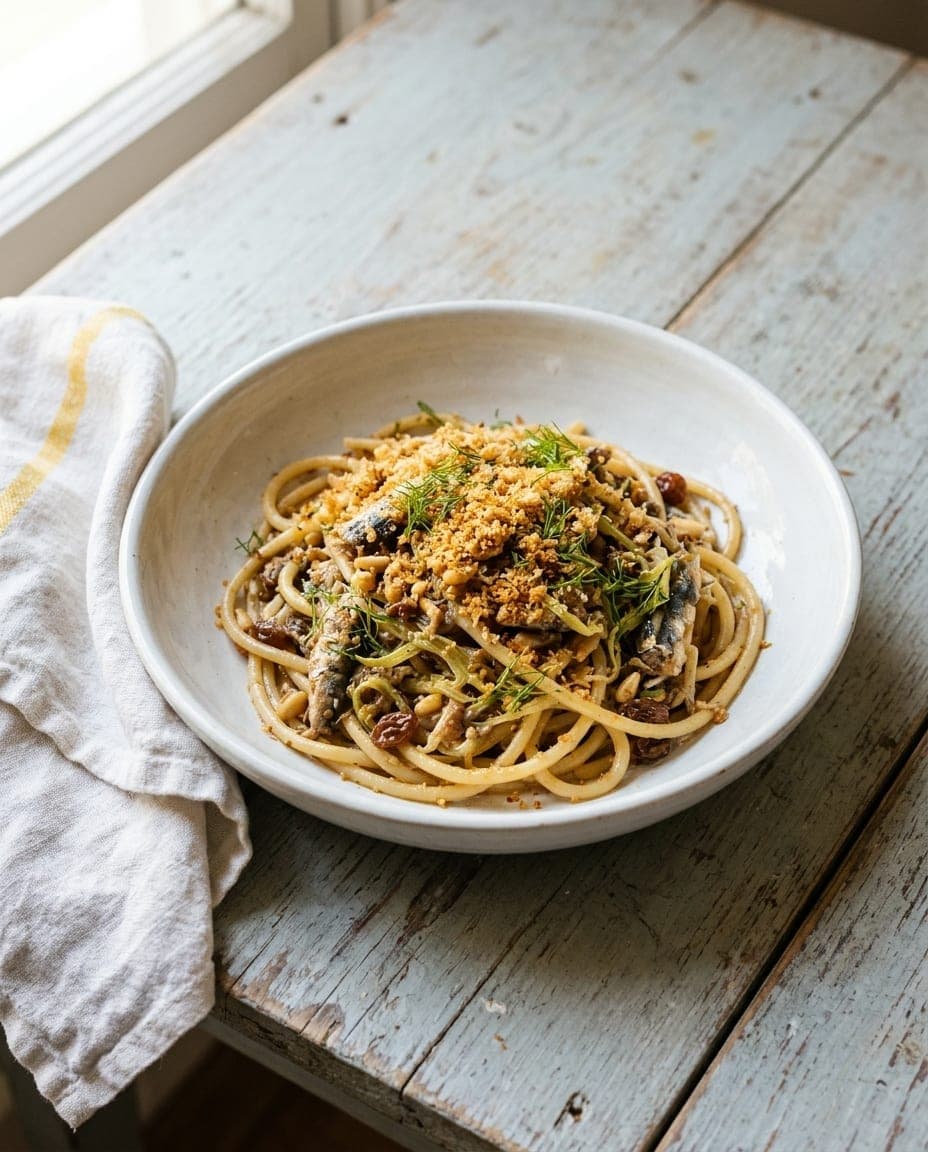
Pasta con le sarde is one of the most celebrated pasta dishes of Sicily, specifically associated with the capital city of Palermo. It is a complex harmony of fresh sardines, wild fennel gathered from the hillsides, raisins, pine nuts and saffron. The result is a dish where sweet and savoury elements do not compete but intertwine to create a taste unique to the island.
The pasta itself is usually bucatini, long, thick strands with a hole running through the middle, which hold the sauce well. The sauce is not heavy with tomato but relies on the fennel and the sardines cooked down with onion and olive oil. It is finished with toasted breadcrumbs, known locally as muddica atturrata, which stand in for cheese. This substitution is traditional because cheese is generally not served with fish in Sicilian cuisine. The dish feels substantial yet bright, a reflection of the coastal life that created it.
The Arab legacy in one plate
The combination of ingredients is often read as a story of Sicily's past. The island has been ruled by many civilisations, and one of the most enduring culinary influences is attributed to the Arabs, who governed Sicily from the 9th to the 11th century and are credited with spreading crops such as citrus and sugar cane and new irrigation techniques. The sardines represent the bounty of the sea surrounding Palermo, and the wild fennel grows freely along roadsides and hills. The pairing of raisins, pine nuts and saffron with fish is commonly linked to that Arab period, although the dish's exact origin is not documented.
When eaten together, these elements create a taste that is distinctly Sicilian. The sweetness of the raisins balances the saltiness of the sardines and the aniseed bitterness of the fennel. The saffron adds a golden colour and an earthy aroma. This sweet-savoury profile is uncommon in Italian cooking but echoes North African and Middle Eastern traditions. The dish serves as an edible record of the island's cultural layers.
How it is made
The preparation relies on the quality of the fresh ingredients rather than a fixed method. The wild fennel is boiled in salted water, then drained and chopped, and the fragrant cooking water is kept. Fresh sardines, cleaned and boned, are cooked in a pan with onion softened in olive oil, often with a few salted anchovies, together with the fennel, raisins, pine nuts and saffron. The pasta is then cooked in the fennel water, so that it absorbs the flavour, before being tossed with the sauce.
The toasted breadcrumbs play a crucial role in the final texture. They are toasted in a pan, often with a little oil, until crisp and golden, then sprinkled over the dish just before serving. This provides a crunch that contrasts with the softness of the pasta and fish. The sardines break into pieces within the sauce rather than being served whole.
Where it is eaten
Pasta con le sarde is best enjoyed in a traditional trattoria in Palermo, particularly those that have kept their recipes for generations. It is usually served as a first course at lunch or dinner. A glass of Grillo, a dry white wine from western Sicily, is a natural companion.
The dish is particularly associated with the feast of St Joseph on 19 March, when many Sicilian families prepare it. In popular tradition the toasted breadcrumbs scattered over the pasta are said to recall the sawdust of the carpenter saint.
Variations on the theme
There are two notable versions of the dish. The first is pasta con le sarde al forno, where the dressed pasta is baked in the oven until the top is crisp and golden. This version is often prepared for feast days and special gatherings.
The second is known as pasta con le sarde a mare, roughly "with the sardines still in the sea". In this version, the fresh fish is omitted. The dish keeps the wild fennel, raisins, pine nuts, saffron and toasted breadcrumbs, usually with a few salted anchovies for savour. This self-mocking dish recalls the times when the sea yielded nothing or fresh fish was too expensive, and it remains popular even when fresh sardines are available.
Curious facts
- The bread replaces the cheese. Toasted breadcrumbs are used instead of grated cheese with fish, a rule that persists in many traditional Sicilian kitchens.
- A spring dish. It is at its best in spring, when wild fennel is tender and abundant across the island.
- The Arab connection. The combination of raisins, pine nuts and saffron is widely associated with Sicily's Arab period, between the 9th and 11th centuries.
- A fishless version. The a mare variation leaves the fresh sardines "at sea", preserving the sweet-savoury balance without them.
- St Joseph's feast. The dish is a fixture of the celebrations on 19 March, with the breadcrumbs said to evoke a carpenter's sawdust.
Where to try it
The most authentic experience of pasta con le sarde can be found in a Palermo trattoria that specialises in traditional Sicilian cuisine. The dish is also common in other towns across Sicily, but it remains the specific emblem of the capital, especially in spring.
Where to try it
1 region
 Wine Tasting21 destinations
Sicily
Sicily, the largest island in the Mediterranean, boasts a rich tapestry of history and culture. Its unique position has made it a crossroads of civilizations, evident in the remnants of Greek temples in Agrigento and the Arab-Norman architecture in Palermo. The island features a diverse landscape, from the volcanic Mount Etna to the picturesque coastal towns of Taormina and Cefalù. Sicilian cuisine stands out for its use of fresh ingredients, with specialties like arancini and cannoli. The region is also famous for its local wines, particularly Nero d'Avola. Off the beaten path, discover the ancient ruins of Selinunte or the quaint streets of Erice. With charming villages and vibrant markets, Sicily offers a deep dive into authentic Italian culture and history.
Wine TastingHikingBoat RentalsAgritourism





