Pandoro
Verona's star-shaped golden bread, served with icing sugar dusting
- Vegetarian
- Local name
- Pandoro
- Served with
- Icing sugar, mascarpone cream
- Best eaten at
- A Verona family Christmas table
- Pairs with
- Moscato d'Asti or Recioto
What it is
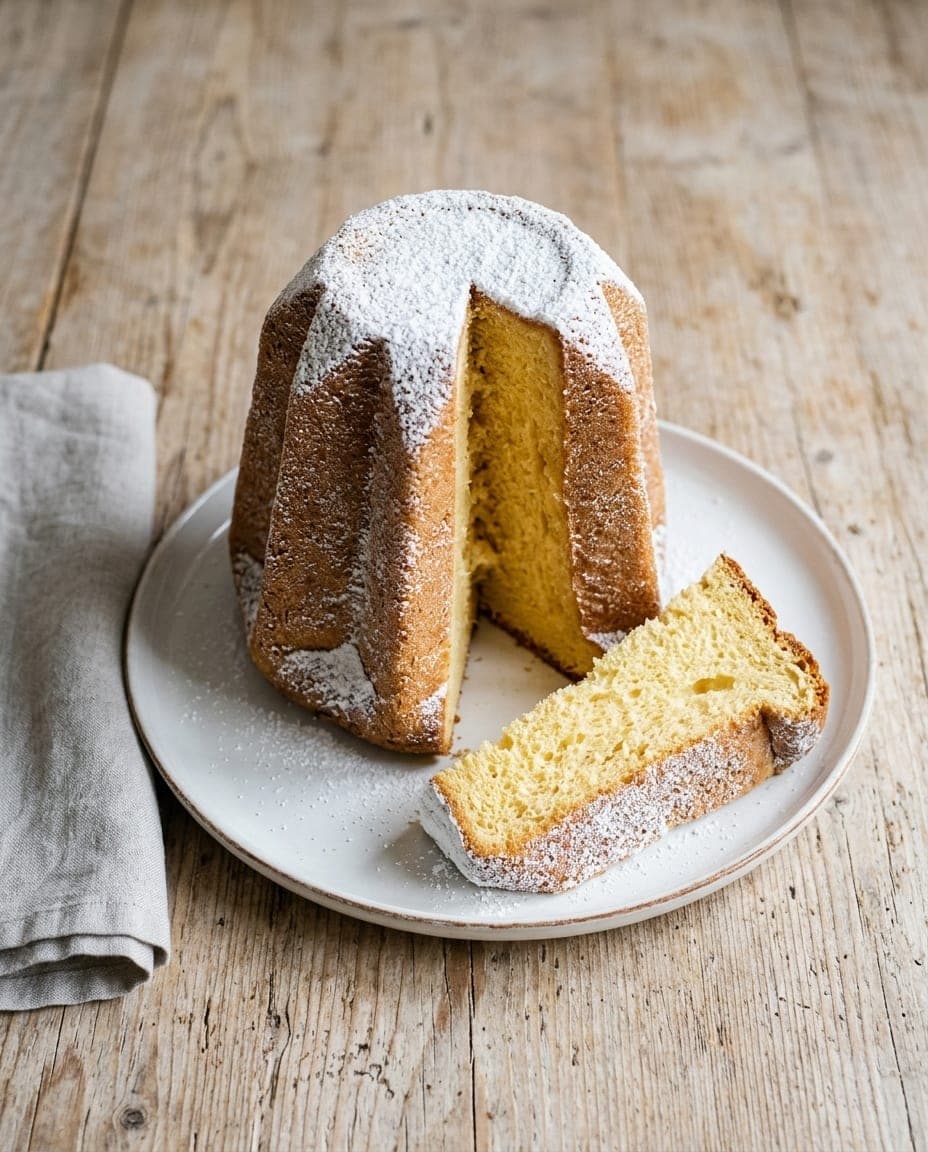
Pandoro is a tall, star-shaped sweet bread that defines the Christmas table across much of Italy, though its heart lies firmly in Verona. The name translates simply to "golden bread", a description that fits both its deep yellow colour, derived from generous amounts of butter and eggs, and its status as a festive staple. It is a leavened cake, similar in texture to brioche but with a lighter, softer crumb that melts in the mouth. Unlike its Milanese cousin, the panettone, pandoro contains no candied fruit, no raisins and no dried peel. Its purity of flavour comes from the butter, eggs and vanilla in the dough.
The cake is instantly recognisable by its shape. It is baked in a tall mould that gives it eight points, creating a star profile. Industrially made pandoro is sold in a tall box with a small sachet of vanilla-flavoured icing sugar for dusting just before serving.
The history of golden bread
The documented origin of the modern pandoro dates to 1894, when the Veronese confectioner Domenico Melegatti advertised his "Pan d'oro" and, on 14 October of that year, obtained an industrial patent for it. He commissioned the eight-pointed star mould from the Veronese impressionist painter Angelo Dall'Oca Bianca, and adapted older recipes by adding more butter and eggs to produce the characteristic light, rich texture.
Before Melegatti's recipe took hold, related cakes already existed in the region. The nadalin, a lower Veronese Christmas sweet topped with sugared pine nuts and almonds, is often considered pandoro's ancestor, and a simpler leavened cake of flour, milk and yeast also preceded it. Another theory links the name to the Republic of Venice, where luxurious foods were sometimes decorated with gold leaf. Melegatti did not invent the idea of a buttery Christmas bread, but he codified the specific form and texture now known as pandoro.
The rivalry between panettone and pandoro plays out every December. Milan claims the panettone with its domed top and fruit filling, while Verona stands firm for the star-shaped pandoro. The two share the same lineage of leavened sweet breads from northern Italy, and many families happily serve both.
How it is made and served
A proper pandoro requires a long, multi-stage leavening process, with several doughs built up over many hours. This slow fermentation allows large amounts of butter to be incorporated while keeping a light, airy crumb rather than a dense cake. The dough is placed in the tall star-shaped mould and baked until the exterior turns a deep golden brown while the interior remains soft.
A popular way of serving it is to cut the cake horizontally into star-shaped slices, then stack them with the points offset so that the whole resembles a Christmas tree. Icing sugar from the sachet is shaken over the top, creating a snowy effect. Others simply cut it vertically into wedges, revealing the even, soft crumb, free of any fruit or nuts. Some serve it with mascarpone cream or vanilla custard on the side, but the classic presentation relies on the dusting of sugar alone.
The taste is a pure expression of the dough itself, with notes of vanilla and butter and a subtle sweetness that pairs well with coffee or sweet wines.
What goes into it
The ingredients of pandoro are simple but precise:
- Wheat flour, strong enough to support the long fermentation.
- Butter, used in large quantities for the rich colour and tender crumb.
- Eggs, which provide colour, flavour and richness.
- Sugar, for sweetness and to help browning.
- Yeast or natural leaven, for the slow rise.
- Vanilla, to complement the butter.
- Salt, to balance the sweetness.
The result is a cake that feels substantial yet melts on the tongue. It is light enough to be eaten for breakfast or dessert, and often both. The absence of candied fruit distinguishes it from many other Christmas cakes across Europe, making its texture the primary focus.
Curious facts
- A painter's mould. The eight-pointed star mould was designed for Melegatti by the painter Angelo Dall'Oca Bianca.
- The sugar sachet. Packaged pandoro comes with a small packet of vanilla-flavoured icing sugar, used to create the "snowy" effect just before serving.
- A shared European tradition. Similar enriched, leavened cakes exist across Europe, such as kugelhopf in Alsace and brioche in France. The Italian version stands out for its star shape and lack of fruit.
- A national debate. The rivalry between panettone and pandoro is a yearly fixture in Italian conversation, with pandoro claiming Verona as its home.
- Christmas tree slices. Cut horizontally and stacked with the points offset, the star-shaped slices form a small sugar-dusted tree.
Where to try it
The best place to taste pandoro is at a family table in Verona during the Christmas season. While it is now produced on an industrial scale and found in supermarkets across Italy, artisan pastry shops in Verona and throughout the Veneto still make it by hand in December.
A visit to a Veronese bakery just before Christmas offers a glimpse into the ritual: the windows display tall, golden stars, and locals carry them home in their boxes. In cafes across the Veneto it may be served with a glass of sweet wine or a hot coffee. Wherever it is eaten, the cake is cut and passed around the table, a symbol of the warmth and generosity of the Italian Christmas.
Where to try it
1 region
 Wine Tasting20 destinations
Veneto
Veneto is a diverse region in northeastern Italy, home to Venice, the only city on the water. It is the eighth largest region in Italy and boasts a rich history shaped by its Roman and Venetian heritage. The countryside features rolling hills, vineyards, and olive groves, producing wines like Prosecco and Amarone. Beyond Venice, towns like Verona, known for its Roman amphitheater, and Vicenza, famous for Palladian architecture, provide cultural depth. The region also offers the picturesque Dolomites for hiking and outdoor activities. Lesser-known villages such as Asolo and Bassano del Grappa reveal local crafts and traditions, ideal for those seeking authentic experiences away from crowds.
Wine TastingHikingThermal Spas





