Montasio
A hard Alpine cheese from Friuli, served with polenta or as frico
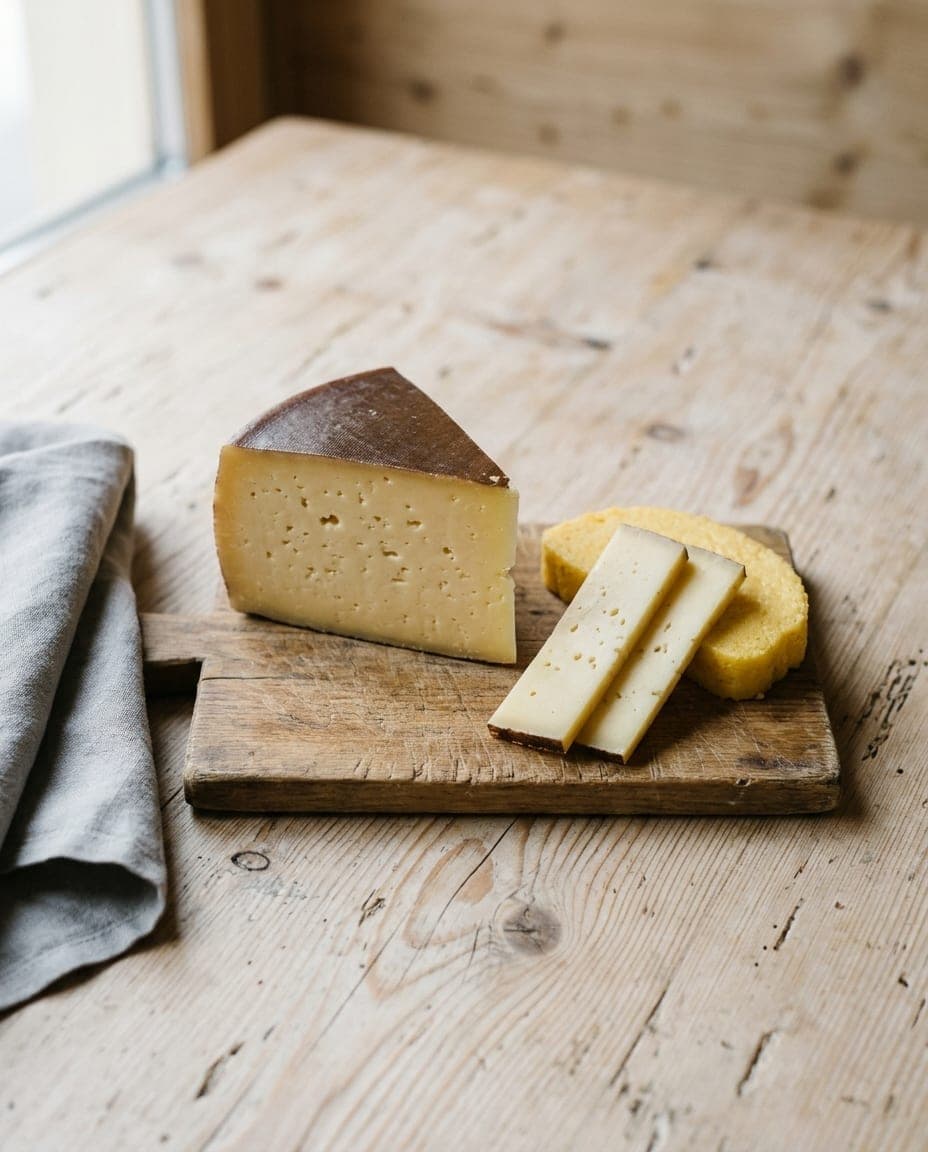
- Local name
- Montasio
- Served with
- Polenta, as frico
- Best eaten at
- A Friulian malga
- Pairs with
- Friulano white
What it is
Montasio is a firm, semi-cooked cheese made from cow's milk in Friuli Venezia Giulia in north-eastern Italy and in the eastern part of Veneto. It takes its name from the Montasio massif (Jôf di Montasio) in the Julian Alps and the high pastures at its foot. It has been a protected designation of origin (PDO) since 1996, and is a regional speciality with deep roots in the mountain landscape.
The cheese is sold in several forms defined by age. The young fresco is ready after at least 60 days, offering an elastic texture and mild, milky flavour. The mezzano, aged for at least four months, develops a firmer body and nuttier notes. The stagionato is aged for at least ten months and has a more complex, savoury profile, while the stravecchio, matured for at least eighteen months, becomes hard, dry and crumbly, suitable for grating over dishes or eating in thin shavings.
The texture ranges from smooth and supple when young to granular and hard when old. It is a cheese that changes character significantly as it ages, offering different experiences depending on how long it has rested in the cellar.
The monastic origin story
The history of Montasio is usually traced to the Benedictine monks of the Abbey of Moggio in the 13th century. According to tradition, the monks made cheese on the Montasio pastures from the milk of cows grazing on the Alpine grasses, refining a method that turned mountain milk into a durable food that could be stored and transported.
Early details are scarce, and much of the monastic story rests on tradition rather than surviving records. The name formaggio Montasio is documented by the 1770s, when it appeared in the market price lists of San Daniele del Friuli, showing that the cheese was by then a recognised product of the region.
The tradition has survived the transition from monastery pastures to the modern market. Montasio was recognised as a designation of origin in Italy in 1986 and registered as a PDO in the European Union in 1996, which sets standards of origin and method for every wheel.
What goes into it
The production of Montasio relies on a few essential elements. It is made exclusively from cow's milk from the designated area, which covers all of Friuli Venezia Giulia, the provinces of Belluno and Treviso, and parts of the provinces of Padua and Venice.
The milk is coagulated with calf rennet. The curd is then cut and heated to around 44–46 °C while being stirred, a semi-cooking step that gives the cheese its firm texture and allows it to be aged for long periods. The flavour comes from the milk and the careful ageing process rather than from additives.
After moulding and pressing, the wheels are salted, mainly in brine and then with dry salt, which helps preserve the cheese and form its rind. They are turned regularly during maturation to ensure even drying. The final product is a result of time, temperature and the quality of the milk.
How it is eaten
The way Montasio is served depends on its age. A young fresco is often sliced or cubed and eaten as a starter or with a glass of local wine. It pairs particularly well with Friulano, a white wine from the region that complements the mild, fresh notes of the young cheese.
The most characteristic use of Montasio is in frico, the classic Friulian dish of melted cheese. In its soft form it is cooked with potatoes and often onion until it forms a golden cake; in its crisp form the cheese alone is fried into a thin, crunchy wafer. Frico is said to have begun as a way to use up leftover pieces and rinds of cheese. The cheese melts into the potato, binding the mixture and giving it a deeply savoury flavour.
Older stagionato and stravecchio cheeses are often grated, including over polenta, a staple of the region. The hard, crumbly texture of the old cheese provides a satisfying contrast to the soft, creamy polenta. It can also be served in small pieces alongside bread and fruit at the end of a meal.
Curious facts
- Several ages in one name. The same cheese is sold as fresco (from two months), mezzano (from four), stagionato (from ten) and stravecchio (from eighteen months), each with a different texture and taste.
- A monastic legacy. The monks of the Abbey of Moggio are credited with developing the cheese in the 13th century, though this rests largely on local tradition.
- The purpose of frico. The famous Friulian dish is said to have begun as a way of using up leftover cheese, turning a potential waste product into a celebrated dish.
- A defined territory. The protected designation covers all of Friuli Venezia Giulia and part of eastern Veneto.
- Named after a mountain. The cheese takes its name from the Montasio massif in the Julian Alps and its summer pastures.
Where to try it
The most atmospheric place to taste Montasio is a malga, a traditional mountain dairy in the Julian Alps. These huts are seasonal, often operating only during the summer months when the cows graze on the upper pastures, and some allow visitors to see cheese being made and to taste it fresh from the source.
In the valleys below, such as those around Udine or Cividale del Friuli, traditional restaurants serve Montasio alongside polenta or in the form of frico, and local cheese shops sell it at different ages, making it easy to compare the young and aged versions side by side.
Where to try it
1 region
 Wine Tasting1 destination
Friuli Venezia Giulia
This northeastern Italian region is known for its diverse landscapes, from the Alps to the Adriatic Sea. It is the only region in Italy with a coastline, featuring beautiful beaches along the Gulf of Trieste. The capital city, Trieste, boasts a rich history as a former Habsburg port, showcasing architecture that reflects its imperial past. The region is famous for its vineyards, producing unique wines like Friulano and Refosco. Notable towns include Cividale del Friuli, a UNESCO site with Lombard heritage, and Gorizia, known for its historic castle. The scenic Collio wine region invites exploration of charming wineries and local cuisine, emphasizing fresh ingredients and traditional recipes.
Wine TastingHikingLocal Cuisine





