Maccheroni alla chitarra
Square egg pasta from Abruzzo cut on a stringed wooden frame, served with lamb ragù
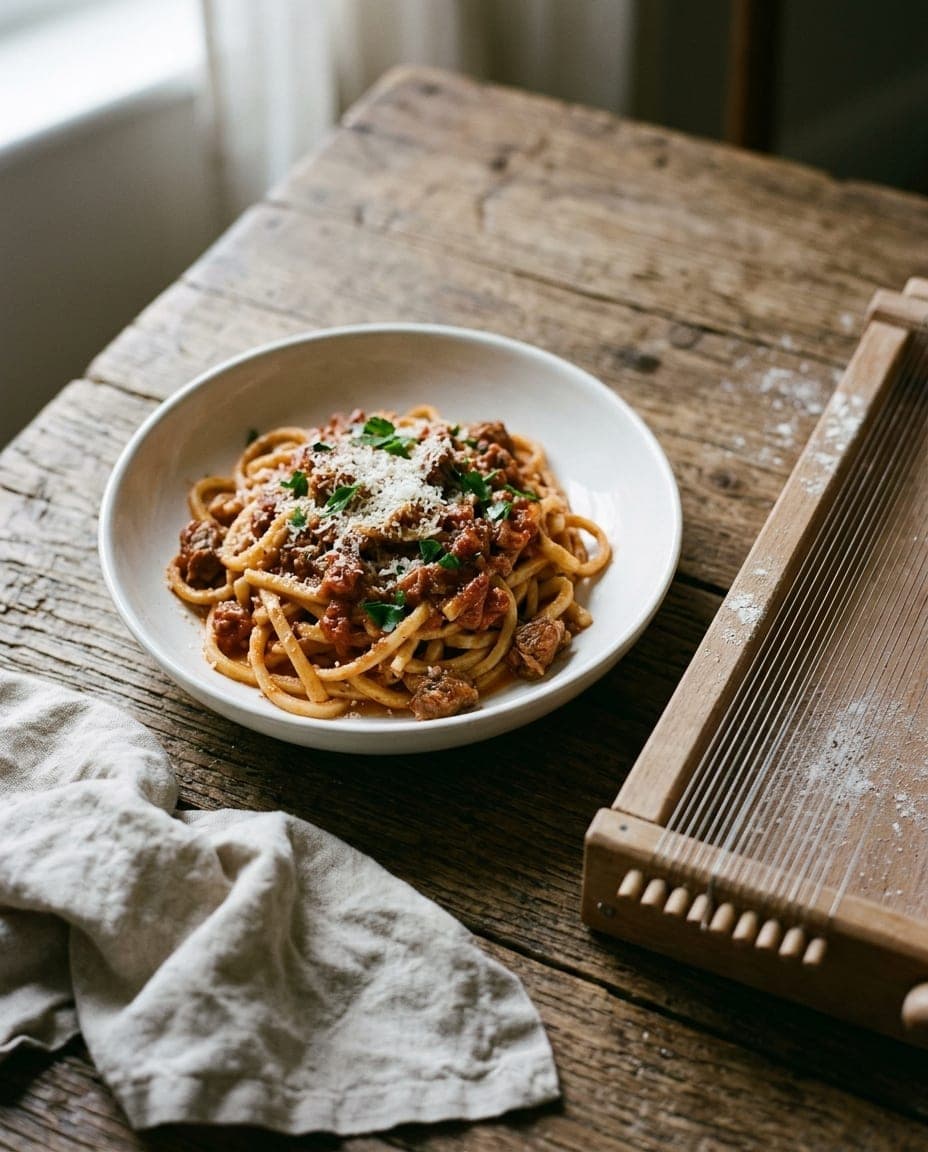
- Local name
- Maccheroni alla chitarra
- Served with
- Lamb ragù
- Best eaten at
- An Abruzzo trattoria
- Pairs with
- Montepulciano d'Abruzzo
The pasta cut by a stringed instrument
Maccheroni alla chitarra is one of the most distinctive pastas in Italy, born not in a factory but in the kitchens of Abruzzo, a mountainous region on the eastern side of the Apennines that runs down to the Adriatic Sea. The name comes from the tool used to make it: the chitarra, or guitar, a wooden frame strung with fine steel wires that resemble the strings of a musical instrument.
To make the pasta, a sheet of fairly thick egg dough is laid over the wires. A rolling pin is pushed firmly across the top, forcing the dough through the gaps in the strings. The result is not the round, smooth spaghetti found in many Italian shops, but strands with four flat sides and sharp corners, about 2 mm across. These square strands are rough and porous, designed to hold onto a hearty sauce rather than let it slide off.
It is a dish that belongs firmly to Abruzzo, where it has been made by hand for generations and is also widely known as spaghetti alla chitarra. Similar pastas are made under other names in neighbouring parts of Molise, Lazio, Marche and Puglia.
The history of the wire cutter
The chitarra is a simple object, made in a rectangular wooden frame, often of beech, with parallel steel wires stretched across it. The spacing of the wires determines the size of the pasta. It is not an industrial machine but a domestic instrument, used regularly to feed large families.
The first prototype of the tool is usually dated to around 1860. It is said that sieve makers, who used imported steel wire for flour sieves, adapted it to help housewives cut pasta. The tool became so common that it was included in the dowry of Abruzzese brides. An older cutting tool, lu rentrocelo, was used in the areas of Pescara and L'Aquila, and the chitarra was locally known as carratore for pasta.
The square shape suited the region's cooking style, which favoured slow-cooked meat sauces that needed a sturdy surface to cling to. The tool is still sold in markets and kitchen shops throughout Abruzzo today.
What goes into the dough and the sauce
The pasta itself is a classic fresh egg pasta of flour and eggs, often made with durum wheat semolina. No oil is added to the dough, which gives it a rich yellow colour and a firm texture when cooked. The sheet is rolled thicker than for many other pastas, so that it can be pressed through the wires without tearing.
The sauce is where the dish finds its character. A classic pairing is a ragù of lamb or mutton, with chunks of meat braised slowly until they fall apart. Another much-loved version, a traditional Sunday lunch, comes with pallottine, tiny meatballs of beef or lamb cooked in a tomato sauce. Other cooks prefer a simple tomato and basil sauce, and seafood versions are found on the coast.
How the dish is served in Abruzzo
Maccheroni alla chitarra is usually served as a primo, the pasta course, at lunch or dinner. The pasta is cooked al dente, then tossed with the hot ragù so that every strand is coated in the meat and its juices. The rough surface of the square strands traps the sauce, ensuring that each bite has a mix of texture and flavour.
In an Abruzzo trattoria, the dish often arrives in a wide shallow bowl, with the meat or small meatballs scattered through the strands. A sprinkle of grated pecorino may be added at the table, though the dish is rich enough on its own.
The pairing is straightforward. A glass of Montepulciano d'Abruzzo, the region's leading red wine, complements the lamb well: its tannins cut the fat of the meat, while its fruit echoes the tomato in the sauce. Crusty bread is often on hand to mop up any remaining sauce.
A taste of the mountain pastures
The connection between the pasta and the land runs deep. Abruzzo has a long tradition of sheep farming on its high mountain slopes, and lamb and mutton feature widely in its cooking, from ragù to the famous arrosticini skewers.
The sound of the rolling pin on the wires has become a symbol of home cooking in Abruzzo. In family kitchens, the rhythmic thud marks the preparation of a meal that will be shared among family and friends, a sound that signals warmth and abundance.
Curious facts
- The square cut matters. The four flat sides and rough surface of maccheroni alla chitarra help a hearty ragù cling firmly to every strand.
- A household tool, not a machine. The chitarra is a wooden frame with steel wires, typically found in family kitchens rather than factories.
- Named for the strings. The tool takes its name from its parallel wires, which look like the strings of a guitar, and the pasta takes its name from the tool.
- Part of the dowry. The chitarra was once common enough to be included in the dowry of Abruzzese brides.
- Small meatballs included. A beloved version features pallottine, tiny meatballs cooked in the sauce rather than served separately.
- Two names, one pasta. The dish is known as both maccheroni and spaghetti alla chitarra.
Where to try it
The best place to eat maccheroni alla chitarra is an Abruzzo trattoria, preferably in a small town or village. The dish is a staple on menus in towns like Sulmona, Teramo and Chieti, as well as in mountain villages near the Gran Sasso.
Sauces vary from kitchen to kitchen: some use a mix of lamb and pork, others stick to lamb alone, and many offer the meatball version. A glass of Montepulciano d'Abruzzo completes the experience.
Where to try it
1 region
 Wine Tasting1 destination
Abruzzo
Nestled between the Apennine mountains and the Adriatic Sea, this region is known for its diverse landscapes, ranging from rugged mountains to sandy beaches. It is the only region in Italy with access to both mountains and coastline, making it a unique destination. L'Aquila, the capital, features stunning medieval architecture and is surrounded by natural parks. The region is famous for its truffles, Montepulciano d'Abruzzo wine, and the ancient practices of shepherding. Explore off-the-beaten-path towns like Sulmona, known for confetti (sugar-coated almonds), and the remote Gran Sasso National Park, home to Italy's highest peak. Local festivals celebrate traditional crafts and culinary delights, providing a deep cultural connection to the land.
Wine Tasting





