Gubana
A spiral yeast cake from Friuli's Natisone valleys, served with a splash of grappa or slivovitz
- Vegetarian
- Local name
- Gubana
- Served with
- Grappa or slivovitz drizzle
- Best eaten at
- A Cividale bakery
- Pairs with
- Picolit
What it is
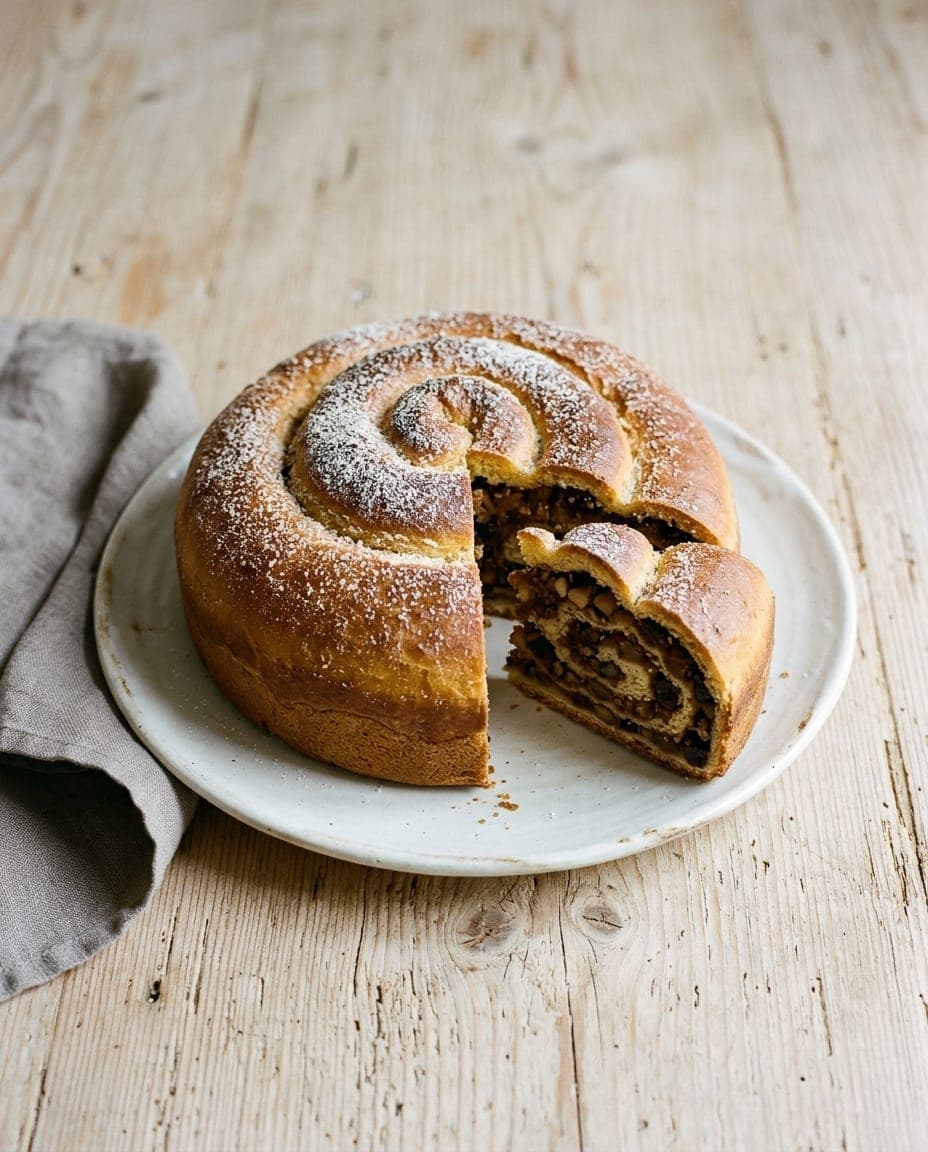
Gubana is a spiral yeast cake from the Natisone valleys in the north-east of Italy, near the Slovenian border, and from the nearby town of Cividale del Friuli. It belongs to the Friuli Venezia Giulia region rather than to Italy as a whole. The cake is defined by its shape: a soft, rich dough is rolled around a sweet filling of nuts and dried fruit, formed into a long roll and coiled like a snail before baking.
When sliced, the cake reveals rings of dark filling against the golden-brown dough. The texture is dense and moist, and the flavour is rich and sweet, dominated by walnuts and raisins with the warming note of grappa in the filling.
In Gorizia a variant exists in which the same filling is wrapped in a thin, flaky pastry instead of the yeast dough, but the leavened spiral remains the signature of the Natisone and Cividale gubana. It is traditionally made for Easter and Christmas, and for family occasions such as weddings and baptisms, though it can be found year-round in local bakeries.
The Slavic roots of the Natisone valleys
The history of gubana is tied to the cultural geography of the Valli del Natisone, an area where Italian, Friulian and Slovene traditions have mingled for centuries; the valleys' inhabitants traditionally speak a local Slovene dialect. The name is often linked to the Slovene verb gubati, "to fold".
Gubana appears in records from the early 15th century. It is said to have been among the dishes served at a grand banquet held in Cividale in 1409 for Pope Gregory XII, and a contract from 1576 reportedly valued a single gubana at a mason's day's pay. Over the centuries it passed from festive family and court tables to the shops of local bakers.
For the farming families of the valleys, the cake was a way to turn stores of nuts and dried fruit into a festive centrepiece. It was not merely a treat but a marker of the season and of life's milestones.
What goes into it
The filling is the heart of the cake. There is no single official recipe, as every baker has a variation, but the core components remain consistent.
- Walnuts: The primary nut, providing an earthy, slightly bitter base.
- Raisins: Sultanas add chewiness and natural sweetness, often soaked in spirit before use.
- Pine nuts: A smaller addition that brings a subtle, resinous note.
- Candied peel and lemon zest: Offering a bright, citrus counterpoint to the nuts.
- Grappa: A measure of spirit binds and perfumes the filling.
- Sugar, butter and crumbled biscuits: Binding the mixture; some versions add hazelnuts, almonds, cocoa or vanilla.
The dough itself is a rich leavened base made with flour, butter, eggs, sugar and milk, which gives a tender crumb able to hold the heavy filling. Some bakers develop the dough over several days with repeated folding and rising.
How it is eaten
Gubana is traditionally served in slices that show the spiral pattern inside. A common local custom is to moisten each slice with a little slivovitz (plum brandy) or grappa just before eating, which intensifies the aroma and softens the texture.
A glass of Picolit, the sweet white wine of the Colli Orientali del Friuli hills, is a fitting partner, its honeyed notes complementing the nutty richness of the cake.
The experience is meant to be slow, suited to long conversations after a meal or to a holiday table. A large gubana is usually shared among several people, cut into slices that are passed around.
Curious facts
- The spiral reveals the filling. When sliced, the rings of gubana show the distribution of nuts and fruit, a visual record of the rolling technique.
- Alcohol twice. Spirit goes into the filling before baking, and is often splashed on the slices again at the table.
- A borderland tradition. Gubana is the signature sweet of the Natisone valleys, a family ritual of the area's Slovene-speaking community.
- A papal banquet. Tradition holds that gubana was served to Pope Gregory XII in Cividale in 1409.
- A pastry variant. The Gorizia version wraps the filling in thin, flaky pastry rather than yeast dough.
Where to try it
The best place to eat gubana is in Cividale del Friuli, the historic town at the mouth of the Natisone valleys, and in the villages of the valleys themselves. Local bakeries and pastry shops produce the cake with an expertise that is difficult to replicate elsewhere, often following family recipes passed down through generations.
Gubane are displayed in shop windows, coiled and ready to be sliced. While the cake can be found in other parts of Friuli Venezia Giulia, the versions from Cividale and the valleys keep the character of the original. Before the holidays, the bakeries become local meeting points, where the community gathers for daily bread and seasonal cakes.
Where to try it
1 region
 Wine Tasting1 destination
Friuli Venezia Giulia
This northeastern Italian region is known for its diverse landscapes, from the Alps to the Adriatic Sea. It is the only region in Italy with a coastline, featuring beautiful beaches along the Gulf of Trieste. The capital city, Trieste, boasts a rich history as a former Habsburg port, showcasing architecture that reflects its imperial past. The region is famous for its vineyards, producing unique wines like Friulano and Refosco. Notable towns include Cividale del Friuli, a UNESCO site with Lombard heritage, and Gorizia, known for its historic castle. The scenic Collio wine region invites exploration of charming wineries and local cuisine, emphasizing fresh ingredients and traditional recipes.
Wine TastingHikingLocal Cuisine





