Fegato alla veneziana
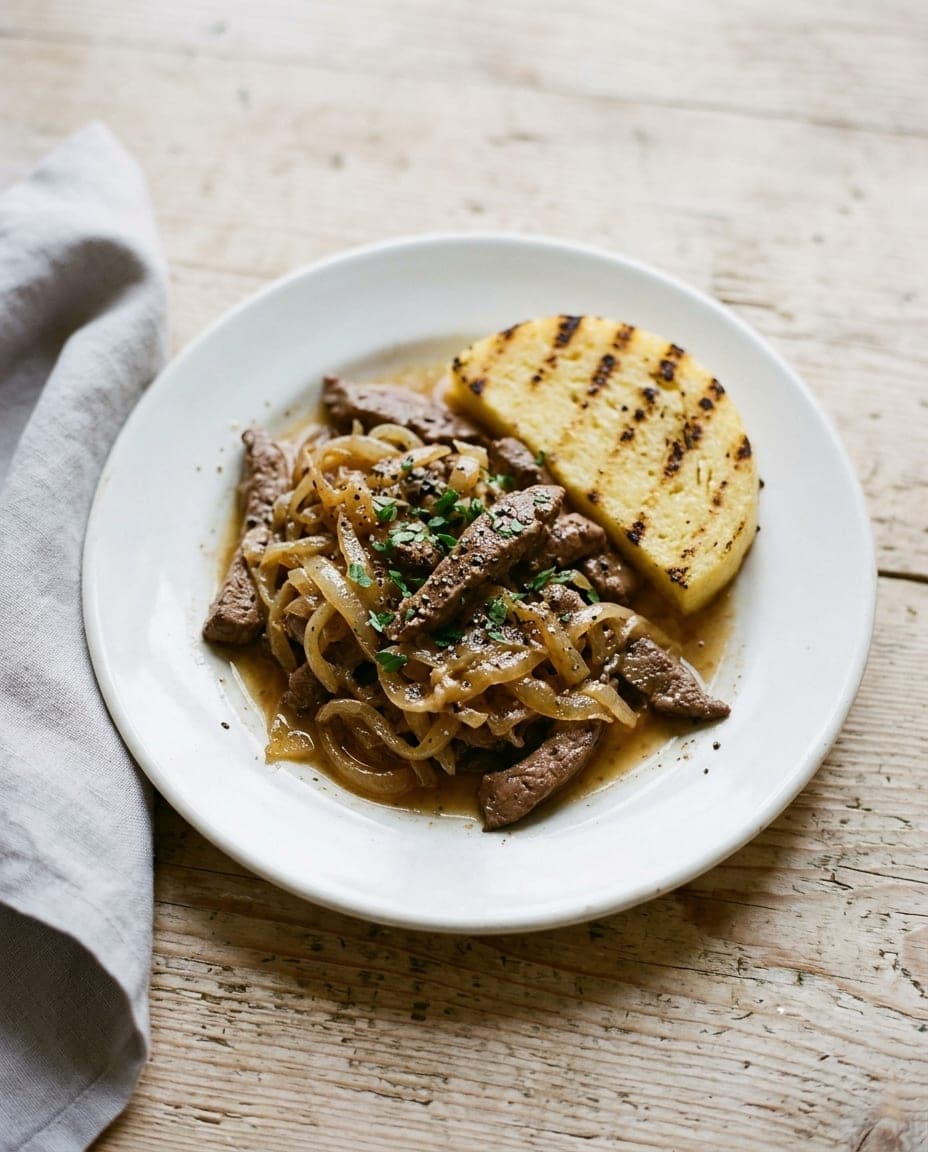
Calf's liver sliced thin and sautéed with slow-cooked onions, served on white polenta
- Local name
- Fegato alla veneziana (figà àea venessiana)
- Served with
- White polenta, soft or grilled
- Best eaten at
- A Venetian bacaro or trattoria
- Pairs with
- Merlot or Refosco
What it is
Fegato alla veneziana, literally "liver in the Venetian style", is one of the most enduring staples of the Veneto and one of the signature dishes of Venice itself. It consists of thin slices of calf's liver cooked briefly with a generous amount of onions that have been softened slowly in oil and butter until they turn into a sweet, translucent tangle. The dish relies on the ratio between the two main ingredients: there should be at least as much onion by volume as there is liver, often more.
The onions are not merely a garnish or a side vegetable. They are cooked down until they lose their sharpness and become almost a sweet sauce that coats the meat. The liver, added only at the end, is cooked for just a minute or two to stay tender. Overcooking turns the texture dry and grainy, which is considered the primary failure of the dish.
It is a simple plate, yet one that carries the weight of Venetian history. Pairing liver with something sweet is an old idea: cooks in antiquity are said to have cooked it with figs to soften its metallic edge, and the Venetian version is often described as swapping the figs for sweet onions. It remains a dish that feels humble but requires precision to execute well.
The history of the onion and the liver
The origins of fegato alla veneziana are rooted in the practicalities of Venetian cooking rather than high culinary theory. Venice depended on the mainland for its produce and meat, which arrived by boat. Onions were cheap, kept well and were available year-round, making them a natural partner for offal such as liver.
The technique of cooking the onions slowly in butter and oil until they melt into a sweet base is a hallmark of Venetian cuisine, seen also in dishes such as sarde in saor. It softens the harshness of the onion and creates a natural sweetness that balances the iron-deep flavour of the liver.
In the past, this was everyday food served in modest taverns, an inexpensive cut stretched with a plateful of onions. Over time it moved from the worker's lunch to a beloved classic that represents the city to visitors and locals alike.
What goes into it
There is no single official recipe for fegato alla veneziana, but the components are consistent:
- Calf's liver, sliced very thin so that it cooks almost instantly.
- Onions, used in a large quantity relative to the meat, cooked slowly until very soft.
- Butter and olive oil, used together to fry the onions and finish the liver.
- A splash of white wine or vinegar, added by some cooks at the end to deglaze the pan and add a sharp note.
- Salt, pepper and often parsley, used simply to season the final result.
The onions are cooked down so thoroughly that they become part of the sauce itself. This is what distinguishes a true Venetian version from a quick sauté in which the onions remain distinct and crunchy.
How it is eaten
Fegato alla veneziana is traditionally served with white polenta, polenta bianca, made from the white maize favoured in the Venetian lagoon. It may be soft and spooned onto the plate, or set, sliced and grilled to add a slight char before the liver and onions go on top. The polenta acts as a neutral base that absorbs the sauce without competing for attention.
The dish turns up in traditional trattorias and in some bacari, the small Venetian wine bars where locals gather for an ombra, a small glass of wine, and a few cicchetti; there it may appear as a small portion on a slice of polenta.
A well-made plate has tender liver and soft, sweet onions coating every slice. A glass of Merlot or Refosco, both grown in the Veneto, makes a good pairing, as their fruit and gentle tannins complement the deep flavours of the dish. The polenta provides a warm foundation that makes the plate feel substantial despite its simple ingredients.
Curious facts
- The ratio matters. A proper version uses at least as much onion by volume as liver, often more, so the meat is swamped in the sweet onion sauce.
- Ancient roots. The pairing of liver with a sweet element goes back to antiquity, when it was cooked with figs; the Italian word fegato itself comes from the Latin iecur ficatum, liver fattened with figs.
- A quick cook. The liver goes in at the very end and cooks for only a minute or two; overcooking ruins the texture.
- Far-travelled. Although it is cooked across Italy, the dish keeps the name of the city that made it famous.
- Bacaro tradition. Small portions on polenta fit naturally into the bacaro habit of cicchetti and wine.
Where to try it
The best place to eat fegato alla veneziana is in a traditional Venetian trattoria or bacaro that cooks for locals as much as visitors.
The appeal lies in the rhythm of the cooking: onions softened slowly, liver added at the last moment, a glass of Merlot or Refosco alongside. Elsewhere in the Veneto, trattorias in towns such as Treviso or Padua also keep the tradition, often with polenta made fresh on site.
Where to try it
1 region
 Wine Tasting20 destinations
Veneto
Veneto is a diverse region in northeastern Italy, home to Venice, the only city on the water. It is the eighth largest region in Italy and boasts a rich history shaped by its Roman and Venetian heritage. The countryside features rolling hills, vineyards, and olive groves, producing wines like Prosecco and Amarone. Beyond Venice, towns like Verona, known for its Roman amphitheater, and Vicenza, famous for Palladian architecture, provide cultural depth. The region also offers the picturesque Dolomites for hiking and outdoor activities. Lesser-known villages such as Asolo and Bassano del Grappa reveal local crafts and traditions, ideal for those seeking authentic experiences away from crowds.
Wine TastingHikingThermal Spas





