Confetti di Sulmona (sugared almonds)
Sugar-coated almonds from Sulmona, wrapped in tulle for Italian weddings
- Vegetarian
- Local name
- Confetti di Sulmona
- Best eaten at
- Italian weddings and christenings
What it is
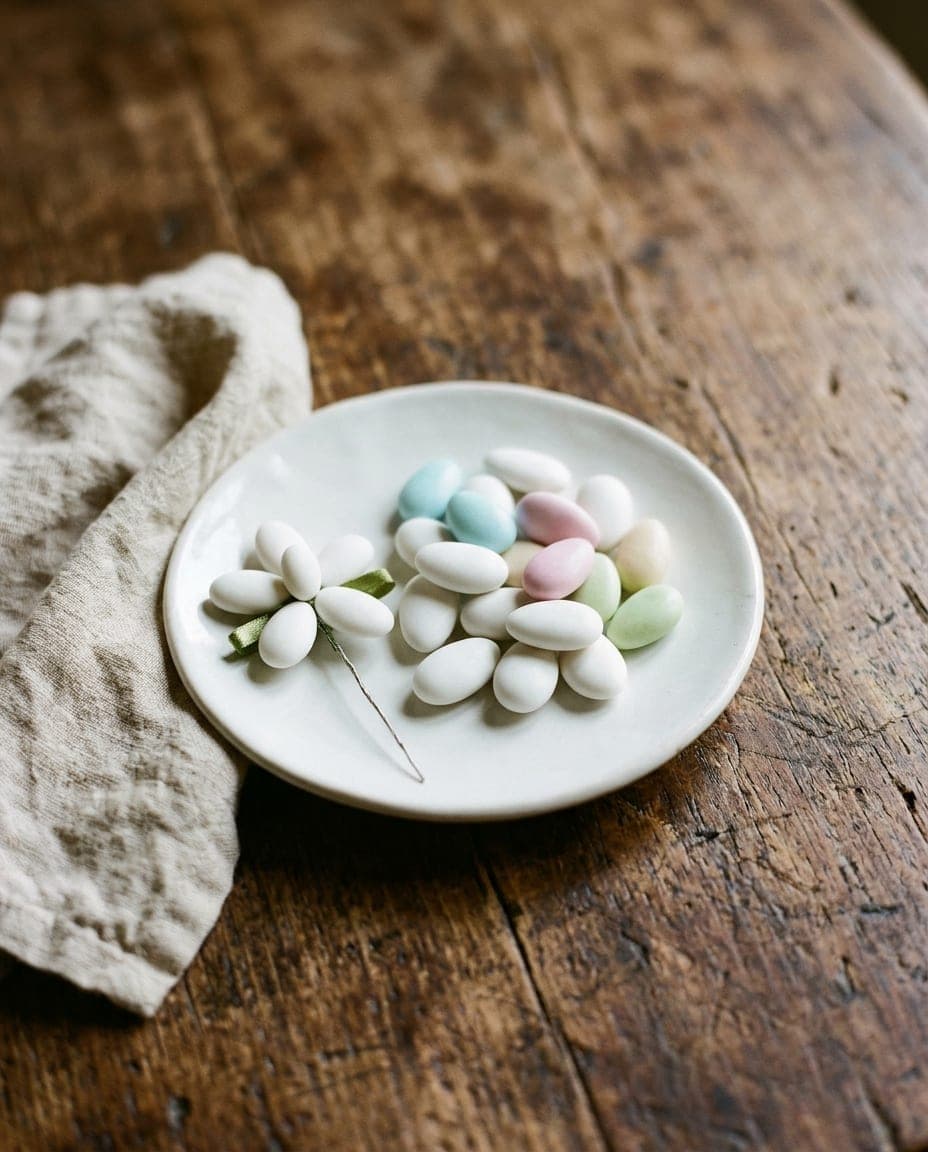
Confetti di Sulmona are not merely confectionery but a symbol of celebration in the Italian region of Abruzzo. They consist of a whole almond coated in multiple thin layers of sugar syrup, built up slowly until the nut is encased in a smooth, hard shell. The word confetto comes from the Latin conficere, "to prepare". In English, confetti now means scraps of paper thrown at parties, but in Italian the word refers to these sugared sweets.
The quality of these almonds lies in their construction. A good Sulmona confetto contains a whole, unbroken almond encased in an even shell of sugar. Cheaper versions may use broken nuts or a thick, coarse coating that cracks easily. The process is slow and labour-intensive. This attention to detail has made them a byword for Italian wedding sweets, traditionally given to guests in odd numbers inside small tulle bags as part of the bomboniera, the wedding favour.
How they are made
The production of confetti di Sulmona relies on rotating copper pans called bassine. Peeled almonds, traditionally from the Valle Peligna or the flat, elongated almonds of Avola in Sicily, are placed in the pan as it turns. A syrup of sugar and water is added gradually in small amounts. As the pan rotates, the syrup coats each nut and dries to form a new layer. The cycle is repeated many times until the coating reaches the right thickness, before the confetti are polished, coloured if required, and dried.
The skill lies in maintaining the integrity of the nut inside. If the heat is too high or the syrup is added too quickly, the coating becomes uneven and brittle rather than smooth and hard. The result is a sweet that breaks cleanly with a satisfying crunch, revealing the kernel within.
The flowers of Sulmona
While the sugared almond itself is a delicacy, the true artistry of Sulmona emerges when these sweets are arranged into shapes. Local craftspeople wrap confetti in fine silk, tulle or cellophane and wire them together into flowers, baskets and sculptures. The resulting bouquets are sold as gifts or used as centrepieces for celebrations.
The craft is credited to the Poor Clare nuns of the convent of Santa Chiara in Sulmona, who from the 15th century made small bouquets of confetti for young noble brides. Today, while simple bags remain common, the elaborate arrangements still fill the shop windows of the town. The work requires patience and a steady hand, as each almond must be positioned to hold its place without breaking the sugar shell.
A history tied to Ovid
Sulmona lies in the Valle Peligna, a basin ringed by mountains in the province of L'Aquila. Sugared almonds have a long history in Italy: early versions used honey, which was replaced by sugar as it spread through Europe. Over the centuries, production in Sulmona moved from the convent into secular workshops, and the town has been known for its confectioners ever since. Sulmona is also home to a museum dedicated to the art of confetti-making.
The town is equally proud of the Roman poet Ovid, who was born there. There is no historical link between Ovid and the sugared almond, but poet and confetto sit side by side as the twin symbols of the town's identity, and visitors will meet both on shop signs and souvenirs.
Where they are eaten
Confetti di Sulmona are most commonly found at Italian weddings and christenings. It is customary for the couple to give each guest a small tulle bag containing an odd number of almonds. The odd number is said to represent a union that cannot be divided. The bag itself is often decorated with ribbons or lace, adding to the ceremonial feel of the gift.
Beyond weddings, these sweets appear at christenings, graduations and other major life celebrations. In Sulmona, they are sold in local shops year-round as souvenirs or gifts. The tradition of giving them remains strong, even as modern alternatives emerge.
Curious facts
- The odd number rule. Guests receive an odd number of almonds in the favour bag, traditionally said to symbolise an indivisible bond between the couple.
- A whole nut inside. High-quality confetti contain a single, unbroken almond.
- Copper pans. The coating is built up in rotating copper bassine, layer after layer of syrup.
- The flower craft. Confetti are wrapped and wired together by hand into bouquets and sculptures, a speciality of Sulmona's confectioners.
- A traditional product. Confetti di Sulmona are listed among Italy's prodotti agroalimentari tradizionali (PAT), the national register of traditional foods.
- Ovid's town. Sulmona is the birthplace of the Roman poet Ovid, and the town pairs his memory with its confetti as part of its cultural identity.
Where to try it
The best place to find confetti di Sulmona is the historic centre of Sulmona itself, where workshops and shops have operated for generations. Local confectioners sell the sweets in small bags, larger bouquets and elaborate sculptures.
Outside Sulmona, they are available in speciality food stores across Italy and in Italian delicatessens abroad. However, the authentic version remains tied to this corner of Abruzzo, and the sweets are best bought fresh from the shop, where the sugar shell is crisp and the almond inside is whole.
Where to try it
1 region
 Wine Tasting1 destination
Abruzzo
Nestled between the Apennine mountains and the Adriatic Sea, this region is known for its diverse landscapes, ranging from rugged mountains to sandy beaches. It is the only region in Italy with access to both mountains and coastline, making it a unique destination. L'Aquila, the capital, features stunning medieval architecture and is surrounded by natural parks. The region is famous for its truffles, Montepulciano d'Abruzzo wine, and the ancient practices of shepherding. Explore off-the-beaten-path towns like Sulmona, known for confetti (sugar-coated almonds), and the remote Gran Sasso National Park, home to Italy's highest peak. Local festivals celebrate traditional crafts and culinary delights, providing a deep cultural connection to the land.
Wine Tasting





