Centerbe
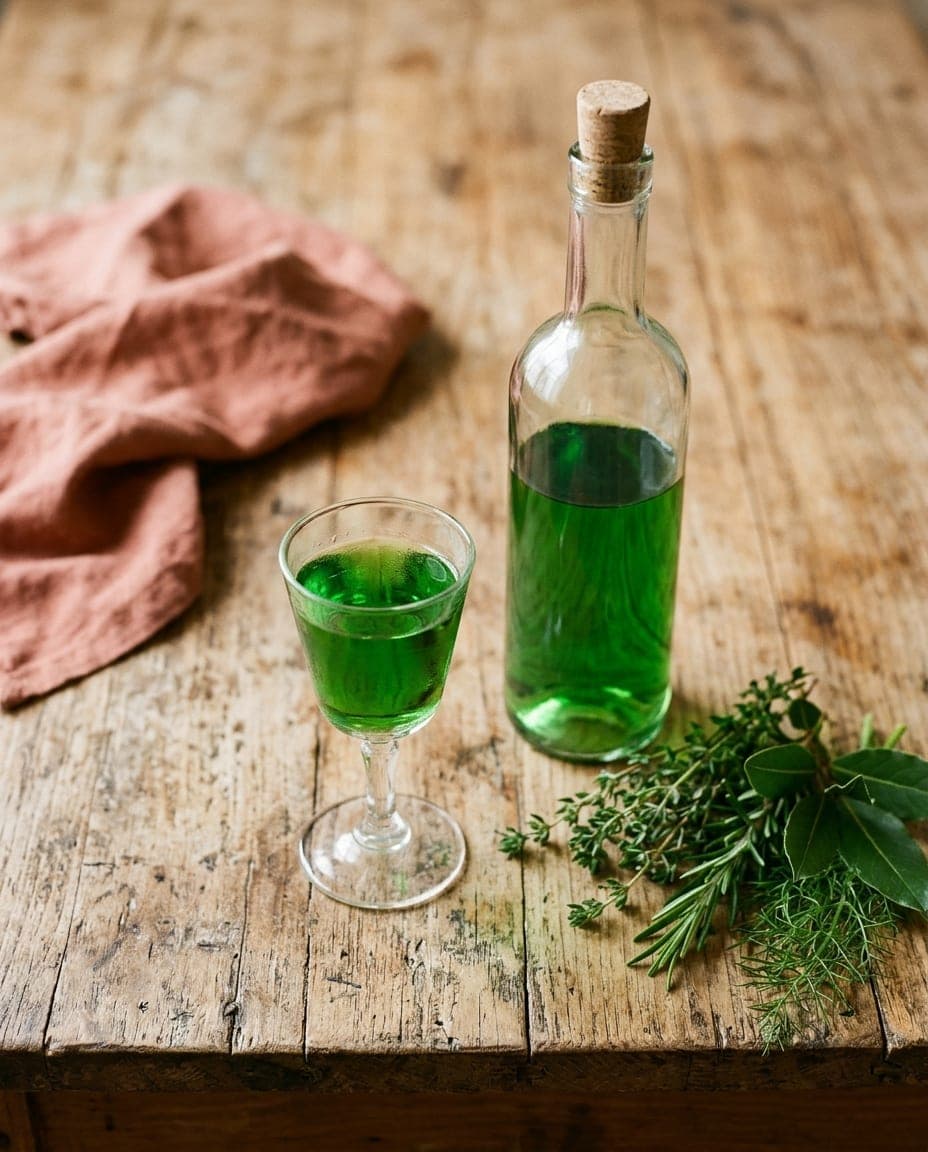
A fiery green herbal liqueur from Tocco da Casauria, bottled at around 70%
- Alcoholic
- Local name
- Centerbe (Centerba)
- Served
- Neat, small glass, as digestif
- Best eaten at
- An Abruzzo trattoria after dinner
- Pairs with
- Rich meat meals
What it is
Centerbe is a fiercely strong herbal liqueur from the small town of Tocco da Casauria in the province of Pescara, Abruzzo. The name refers to its composition: cento erbe means "one hundred herbs", and the traditional recipe is said to use around a hundred wild mountain plants. It is not a drink for casual sipping but a potent elixir, deep green in colour and intensely aromatic, with a sharp, bitter finish that lingers on the tongue.
The defining characteristic of Centerbe is its strength. While most herbal liqueurs sit between 25 and 40 per cent alcohol by volume, the strong (forte) version from Tocco da Casauria reaches around 70 per cent, making it one of the strongest drinks in the Italian tradition. It is drunk in tiny quantities, in a small glass, either neat and sipped slowly or diluted with water or added to coffee to soften its edge.
The alchemy of Tocco da Casauria
Herbal infusions of this kind were long made in Abruzzo households. In 1817 Beniamino Toro, a pharmacist in Tocco da Casauria, began producing the family recipe commercially under the name Centerba Toro. The recipe remains a closely guarded secret of the Toro family business, which still makes the liqueur in the town today, while home-made and other commercial versions are found across Abruzzo.
The herbs are gathered on the slopes of the Maiella and Morrone mountains. The Maiella, whose summit Monte Amaro is the second-highest peak of the Apennines, lies at the heart of the Majella National Park, a landscape of high limestone plateaux and rugged terrain where wild plants thrive. Recipes include aromatic plants such as mint, sage, thyme, rosemary, marjoram and chamomile, which give the liqueur its bright green hue and complex taste.
The drink began as a pharmacist's preparation and was long kept as a household remedy against the chill of mountain winters. Today it serves primarily as a digestif, taken after a heavy meal.
How it is made
The production of Centerbe relies on the quality of the herbs and the patience of the maker. Herbs are collected by hand, often at specific times of the year. In the Toro method they undergo a slow, cold infusion in alcohol before distillation; home versions simply macerate the herbs in strong alcohol for about a month, then filter the liquid and sweeten it with sugar syrup.
The result is visually striking and powerfully flavoured. The green colour is traditionally derived from the herbs themselves. The taste is dominated by a sharp mintiness and a deep bitterness, with notes of spices and flowers beneath. A milder version exists for those who find the traditional strength too intense, but the high-alcohol forte remains the most celebrated.
Curious facts
- A formidable strength. At around 70 per cent alcohol, the strong version of Centerbe is far stronger than most liqueurs and many spirits.
- Herbs from the high mountains. The plants come from the slopes of the Maiella and Morrone, in the mountains of central Abruzzo.
- A two-century-old recipe. The Toro family has produced its Centerba since 1817 and keeps the exact recipe secret.
- Pharmacy origins. Like many Italian herbal liqueurs, it began as an apothecary's preparation before becoming a digestif.
- A cocktail past. Centerbe appeared in early 20th-century cocktail books, in mixed drinks such as the Green Devil.
Where to try it
The natural place to taste Centerbe is in Tocco da Casauria itself or in a traditional Abruzzo trattoria, where it is often offered at the end of a meal. It is not widely exported and rarely appears on menus outside the region, though bottles can be found in Italian speciality shops.
It is typically served in a small glass after a meal of rich meat dishes, such as lamb or game, either neat for a quick, powerful finish or softened with a splash of water or in a hot coffee. Sipped slowly, its herbal notes unfold gradually, a fitting close to the hearty, savoury cooking of Abruzzo's mountains.
Where to try it
1 region
 Wine Tasting1 destination
Abruzzo
Nestled between the Apennine mountains and the Adriatic Sea, this region is known for its diverse landscapes, ranging from rugged mountains to sandy beaches. It is the only region in Italy with access to both mountains and coastline, making it a unique destination. L'Aquila, the capital, features stunning medieval architecture and is surrounded by natural parks. The region is famous for its truffles, Montepulciano d'Abruzzo wine, and the ancient practices of shepherding. Explore off-the-beaten-path towns like Sulmona, known for confetti (sugar-coated almonds), and the remote Gran Sasso National Park, home to Italy's highest peak. Local festivals celebrate traditional crafts and culinary delights, providing a deep cultural connection to the land.
Wine Tasting





