Carciofi alla romana
Roman artichokes braised in olive oil with mint and garlic
- Vegetarian
- Local name
- Carciofi alla romana
- Best eaten at
- A Roman trattoria
- Pairs with
- Frascati
What it is
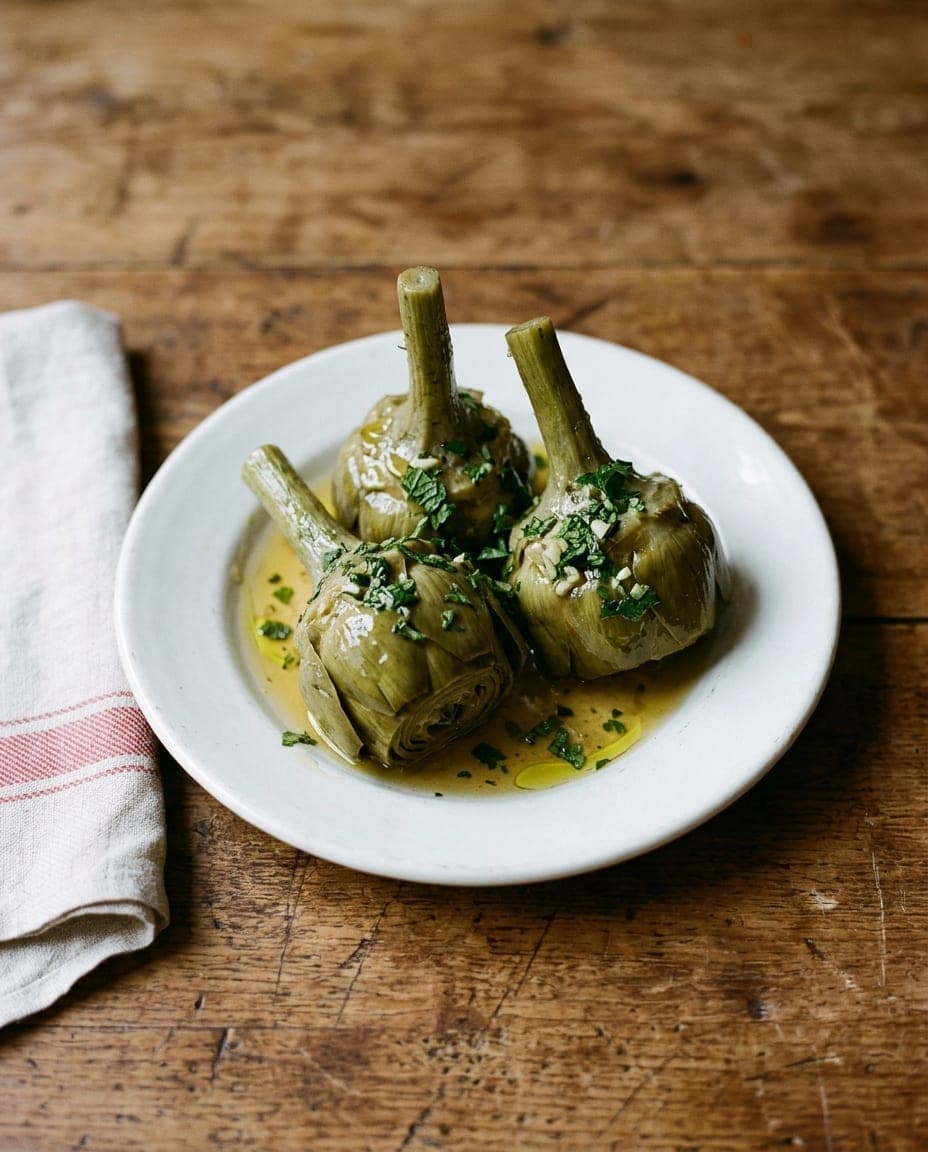
Carciofi alla romana is the most famous vegetable dish of Rome and its surrounding Lazio region. It consists of globe artichokes trimmed down to their tender hearts, with part of the stalk left attached, then stuffed with a mixture of garlic, parsley and mentuccia — a small, wild Roman herb related to mint — before being braised in a pan of olive oil and water. The result is a dish where the artichokes are completely soft, almost melting, yet retain their shape. They are served warm or at room temperature, whole, with the cooking juices spooned over.
This preparation is distinct from carciofi alla giudia, which involves deep-frying the artichokes until they resemble golden flowers. Both dishes rely on the same Roman artichoke, but their methods and textures are opposites: one is braised and tender, the other crisp and fried. Carciofi alla romana is the dish that defines the Roman artichoke season, which peaks roughly from February to April.
The variety is the carciofo romanesco, protected as the IGP Carciofo Romanesco del Lazio: a round, compact, thornless globe of greyish green tinged with violet. It is grown mainly along the Tyrrhenian coast of Lazio, in areas such as Cerveteri, Ladispoli, Tarquinia and Sezze, and harvested by hand from January to May.
The role of mentuccia
The ingredient that sets this dish apart from other artichoke preparations is mentuccia, a wild herb that grows in the Roman countryside. It is smaller and more pungent than common garden mint and is not the same plant. Ordinary mint is sometimes used when fresh mentuccia is unavailable, but Roman cooks consider it a substitute. The herb provides a sharp, cooling contrast to the richness of the olive oil and the earthy sweetness of the artichoke.
The stuffing typically combines garlic and flat-leaf parsley with the mentuccia, chopped together and pushed into the centre of the trimmed artichoke. Lemon is used while trimming, to stop the cut surfaces from darkening. The exact ratio of herbs varies from kitchen to kitchen, but the presence of mentuccia is considered essential for a dish that claims to be truly Roman.
How it is made
The preparation begins with careful trimming. The tough outer leaves are pulled away until only the pale inner leaves remain, the tips are cut off, and the stalk is shortened and peeled to remove its fibrous outer layer. The leaves are gently opened so the herb mixture can be pressed into the centre.
Once stuffed, the artichokes are packed tightly into a high-sided pan, traditionally head down with the stalks pointing upwards, so that they hold each other in place. They are then covered with a generous amount of extra virgin olive oil and enough water to come part of the way up. The pan is covered, traditionally with a sheet of paper rather than a tight lid, and left to cook gently for around half an hour. The artichokes become tender without turning mushy or losing their structure, and the oil and water reduce into an aromatic sauce.
What goes into it
The ingredients are simple and few:
- Carciofo romanesco: The round, thornless Roman artichoke grown along the coast of Lazio.
- Mentuccia: The wild Roman herb that gives the dish its distinctive aroma.
- Garlic: Chopped with the herbs to perfume the oil and the artichoke.
- Flat-leaf parsley: Added for freshness, balancing the intensity of the mentuccia and garlic.
- Extra virgin olive oil: Used in abundance as both cooking medium and flavour.
- Water: Added to the oil so the artichokes braise gently without burning.
- Lemon: Used in the trimming stage to keep the artichokes pale.
How it is eaten
Carciofi alla romana is served as a starter or as a contorno, a side dish to a main course of meat or fish. The artichokes are presented whole in their own juices. Because the leaves have been trimmed back to the tender part, almost everything is edible: the leaves, the heart and the peeled stalk are eaten with a knife and fork, with bread to mop up the oil and herbs left on the plate.
The texture is key: the leaves should be soft enough to cut easily, and the heart should be creamy without being watery. The flavour is earthy and sweet, with a clear, sharp finish from the mentuccia and garlic. A glass of Frascati, the local white wine from the Castelli Romani hills south-east of Rome, complements the oil and herbs without overpowering them.
The Roman trattoria tradition
The dish belongs to the unpretentious neighbourhood trattorias of Rome, where the focus is on local produce and simple cooking. In season, many of them prepare it daily.
In spring, the city's markets display piles of the violet-tinged globes, and it is common for families to buy them fresh to cook at home.
Curious facts
- A protected artichoke: The carciofo romanesco is protected as the IGP Carciofo Romanesco del Lazio, grown mainly along the coast north and south of Rome.
- Upside down: The artichokes are traditionally cooked head down, packed tightly, with the stalks pointing up.
- Warm or room temperature: Unlike many vegetable dishes, carciofi alla romana is often served lukewarm, allowing the flavours of the oil and herbs to settle.
- The mentuccia marker: The wild Roman herb is the ingredient that distinguishes this dish; ordinary mint is a substitute rather than the authentic flavour.
- A seasonal ritual: The season peaks from February to April, when the artichokes are at their most tender.
- Not fried: Unlike carciofi alla giudia, carciofi alla romana is always braised, giving a soft texture rather than crispness.
Where to try it
1 region
 Camper Van Rentals2 destinations
Lazio
Lazio is Italy's second-largest region, renowned for its rich history and diverse landscapes. The capital, Rome, boasts ancient ruins and vibrant street life, but the surrounding areas are equally captivating. Explore the hill towns like Viterbo, known for its thermal springs and medieval architecture. The region also features the stunning coastline of the Tyrrhenian Sea, offering hidden beaches and charming fishing villages. Lazio is famous for its culinary traditions, including artichokes from Rome and wines from Frascati. The region is home to the beautiful countryside of the Castelli Romani, dotted with vineyards and historic castles, providing a glimpse into local life away from the tourist crowds.
Camper Van RentalsHikingWine Tasting





