Caponata
A Sicilian sweet-and-sour aubergine stew with capers, olives and pine nuts
- Vegetarian
- Local name
- Caponata
- Served with
- Bread
- Best eaten at
- A Sicilian trattoria
- Pairs with
- Nero d'Avola or Grillo
What it is
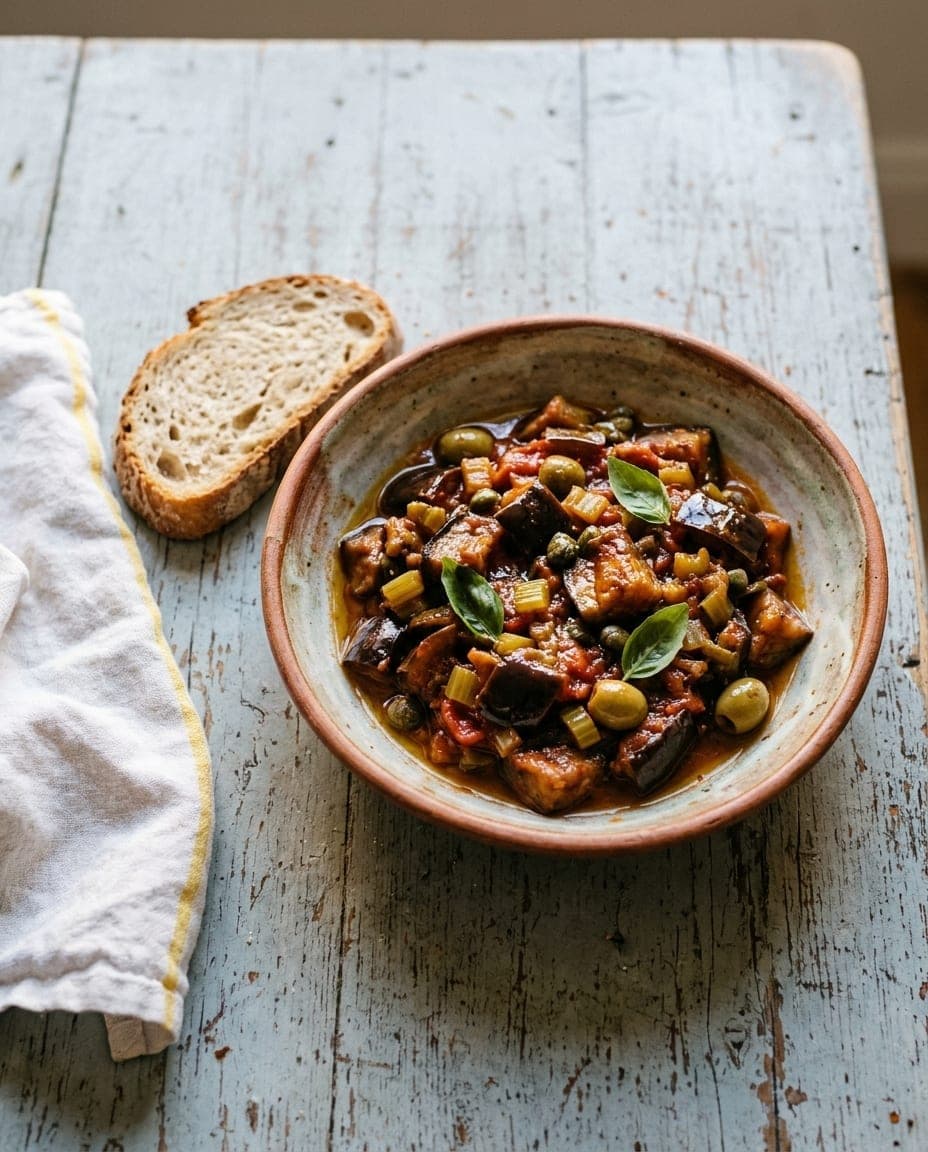
Caponata is the definitive sweet-and-sour vegetable stew of Sicily. It is not merely a side dish but a culinary institution that appears on tables from humble family kitchens to festive spreads across the island. The composition is distinct: chunks of fried aubergine, celery, onion and tomato are bound together in a glossy agrodolce sauce made from vinegar and sugar, then studded with capers and olives.
The texture is a study in contrasts. The aubergines offer a soft, almost melting interior that has absorbed the sharp tang of the vinegar and the sweetness of the sugar, while the celery provides a necessary crunch. Pine nuts or raisins appear in many recipes, adding a nutty or fruity note that balances the acidity. The dish is not served hot. It is left to cool to room temperature, which allows the flavours to marry and the oil to settle. Many cooks insist that caponata tastes best the following day, after the ingredients have had time to rest in their sauce.
The roots of the sweet-and-sour flavour
The defining characteristic of caponata is its agrodolce profile, a combination of sour and sweet that is often linked to the Arab period in Sicily between the 9th and 11th centuries, when sugar cane, citrus and new spices reached the island. Sweet-and-sour sauces were, however, already known in ancient Roman cooking, so the Arab influence is best seen as one layer among several. The sweet-and-sour finish became a hallmark of Sicilian cooking, visible today not only in caponata but also in various fish and vegetable preparations.
The dish itself is younger than its flavours. The oldest Sicilian sources, from the 17th century, describe a caponata built on seafood and biscuits dressed with oil and vinegar; aubergine appears only in later dictionaries. The method that took shape required patience: the vegetables were fried separately so they did not turn to mush before absorbing the sauce, then left to cool so the flavours could deepen. It was a way of making humble ingredients taste like a feast, turning the bounty of the harvest into something that could be eaten over several days.
The name and its disputed origins
The etymology of the word caponata remains a subject of debate, and no theory has been definitively proven. One school of thought suggests the name derives from capone, a Sicilian name for a fish that was sometimes served with a similar sweet-and-sour sauce. Another links it to the Latin caupona, a tavern or inn where such dishes were served to travellers. A third connects it to a Latin verb meaning to cut into small pieces.
This ambiguity is common in Sicilian culinary history, where layers of Greek, Roman, Arab, Norman and Spanish influence have merged into a single language of flavour. The term refers to the dish as a whole, not just the aubergines within it. In some contexts the word is used loosely for any vegetable stew with a sweet-and-sour sauce, but in its best-known form caponata is the specific combination of fried aubergine, celery, onion, tomato, capers and olives.
Variations across the island
While the core ingredients remain constant, caponata is not a single recipe but a family of dishes that change with every town and even every kitchen. In Palermo, the dish usually includes celery and a generous amount of capers, and some historic versions added courgette, pumpkin or slices of hard-boiled egg.
Elsewhere on the island, some cooks add sweet peppers alongside the aubergine, giving the stew a deeper colour, though purists consider peppers untraditional. Toasted almonds sometimes take the place of pine nuts, some variations include raisins or currants for sweetness, and others add a touch of spice, though this is less common in modern preparations. The only constant is the method: frying the vegetables separately and then combining them in the agrodolce sauce.
How it is eaten
Caponata is almost always served at room temperature or cold, even in winter. This makes it an ideal starter, or antipasto, to be shared before the main course. It is also a classic accompaniment to grilled fish or meat, where its acidity cuts the richness. The traditional way to eat it is with bread: a thick slice of rustic loaf from a local forno is used to scoop up the mixture, soaking up the sauce and the oil that has risen to the surface.
In a Sicilian trattoria, the dish arrives in a shallow bowl or on a platter for sharing, with bread on the table nearby. A glass of Nero d'Avola complements the savoury notes, while a crisp Grillo can mirror the acidity of the vinegar.
Curious facts
- Layered origins. The sweet-and-sour taste is often credited to the Arab period in Sicily, though Roman cooks already used sweet-sour sauces.
- A cold dish. Caponata is served at room temperature or chilled, allowing the flavours to meld and the oil to settle.
- Not always aubergine. The earliest known Sicilian recipes for caponata were based on seafood; aubergine became central later.
- A shared starter. It is traditionally eaten with bread as an antipasto or alongside grilled fish.
- Preservation roots. Vinegar and sugar helped the dish keep for several days before refrigeration.
- A disputed name. Theories link the word to a fish (capone), to a tavern (caupona) or to a verb for chopping, and none has been definitively proven.
Where to try it
The most authentic caponata is found in a traditional Sicilian trattoria or a family-run osteria on the island itself. In Palermo, Catania or Trapani it appears on most menus serving local cuisine, often as part of a larger spread of antipasti. There is no single "best" place, as the dish is bound up with the daily life of the island rather than a specific establishment. It is so ubiquitous that it also appears in markets and delicatessens, sold in jars alongside other preserves.
Where to try it
1 region
 Wine Tasting21 destinations
Sicily
Sicily, the largest island in the Mediterranean, boasts a rich tapestry of history and culture. Its unique position has made it a crossroads of civilizations, evident in the remnants of Greek temples in Agrigento and the Arab-Norman architecture in Palermo. The island features a diverse landscape, from the volcanic Mount Etna to the picturesque coastal towns of Taormina and Cefalù. Sicilian cuisine stands out for its use of fresh ingredients, with specialties like arancini and cannoli. The region is also famous for its local wines, particularly Nero d'Avola. Off the beaten path, discover the ancient ruins of Selinunte or the quaint streets of Erice. With charming villages and vibrant markets, Sicily offers a deep dive into authentic Italian culture and history.
Wine TastingHikingBoat RentalsAgritourism





