Cantucci
Twice-baked Tuscan almond biscuits served with Vin Santo
- Vegetarian
- Local name
- Cantucci, biscotti di Prato
- Served with
- Dipped in Vin Santo
- Best eaten at
- A Tuscan trattoria after dinner
- Pairs with
- Vin Santo
What they are
Cantucci, often called cantuccini and known in their home town as biscotti di Prato, are the most recognisable biscuits of Tuscany. They are not soft cookies or delicate cakes. These are hard, dry biscuits, baked twice until they are brittle enough to keep for a long time. They belong to the wider Italian family of biscotti, a word that itself means "twice-cooked": the dough is baked once as a loaf, sliced, and baked a second time.
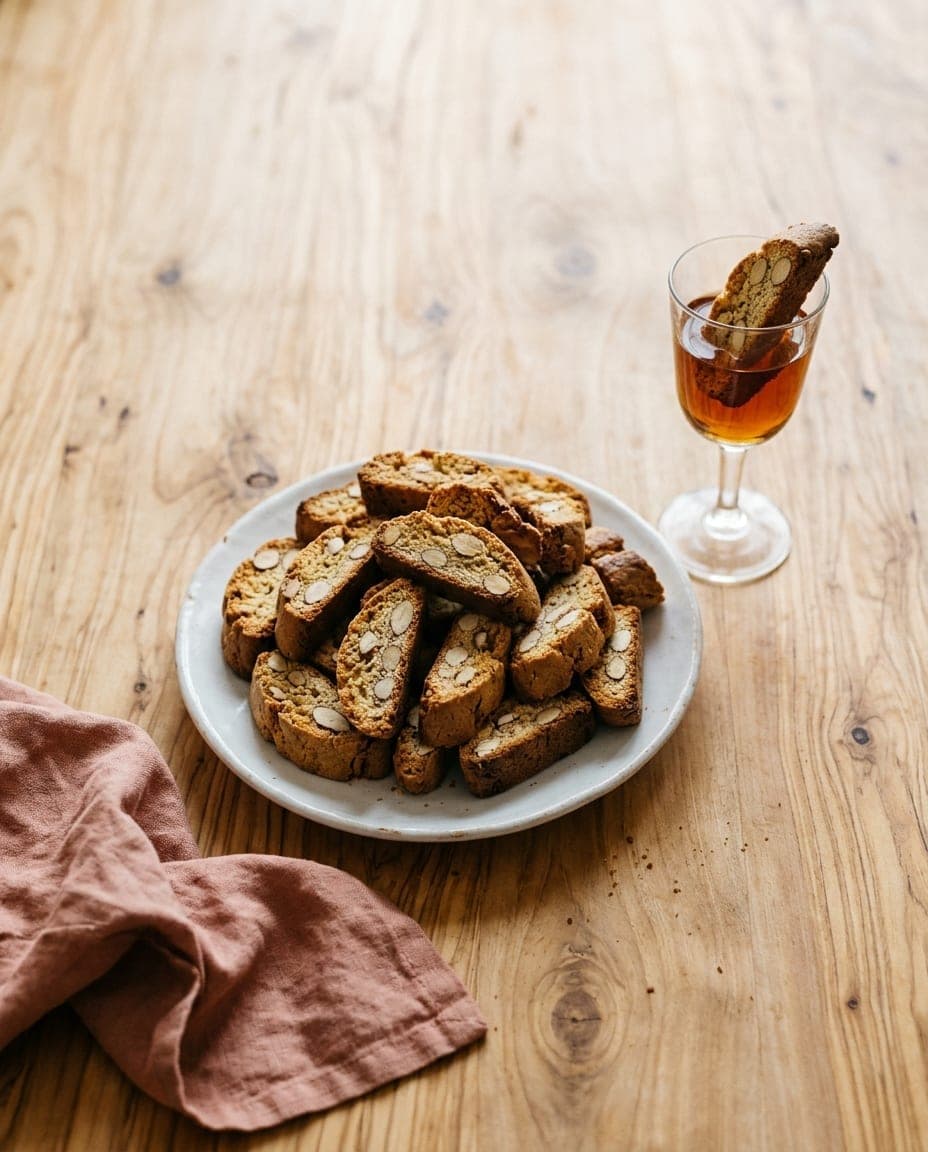
The classic form is a long log of dough studded with whole, unpeeled almonds. Once baked, the log is sliced on a diagonal before being returned to the oven to dry out. The result is a crunchy, golden wedge that can be held in one hand without crumbling. They are eaten with coffee or on their own, but their most famous role is as the final act of a Tuscan meal, dipped into a glass of sweet wine.
The history of the Prato biscuit
The origin of cantucci is tied closely to the city of Prato, just north-west of Florence in the valley of the Bisenzio River. Twice-baked biscuits were already known at the Medici court, but the almond version is above all associated with Prato. One of the earliest written recipes is attributed to Amadio Baldanzi, an eighteenth-century Prato priest and physician whose manuscript is kept in the city's State Archives. In 1858 the Prato pastry cook Antonio Mattei opened his shop and made the biscuits his speciality, winning prizes at the Italian Exhibition of 1861 and the Paris Universal Exposition of 1867, and doing much to fix the recipe and spread its fame.
The biscuit's longevity made it practical for local life. In an era before refrigeration, hard biscuits could be kept for weeks without going stale, making them ideal for travellers, farmers working long hours in the fields, and merchants on the road.
Over time, the biscuit moved from a practical provision to a culinary tradition. Since 2016, Cantucci Toscani (or Cantuccini Toscani) has been a Protected Geographical Indication covering the whole of Tuscany, meaning that only biscuits made to the agreed recipe within the region can carry that name. Prato's bakers had hoped for protection of the name biscotti di Prato, but the regional name prevailed. Cantuccio is the singular form and cantucci the plural, while cantuccini is the diminutive; outside Tuscany, the diminutive has become the most common term.
How they are made
The traditional method for making cantucci relies on a few simple ingredients and a specific sequence of steps that prioritises crunch over softness. The structure comes from eggs, sugar, flour and whole almonds. The Prato tradition keeps fat to a minimum, while the protected Cantucci Toscani recipe also includes a small amount of butter.
The process begins with a thick dough of flour, sugar and beaten eggs, into which whole, unpeeled almonds are folded. The mixture is shaped into a long, flat loaf rather than individual rounds. This log is baked until it is firm and golden. Once removed from the oven, while still warm but cool enough to handle, the log is sliced diagonally into oblong wedges. These slices are then arranged on a baking sheet and returned to the oven for a second bake. This drying phase removes almost all moisture, leaving the biscuit with its characteristic crunch and long shelf life.
The almonds are left unpeeled, preserving their slight bitterness and earthy flavour, which balances the sweetness of the sugar. Some variations include a hint of anise or vanilla, but the classic versions keep the taste simple and focused on the nut and the egg.
How they are eaten
The best-known partner of a cantuccio is Vin Santo. In Tuscan restaurants, cantucci with a small glass of this sweet wine are a classic way to close a meal, after the savoury courses and any cheese or fruit have been cleared away.
Vin Santo is made from grapes that have been dried for several months before fermentation, concentrating their sugar and flavour into a golden to amber wine. The diner takes a biscuit, dips it into the wine, waits a moment for the liquid to soak into the hard surface, and then eats it.
The experience transforms the texture of the biscuit. The dry interior absorbs the sweet wine, becoming softer while the edges keep some crunch. The bitterness of the almond skin deepens, and the sweetness of the sugar mellows into the nutty richness of the wine.
A regional speciality
Almond biscuits are found in many parts of Italy, but the cantuccio is a distinct product of Tuscany, and biscotti di Prato is simply the Prato name for the same biscuit. Prato still claims the biscuit as its signature, even though the protected name covers the whole region. The PGI has helped preserve the recipe against industrial shortcuts, keeping the method of twice-baking and the use of whole almonds intact.
Curious facts
- The diagonal cut matters. The slices are cut on the bias rather than straight across, creating longer pieces that are easier to dip.
- A long shelf life. Because they are baked until dry, cantucci keep in airtight containers for weeks.
- Many names, one biscuit. Cantucci, cantuccini and biscotti di Prato all refer to essentially the same twice-baked almond biscuit.
- Prize-winning since the 1860s. Antonio Mattei's Prato biscuits won awards at exhibitions in Florence in 1861 and Paris in 1867.
- The almonds stay whole. Authentic versions use whole, unpeeled almonds, adding a subtle bitterness that balances the sweetness of the sugar and wine.
Where to try them
In many Tuscan restaurants, cantucci arrive on a small plate at the end of the meal, accompanied by a glass of Vin Santo for dipping.
For the most authentic experience, a visit to a bakery in Prato, where the biscuits are still made in the traditional way and sold fresh, is the classic choice. The smell of baking almonds and sugar draws customers in, but the true test comes with the first bite dipped in the sweet wine.
Where to try it
1 region
 Wine Tasting38 destinations
Tuscany
Tuscany, known for its rolling hills and rich history, is the second-largest region in Italy. Florence, its capital, is renowned for Renaissance art and architecture, but also worth exploring are smaller towns like Pienza, famous for pecorino cheese, and San Gimignano, known for its medieval towers. The region boasts diverse landscapes from the Chianti vineyards to the coastal Maremma. Tuscany is also celebrated for its local festivals, such as the Palio di Siena, and its traditional cuisine that emphasizes fresh, local ingredients. This area offers a glimpse into Italy's agrarian past with its rustic farms and olive groves, making it a unique place to slow down and connect with the local culture.
Wine TastingThermal SpasHikingAgritourism





