Caciocavallo di Agnone
Caciocavallo di Agnone: Molise's pear-shaped mountain cheese
- Local name
- Caciocavallo di Agnone
- Served with
- Grilled, or with bread
- Best eaten at
- Agnone cheese makers
- Pairs with
- Tintilia del Molise
What it is
Caciocavallo di Agnone is a stretched-curd cheese from the small mountain town of Agnone in Molise, a small region on Italy's central-southern Adriatic side. It belongs to the broad family of caciocavalli, cheeses found across southern Italy and Sicily that share a common method of production. What sets this version apart is its origin in Agnone, a town situated at roughly 800 metres above sea level in the Apennine mountains of Alto Molise, and the slow ageing of the cheese in cool, airy rooms and cellars.
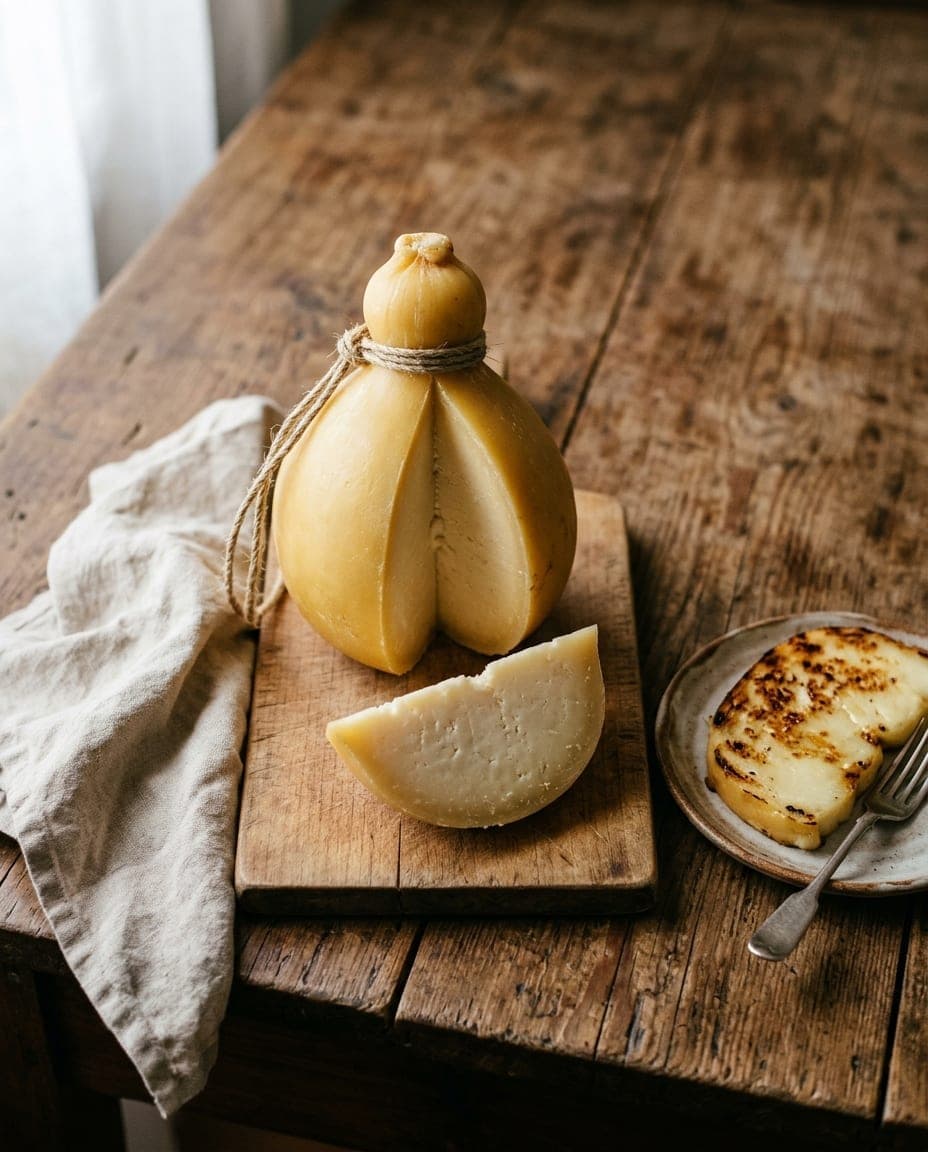
The cheese takes the shape of a gourd or a pear, with a bulbous body and a narrow neck that serves as a handle. Traditionally, pairs of these cheeses are tied together by their necks and hung astride a pole to mature. The raw milk comes from cows (Bruna, Pezzata Rossa, Podolica and their crosses) largely grazed on the high meadows of Agnone, Capracotta and Vastogirardi, giving the final product a distinct character linked to the local landscape. It is not a mass-produced item but a regional speciality made in small batches by local dairy producers.
How it is made
The milk is coagulated with calf or kid rennet, and production then follows the pasta filata method, where the curd is heated and stretched until it becomes elastic. Workers pull the warm curd into long ropes, which are then shaped by hand into the characteristic gourd form. The cheese is dipped in brine before being hung up to age; some producers use cellars or natural caves for this stage.
The duration of this maturation defines the character of the final product. A young Caciocavallo di Agnone, aged for the minimum of about two months, is mild and sweet with an elastic texture that can be pulled apart. As it matures over six months or up to a year, the flavour deepens. The texture becomes firmer and drier, while the taste turns sharp and piquant.
What goes into it
The ingredients are minimal, relying on the quality of the milk and the skill of the maker:
- Cow's milk from the high pastures of Agnone
- Natural whey starter to ferment the milk
- Calf or kid rennet to set the curd
- Salt for the brine bath
The final taste comes from the milk, the stretching process and the environment in which the cheese rests.
How it is eaten
Caciocavallo di Agnone is versatile depending on its age. A young cheese is often sliced thinly and served with crusty bread or eaten as part of a cheese board. The aged version, with its firm texture and intense flavour, is frequently grated over hot pasta dishes or baked into regional casseroles.
A popular way to serve it is simply grilled. Slices are placed on a hot griddle until the exterior browns and the interior softens, releasing a nutty aroma. It pairs naturally with the local red wine Tintilia del Molise, which offers enough tannin to balance the fat of the aged cheese.
Curious facts
- The name. Caciocavallo literally means "cheese on horseback": the paired cheeses are hung astride a pole, as a rider sits astride a horse.
- Cool rooms and cellars. The cool mountain air of Alto Molise has long allowed the cheese to mature in ventilated rooms and cellars.
- A town of bells. Agnone is known not just for dairy but also for bell-making, which gives the town an identity beyond its cheese.
- Traditional, not DOP by name. Caciocavallo di Agnone is recorded among Molise's traditional food products rather than as a DOP in its own right, although the province of Isernia lies within the production area of the Caciocavallo Silano DOP.
Where to try it
The most authentic experience is found in Agnone itself and the surrounding Alto Molise, home to small dairies where the process remains largely traditional and the cheeses can be seen hanging in pairs in the ageing rooms.
Outside the town, the cheese appears on the menus of traditional restaurants in Molise that focus on local produce. It is less common outside the region. Summer, when the cows graze the high slopes, is a good time to visit the area.
Where to try it
1 region

Molise
Nestled between Abruzzo and Campania, this is Italy's second smallest region, known for its rugged mountains and rolling hills. Termoli, the only coastal city, offers a blend of medieval architecture and beautiful beaches. The region is rich in history, with ancient villages like Campobasso, famous for its castle and local crafts. Molise is also notable for its traditional cuisine, including handmade pasta and local wines such as Trebbiano and Sangiovese. The countryside is dotted with olive groves and vineyards, making it ideal for food and wine enthusiasts. Festivals celebrating local culture, such as the 'Festa di San Basso,' highlight the region's vibrant traditions.





