Cacciucco
Livorno's chilli-spiked fish stew served over garlic-rubbed toast
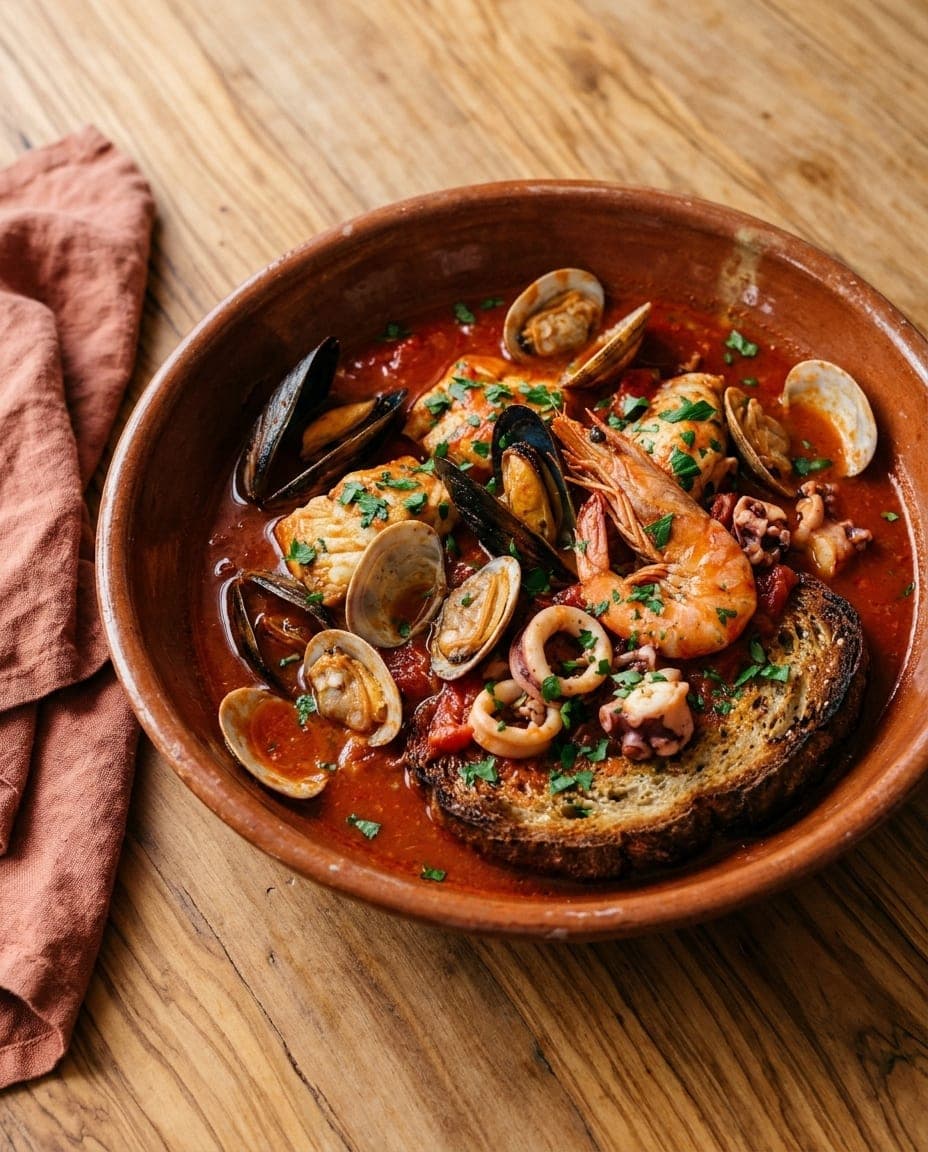
- Local name
- Cacciucco
- Served with
- Garlic-rubbed toasted bread
- Best eaten at
- A Livorno trattoria
- Pairs with
- Young Tuscan red
What it is
Cacciucco is the definitive fish stew of Livorno, a port city on the western coast of Tuscany. It is not a dish found in every kitchen across Italy, but rather a local speciality bound up with the rhythm of the sea and the history of this Tuscan harbour. The result is a thick, dark, intensely flavoured stew in which fish, shellfish, octopus and cuttlefish simmer together in a sauce of tomato, garlic, sage, olive oil and a generous amount of chilli.
The stew arrives at the table in a wide bowl, served with or over toasted bread that has been rubbed with raw garlic. The bread is not merely an accompaniment; it acts as the foundation, absorbing the rich, spicy sauce until it becomes soft and savoury. This combination of seafood and toast creates a meal that is substantial enough to serve as a full lunch or dinner, yet remains deeply connected to the working-class origins of the port.
The most famous rule governing cacciucco is the number five. A traditional saying states that the dish must contain at least five different kinds of fish, one for each letter c in the word cacciucco. This is a guiding principle rather than a rigid requirement, but it ensures variety and depth. The order of cooking matters: octopus, cuttlefish, squid and crustaceans go in first to simmer for longer, while the fish are added later so that they do not fall apart.
The history of a port stew
Cacciucco is inextricably linked to Livorno's identity as a free port. For centuries, merchants of many nationalities traded and settled in the city, and its fishing fleet landed a wide array of species, including those considered too bony or unattractive to sell.
The stew began as a way for fishermen and their families to use the unsold fish of the day: species with many bones and little commercial value, and shellfish that needed little preparation. Over time, this humble practice evolved into a celebrated culinary tradition, now protected locally by a De.Co. (denominazione comunale), Livorno's municipal mark of origin.
The origin of the name is uncertain. One theory links it to the Turkish küçük, meaning small, a reference to the mix of little fish; another connects it to a dialect word for a mixture. Fittingly for a port open to the world, neither has been proved.
What goes into it
There is no single official recipe, and every cook in Livorno guards their own variation. However, the core components remain consistent across traditional kitchens. The base is a sauce of garlic, tomato, sage, olive oil and chilli, which gives the stew its characteristic deep colour and spicy kick; many cooks also add a splash of wine.
The seafood itself is a study in contrasts:
- Octopus, cuttlefish and squid: Added early in the cooking so that they become tender.
- Crustaceans: Mantis shrimp and other shellfish lend sweetness and depth to the sauce.
- Mussels and clams: Often included, opening in the hot sauce and releasing their briny juices.
- Scorpionfish, weever and gurnard: These bony, flavourful rock fish form the backbone of the stew.
- Smooth-hound (palombo): A small shark used for its firm flesh, which holds up well in the pot.
The bread is equally important. It is typically stale local bread, sliced thickly, toasted and rubbed with raw garlic. It serves as the vessel for the stew, soaking up every drop of the spicy sauce.
How it is eaten
Cacciucco is traditionally eaten in a Livorno trattoria as a main course rather than a starter, given its hearty nature. The toast is placed in the bowl, or served alongside, and the hot stew is ladled over it so that the bread softens into the sauce.
Diners use a spoon to scoop up fish, shellfish and bread together, so that every bite contains a mix of textures and flavours. The chilli provides a warming heat that lingers on the palate, while the acidity of the tomatoes balances the richness of the seafood.
Unusually for a fish dish, cacciucco is traditionally paired with red wine; a glass of young Tuscan red is the standard companion, its fruit and gentle tannins standing up to the spicy sauce. In the summer months, the dish is often enjoyed outside, near the harbour, where the sea breeze adds to the atmosphere.
Beyond Livorno
While Livorno is the heart of cacciucco, the dish is also made further north along the Tuscan coast. Viareggio has its own well-known version, often thicker, with part of the stew passed through a food mill to make a denser sauce. Locals there often spell it with fewer c's, a detail that Livornesi are quick to point out.
The connection between the two places shows how a regional dish can travel along a coast and take root in neighbouring communities, keeping its core identity while adapting slightly to local tastes.
Curious facts
- The five-c rule. The saying that cacciucco must contain at least five kinds of fish, one for each c in the name, is a local tradition rather than a strict law.
- A port-born dish. The stew originated as a way to use the cheapest, boniest fish from the daily catch.
- The bread is essential. In cacciucco the garlic-rubbed toast is a fundamental part of the dish, absorbing the sauce.
- Chilli and sage. The combination of chilli and sage in a tomato base sets it apart from the Adriatic brodetti of the Marche, which are often sharpened with vinegar instead.
- Red wine with fish. Cacciucco is one of the few Italian fish dishes traditionally served with red wine.
Where to try it
The best place to eat cacciucco is a traditional trattoria in Livorno, where the dish is prepared with fresh catches from the harbour. The city's old port area is dotted with such establishments, each offering its own version of the stew, and the garlic-rubbed bread that soaks up the spicy sauce is part of every bowl.
Where to try it
1 destination
 Wine Tasting
Castagneto Carducci
Coastal Tuscan town in Bolgheri wine area producing prestigious Super Tuscan wines.
Wine TastingHiking





