Bottarga di tonno
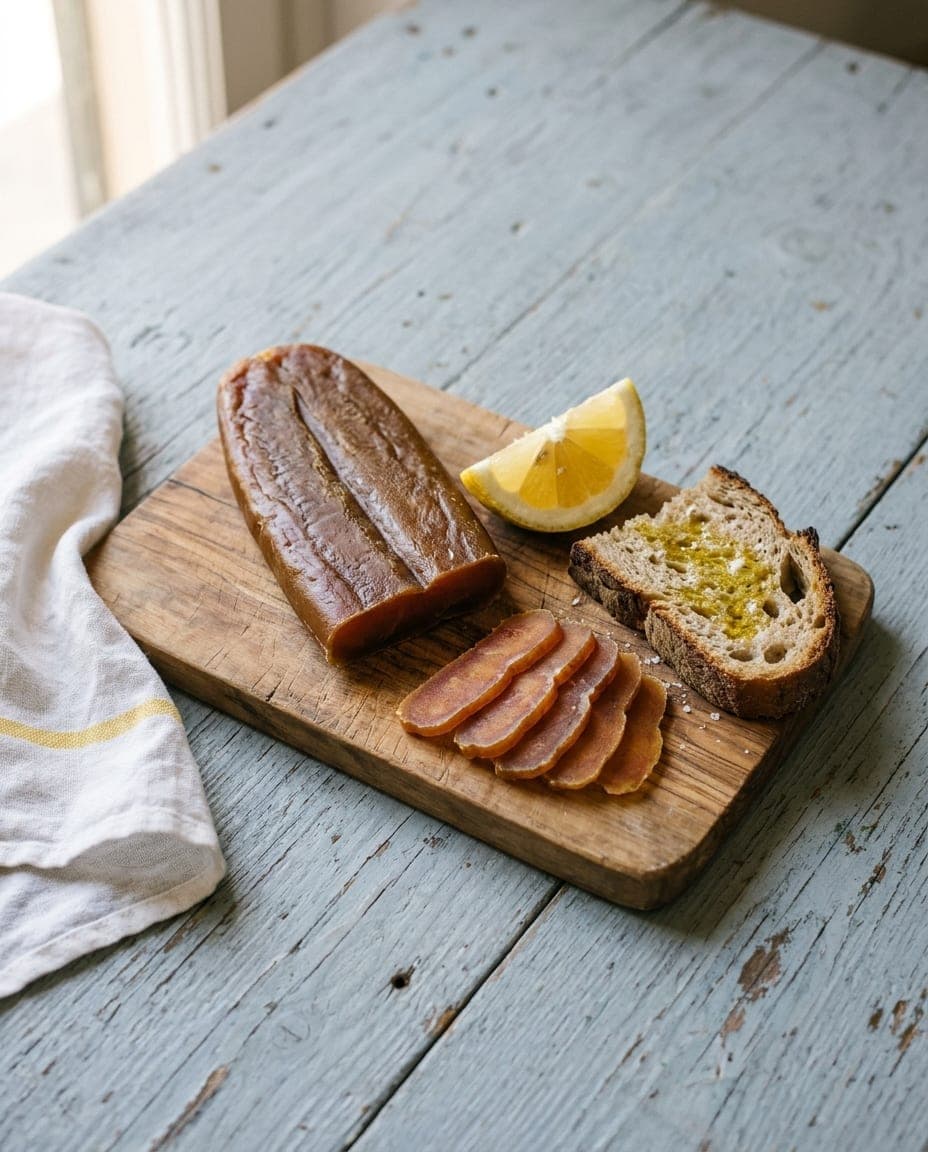
Salted Sicilian tuna roe, sliced thin over pasta or bread with oil
- Local name
- Bottarga di tonno
- Served with
- Olive oil, lemon, bread
- Pairs with
- Grillo
What it is
Bottarga di tonno is the salted, pressed and air-dried roe sac of the bluefin tuna, a delicacy closely tied to Sicily. It arrives as a hard, dark block that feels almost like stone in the hand, its colour ranging from deep pink to reddish-brown. When sliced paper-thin with a sharp knife, the roe turns slightly translucent; grated, it becomes a fine, salty powder that coats every bite.
The taste is intense and briny, carrying the concentrated essence of the open sea. It is sharp, saline and savoury rather than simply fishy, and powerful enough that a few slices can transform a simple dish, which is why it is always used with restraint.
This is not a nationwide Italian staple but a regional speciality tied to the island's fishing history. While other parts of Italy, Sardinia above all, are known for cured mullet roe, the Sicilian tuna version stands apart for its depth and colour. It is a by-product of the tonnara, the fixed-net tuna fishery that once lined the coast.
The history of the tonnara
The story of bottarga di tonno begins with the tonnare, the large tuna fisheries that operated along the Sicilian coastline for centuries. Long walls of fixed nets guided migrating bluefin tuna into a series of net chambers, ending in the camera della morte. The climax of the season was the mattanza, the dramatic, ritualised final stage of the catch.
The most famous of these sites were in the west of the island, around Trapani and on the Egadi islands, particularly Favignana, where the tonnara was the economic heart of the community. On the south-eastern tip of Sicily, the fishing village of Marzamemi also grew up around its own tonnara. The roe was salted and pressed so that it would keep for months after the brief tuna season had passed.
Today the great fixed-net traps have almost all closed, and the traditional mattanza is no longer practised as it once was. Yet the tradition of curing the roe survives. Producers in western Sicily and around Marzamemi continue to make bottarga di tonno, preserving a link to a time when the sea dictated the rhythm of life on the coast.
What goes into it
The process is defined by what is left out. The essential elements are the tuna roe sac, sea salt and time. No smoke and no spices are involved. The quality of the final product depends on the raw material and the patience of the maker.
First, the ovary sac is removed whole from the fish with care to avoid breaking it, then washed and pressed under weights. It is salted and pressed again for around a week or more, with the salt changed as it draws out moisture. Finally, the block is left to dry and mature, typically for around a month or more depending on humidity and temperature, until it hardens completely.
The result is a dark, firm block that contrasts with bottarga di muggine, the cured roe of the grey mullet that is famous in Sardinia. That version is amber-coloured and has a more nuanced flavour. The tuna bottarga is darker and stronger, a heavier note in the culinary landscape.
How it is eaten
In Sicily, the block is treated with respect. It is not cooked, as heat would dull its flavour; instead it is shaved or grated just before serving. A sharp knife produces thin ribbons that glisten on the plate, while a grater turns it into a fine dust that clings to other ingredients.
A classic way to enjoy it is over a bowl of pasta. The roe is shaved or grated over hot spaghetti dressed simply with extra virgin olive oil and perhaps a little garlic; the heat of the pasta releases its aroma. It is also served on slices of crusty bread, sometimes with a squeeze of lemon to cut the saltiness, or over raw vegetables like fennel.
Bottarga is rarely eaten alone. It acts as a condiment or a finishing touch, used sparingly to lift other ingredients. The traditional accompaniments are olive oil, lemon and bread, and a glass of Grillo, the crisp Sicilian white wine, is a classic pairing.
Curious facts
- The colour tells the story. Tuna bottarga is dark pink to reddish-brown, while mullet bottarga is amber—an easy way to tell them apart.
- A tool for preservation. Before refrigeration, salting and pressing were essential to keep the delicate roe edible long after the tuna season ended.
- The mattanza is quiet now. The tonnare that once employed whole communities during the tuna season have almost all closed, leaving bottarga as one of the last reminders of that industry.
- Sardinia's mullet version. Sardinian bottarga di muggine is paler and more delicate, lacking the intense punch of the tuna variety.
- Added at the end. Bottarga is shaved over hot food or grated onto cold dishes just before serving.
Where to try it
The most rewarding places to taste it are the old tuna-fishing coasts: Trapani and the Egadi islands, particularly Favignana, in the west, and Marzamemi in the south-east. Here small producers still cure the roe, often selling it in local shops and markets.
In Marzamemi, a former fishing village now known for its seafood restaurants, bottarga di tonno is served over simple pastas or on rustic bread, and the roe is often sold in blocks to take home. The dish is not on every menu, but where it appears, it is usually prepared with care: a plate of pasta with grated bottarga, a drizzle of local olive oil and a squeeze of lemon offers a direct link to the Sicilian sea and its history.
Where to try it
1 destination
 Boat Rentals
Marzamemi
Charming Sicilian fishing village with small harbor and boat rentals on the Ionian coast.
Boat Rentals





