Rákóczi túrós
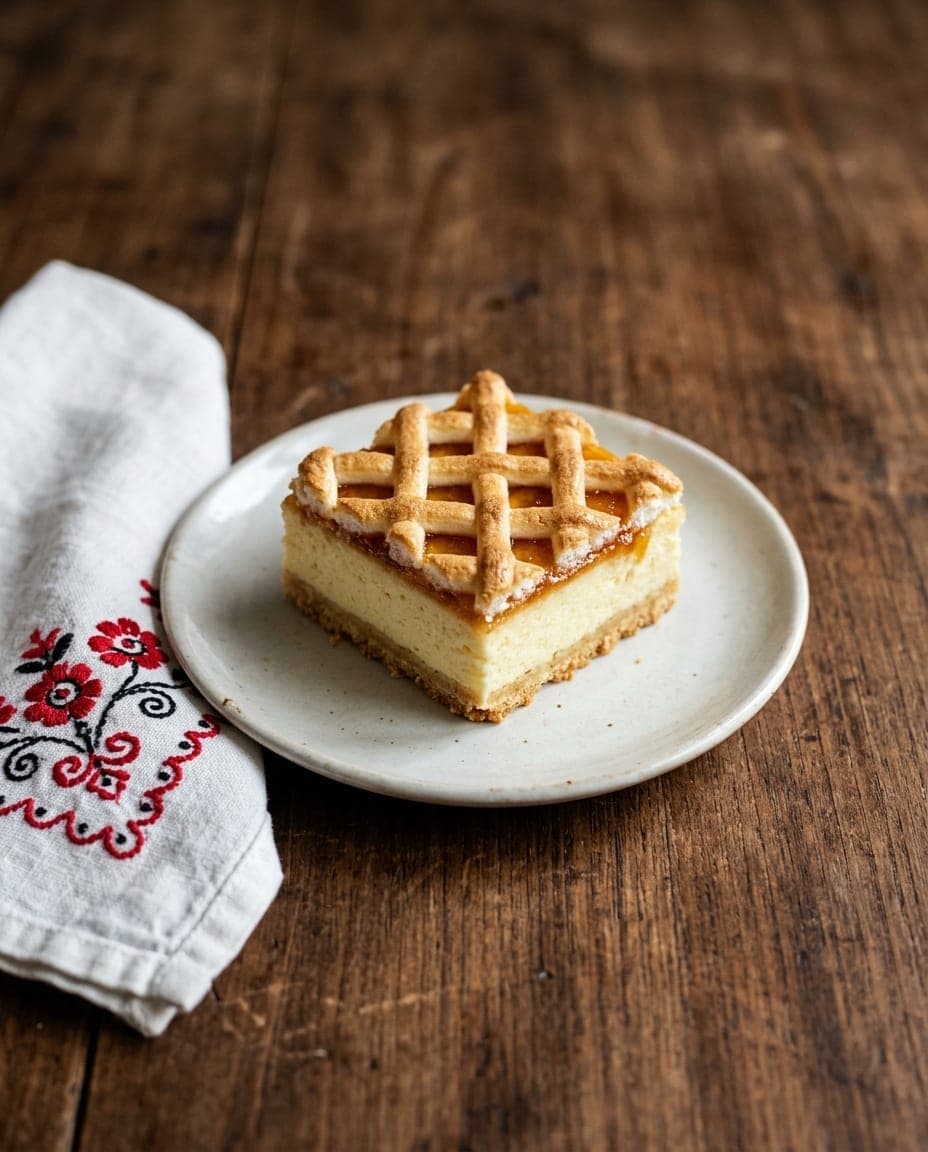
Curd cheese, apricot jam and a meringue lattice
- Local name
- Rákóczi túrós
- Served with
- Coffee
- Best eaten at
- A Budapest cukrászda
- Pairs with
- Coffee
What it is
Rákóczi túrós is a tray-baked cake from Budapest that balances the sour note of fresh curd with the sweetness of apricot jam and a crisp meringue topping. It is not a soft cheesecake, but a tray bake in three layers: a thin shortcrust base, a thick layer of sweetened curd cheese baked until set, and a piped meringue lattice that turns golden in the oven, with apricot jam in the gaps. The result is a dense, creamy interior on a crumbly base, cut into neat squares for serving.
The name honours János Rákóczi, a Budapest confectioner and chef of the mid-20th century. He is credited with creating the cake, though the exact year and occasion are a matter of local tradition rather than official record. The most common account has it presented at the 1958 Brussels World's Fair, while food historians point to older Hungarian curd cakes with meringue as its ancestors. The surname Rákóczi also belongs to a famous Hungarian princely family, which often leads visitors to assume a royal connection where none exists beyond the chef's name.
The curd that defines it
At the heart of this cake is túró, a fresh Hungarian curd cheese that distinguishes the dish from other European variations. It is drier and more crumbly than ricotta, and less lumpy and wet than cottage cheese. Túró has a distinct freshness, a slight tang that cuts through the sugar and eggs in the batter. When mixed with sugar, lemon zest and egg yolks, often with raisins and folded-in egg white, it becomes a light yet substantial filling that holds its shape when baked but remains moist inside.
In Budapest bakeries, the quality of the túró varies by producer, but the standard is always fresh curd that has been drained well enough to bake without releasing too much water. The cheese forms the base of the cake, a thick layer that supports the jam and meringue above it. Without this specific ingredient, the dish would simply be another sweet pastry; with it, it becomes a regional speciality tied to the capital's baking heritage.
How it is made
The cake begins with a sweet shortcrust rolled into a rectangular tin and part-baked. The túró is beaten with egg yolks, sugar and a touch of lemon zest until smooth, then spread over the base and baked until set. A stiff meringue of egg whites and sugar is then piped over the top in a lattice, and the cake returns to the oven until the meringue turns a warm golden brown. Apricot jam is spooned into the gaps of the lattice; some recipes spread it under the curd instead.
Once cooled, it is cut into squares. The texture is firm enough to hold together when lifted, yet soft and creamy at the centre. The apricot jam provides a bright, fruity counterpoint to the rich curd, while the meringue adds a delicate crispness that contrasts with the smooth interior. It is a cake designed for sharing, often appearing in large trays at Budapest cukrászda, traditional pastry shops where it remains a staple.
How to eat it
Rákóczi túrós is best enjoyed as a mid-morning or afternoon treat at a Budapest cukrászda, a traditional pastry shop where the coffee culture thrives. The cake pairs naturally with a strong black coffee, which cuts through the sweetness and highlights the sour notes of the curd. A cup of tea or a glass of milk is also common, but coffee remains the classic companion.
It is rarely eaten as a dessert after a full meal; instead, it fits comfortably into the rhythm of a coffee break. A square is substantial without ruling out a second cup. It is often ordered alongside a fruit tart or a cream-filled roll.
Curious facts
- A chef's surname. The name comes from the pastry chef János Rákóczi, not the princely family, though the coincidence often causes confusion for visitors.
- A World's Fair debut. The cake is usually said to have been presented at the 1958 Brussels World's Fair, though no single date is confirmed.
- The curd is key. The túró must be fresh and slightly sour; using a different cheese changes the character of the entire dish.
- A tray-baked tradition. Unlike round layered cakes, it is baked in a rectangular tin and cut into squares.
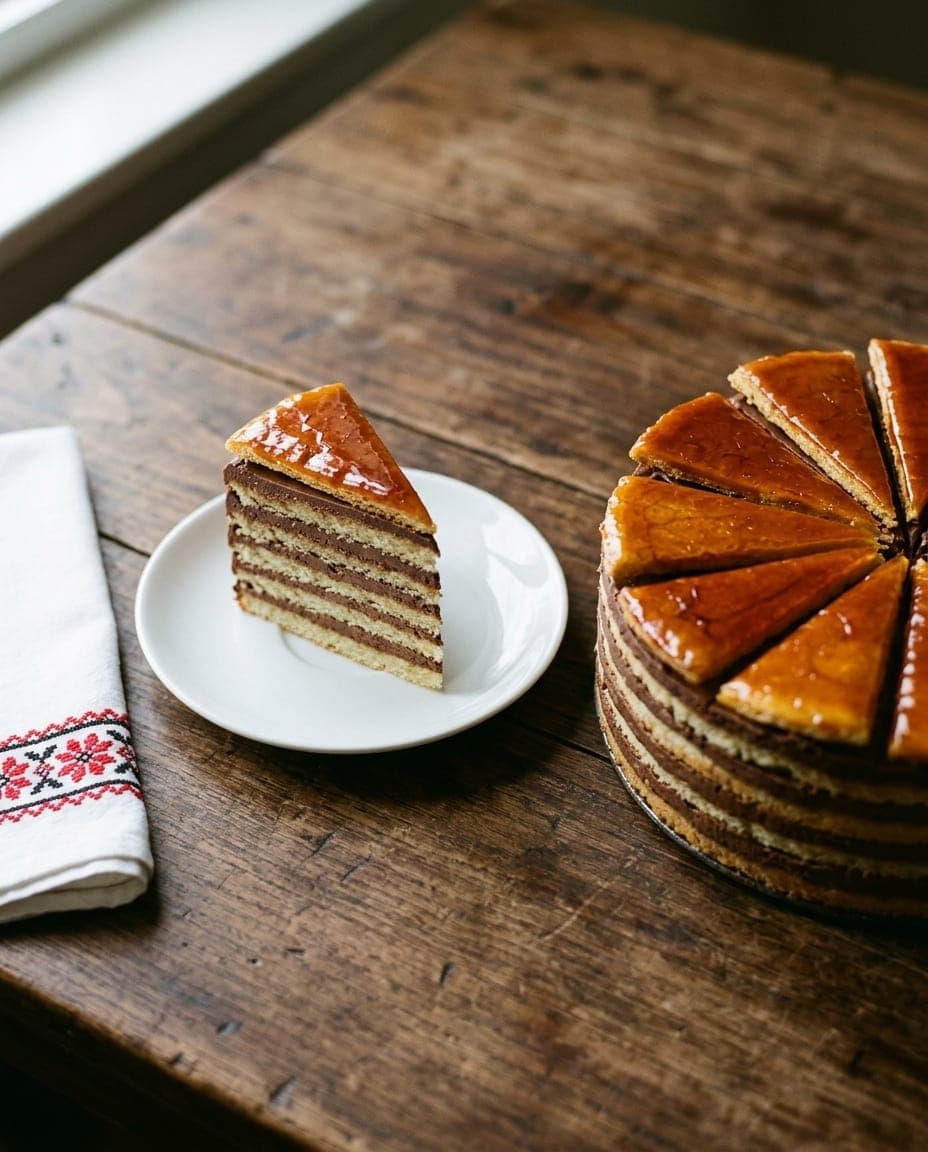
- A coffee house staple. It remains a fixture in Budapest cukrászda menus, often served alongside other classics like krémes or Dobos torta.
Where to try it
The most reliable place to find Rákóczi túrós is in a traditional Budapest cukrászda, where the cake has been a regular offering for decades. These are not modern cafés but established pastry shops with long histories, often located near the city centre or in neighbourhoods known for their baking traditions. While no single shop claims ownership of the recipe, any well-regarded cukrászda will likely serve it, especially during the morning coffee hours.
Where to try it
1 region

Budapest
Hungary's capital, Budapest, is divided by the Danube River into Buda and Pest, each offering distinct experiences. Buda is home to historic sites like the Castle District, featuring medieval architecture and the Matthias Church. Pest is known for vibrant cultural life, including the famous ruin bars and the Hungarian State Opera. The city is renowned for its thermal baths, such as Gellért and Széchenyi, which have been used for centuries. Explore the nearby towns of Szentendre, known for its artists, and Visegrád, with its medieval castle. Budapest is also a center for traditional Hungarian cuisine, featuring dishes like goulash and chimney cake. Its rich history, combined with modern culture, makes it a fascinating destination for deeper exploration.