Paprikás csirke (chicken paprikash)
Chicken in sweet paprika and sour cream
- Local name
- Paprikás csirke
- Served with
- Nokedli, cucumber salad
- Best eaten at
- A Hungarian csárda
- Pairs with
- Kadarka red
What it is
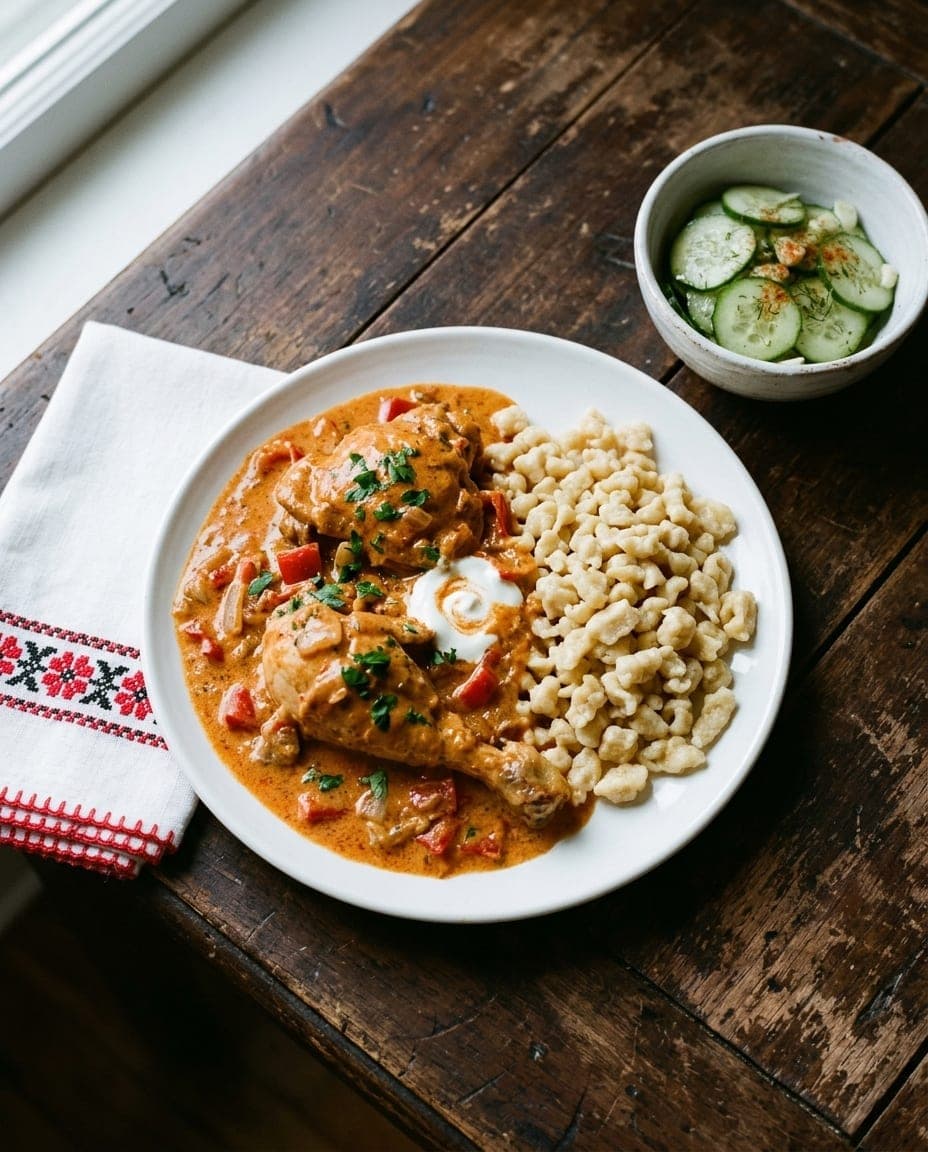
Paprikás csirke, or chicken paprikash, is, after goulash, one of the best-known dishes of Hungarian cuisine outside the country's borders. It is a stew of chicken pieces cooked slowly in a base of onions softened in lard and seasoned with a generous amount of sweet paprika, finished with sour cream and served with nokedli, small flour-and-egg dumplings scraped into boiling water. The result is a thick, rosy orange-red sauce that clings to the meat rather than pooling at the bottom of the bowl.
It is Sunday food, eaten when families gather after church or market, and it is a standing item in a csárda, the Hungarian roadside inn. While the recipe varies from kitchen to kitchen, the core elements remain constant: the deep red colour comes from the paprika, the richness from the lard and sour cream, and the texture from the dumplings that absorb the sauce.
The history of a Sunday staple
The roots of the dish lie in the agricultural traditions of the Great Hungarian Plain, where chickens were often kept for their eggs until they were too old to lay, at which point they became the meat for a special occasion. Paprika stews (pörkölt) spread among the peasantry there in the 18th and 19th centuries, and poultry versions followed; the earliest known printed recipe, in István Czifray's cookbook of 1830, already calls for chicken, lard or butter, onion, paprika, flour and sour cream. The sour cream is usually read as a touch of town cooking that later spread to every household.
It is a dish that travelled with emigrants. As Hungarians left for America and other parts of Europe in the late 19th and early 20th centuries, they took their recipes with them. Abroad it is often among the first Hungarian dishes people meet, sometimes simply as "chicken stew". The specific combination of chicken, heavy onion sauce, and nokedli remains a distinctively Hungarian signature, even when prepared abroad with slight adaptations.
The dish is tied closely to the rhythm of the week. In many households, it was reserved for Sunday lunch because it required time to prepare and cook slowly. The onions had to be softened until they melted into the lard, the chicken needed to simmer until tender, and the dumplings required careful attention. This labour made it a dish of celebration rather than daily routine, a fact that persists in the modern csárda, where it remains the standard choice for a substantial Sunday meal.
The two rules of the sauce
What separates a good paprikás from a poor one is not the quality of the chicken or the amount of sour cream, but the handling of two critical steps. The first rule concerns the paprika itself. Because the spice can burn easily and turn bitter, it must be added to the pan only after the heat has been turned off or reduced to the lowest setting. The cook stirs the onion-lard mixture until the onions are soft, removes the pan from the burner, sprinkles in the paprika, and then returns the pan to the heat briefly to meld the flavours without scorching the spice.
The second rule involves the sour cream. Adding cold dairy directly to a hot stew often causes it to split, separating into grainy curds and watery liquid. To prevent this, the cook must temper the sour cream by whisking in a little of the hot sauce or mixing it with flour before it enters the pot. This ensures the final sauce is smooth, glossy, and orange-red, coating the chicken and dumplings rather than looking thin or broken.
These technical points are what Hungarian cooks care about most. A dish that meets these criteria produces a thick, creamy texture that holds its shape on the plate. The taste is savoury and slightly sweet from the onions, with the paprika providing a warm, earthy depth that is neither sharp nor bitter.
What goes into it
A short list, and two items on it are not interchangeable:
- Chicken, usually cut into pieces from a whole bird, traditionally an older hen, today more often a younger bird.
- Onions, chopped finely and cooked slowly until they dissolve into the fat, forming the base of the sauce.
- Lard, the traditional fat used to soften the onions, which gives the dish its characteristic richness and sheen.
- Sweet paprika, a generous amount that defines the colour and the primary flavour of the stew.
- Sour cream, stirred in at the end to create the creamy finish, often tempered with flour or hot liquid first.
- Salt, and often a green pepper and a little tomato cooked into the base; some cooks add garlic.
The dish is not vegetarian, as it relies on animal fat and meat for its core character. The sour cream adds a tangy contrast to the sweet paprika, balancing the fat of the lard.
How it is eaten
Paprikás csirke is served as a main course, typically at lunchtime on Sundays or during a visit to a csárda. It arrives in a deep bowl or a wide plate, piled high with chicken pieces and generously coated in the orange-red sauce. The nokedli are placed alongside or underneath the chicken, absorbing the flavour of the stew as they soften.
The standard accompaniment is a cucumber salad, made with thinly sliced cucumbers, vinegar, a little sugar, and often garlic and a dusting of paprika. This fresh, acidic element cuts the fat of the lard and sour cream, cleansing the palate between bites. A glass of Kadarka, a light, spicy red, is a common pairing, its soft tannins sitting well with the creamy sauce without overpowering it.
In a csárda, the dish is often served family-style or in large portions meant for sharing. The nokedli are soft and pillowy, designed to scoop up the sauce along with the chicken. It is a meal that demands attention; the texture of the dumplings and the consistency of the sauce are key indicators of a well-prepared dish.
Where it comes from
While eaten across the whole country today, the dish has its strongest roots on the Great Hungarian Plain, where paprika was used most heavily and where the paprika towns of Szeged and Kalocsa still grow the spice. An innkeeper's price list from Nyíregyháza already offered a paprika chicken in 1834, and the csárda culture helped spread the dish to other parts of Hungary.
The connection to the plain is visible in the ingredients available there: lard from local livestock, abundant onions, and the ground paprika of the southern counties. As the dish moved beyond this area, it was adapted to local tastes but retained its core identity. Today, it is a national icon, found on menus from Budapest to the smallest village taverns.
Curious facts
- The onion must melt. In a true paprikás, the onions are cooked so long that they disappear into the sauce, leaving no visible chunks, only a thick, sweet base.
- Paprika burns easily. The spice turns bitter almost instantly if it touches hot oil directly; removing the pan from the heat is a non-negotiable step in traditional cooking.
- Nokedli are scraped. These dumplings are not rolled or shaped by hand but scraped from a board into boiling water, creating their distinctive irregular shapes.
- A Sunday tradition. The dish was historically kept for Sundays because of the time it takes and because a bird was killed only for special occasions.
- A printed pedigree. A recipe for paprika chicken with sour cream appears in István Czifray's Hungarian cookbook as early as 1830.
- The sour cream trick. Adding cold sour cream directly to hot stew causes it to split; tempering with flour or hot liquid is essential for a smooth finish.
Where to try it
The best place to eat paprikás csirke is in a csárda, the traditional Hungarian roadside inn that serves as a gathering point for locals and travellers alike. These establishments, found across the country and especially on the Great Plain, are where the dish is most at home.
Budapest restaurants cook it well; the village version is usually plainer and closer to the Sunday original. A visit to a small village csárda will provide a meal that reflects the daily life of Hungarian families. A glass of Kadarka and a cucumber salad are the usual accompaniments.
Where to try it
1 region

Komárom-Esztergom
Komárom-Esztergom is a prominent region in Hungary, known for its historical significance and rich cultural heritage. The region features Esztergom, home to Hungary's largest basilica, and a stunning fortress overlooking the Danube River. The area is also renowned for its wine production, particularly the white wines from the local vineyards. Visitors can explore the scenic Danube Bend, where charming towns like Visegrád and Szentendre offer insights into local traditions. Hiking trails through the Pilis Mountains provide opportunities to connect with nature. This region, with its blend of history, culture, and natural beauty, encourages travelers to discover its hidden gems at a leisurely pace.